The best capture card with HDR10 passthrough lets you record or stream gameplay without sacrificing the high-contrast picture and smooth refresh rates your display supports.
We compare 10 USB and internal options for PS5, Xbox Series X/S, Switch 2, and PC setups, covering 4K capture, HDMI 2.1 bandwidth, VRR, latency, and setup flexibility.
Best 10 Capture Card with Hdr10 Passthrough Picks for 2026
Best All-Around Choice

- 4K60 input and capture support
- HDR10 passthrough with VRR
- Plug-and-play Windows, macOS, and Linux support
Best For: Flexible 4K gaming, streaming, and content creation
Best Premium Console Pick

- 4K60 capture with HDR10 support
- 1440p120 and 1080p240 passthrough
- 3.5mm analog audio input
Best For: PS5, Xbox Series X/S, and Switch 2 streaming
Best Audio-Flexible Option
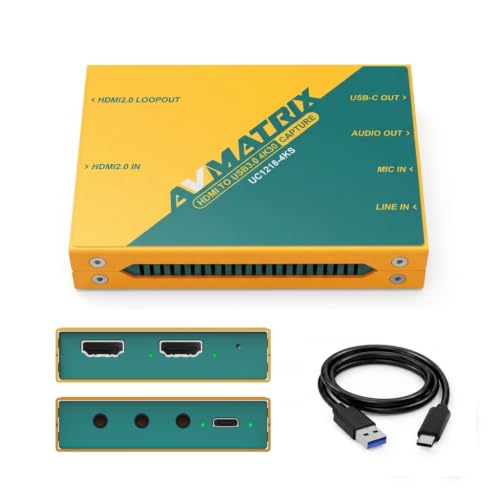
- 4K60 HDR10 and VRR loop-out
- Mic and line inputs with audio mixing
- Driver-free support for major streaming software
Best For: Streamers needing flexible audio and high-refresh passthrough
Best High-Refresh Pick
GUERMOK HDMI 2.1 4K144 Capture Card

- 4K144 HDR10 and VRR passthrough
- USB 3.2 Gen2 high-bandwidth connection
- Multiple audio inputs and outputs
Best For: High-refresh competitive gaming and dual-PC streaming
Best HDR10 Value
NearStream CCD30 4K60 Capture Card

- 4K60 capture with high-refresh passthrough
- HDR10 passthrough for compatible displays
- Mic input and headphone monitoring
Best For: Flexible console, camera, and dual-PC setups
Best Internal Upgrade

- 8K60 HDMI 2.1 passthrough
- 4K60 HDR10 capture and 1080p240 recording
- VRR support for smooth gameplay
Best For: High-end Windows desktop and dual-PC streaming
Best for Comfort
AVerMedia Live Gamer Ultra 2.1

- 4K144 HDR/VRR passthrough
- Up to 4K144 capture on Windows
- Party chat and 5.1-channel audio support
Best For: Competitive gaming with high-refresh displays
Best Overall
FEELWORLD C4K PRO 4K Capture Card

- 4K60 capture with HDR10 and VRR passthrough
- Plug-and-play setup for major consoles
- Includes USB and HDMI cables
Best For: Flexible 4K streaming and recording
Best Portable Option

- 4K60 HDR passthrough
- 1080p60 capture for streaming
- Compact 93-gram design
Best For: Portable Full HD console streaming
Best for High Refresh Rates
Hunter4K Pro 4K144Hz Capture Card

- 4K144Hz capture and passthrough
- Supports up to 1080p360Hz passthrough
- Captures PS5 party-chat audio
Best For: Competitive high-refresh gaming setups
Best All-Around Choice – OREI VC-4K60 Capture Card
If you want a capture card with HDR10 passthrough for high-resolution gaming and streaming, the OREI VC-4K60 combines 4K input and capture support with VRR. Its USB 3.0, UVC/UAC, and plug-and-play design make it a flexible option for consoles, cameras, and computers.
Best For: Gamers and creators who want 4K60 capture, HDR10 passthrough, and broad Windows, macOS, and Linux compatibility.
Pros:
- Supports HDMI input and capture up to 4K at 60Hz.
- HDR10 passthrough and VRR support enhance compatible gaming setups.
- Works with USB 3.0 or USB 2.0 and requires no driver installation.
Cons:
- The supplied notes do not specify detailed minimum system requirements.
- USB 2.0 compatibility may not provide the same bandwidth as USB 3.0.
The OREI is a strong general-purpose pick when resolution, HDR10 passthrough, and operating-system flexibility matter. Its one-year warranty adds basic coverage for a straightforward streaming setup.
Best Premium Console Pick – Elgato 4K S Capture Card
The Elgato 4K S is a polished capture card with HDR10 passthrough support for PS5, Xbox Series X/S, and Switch 2 setups. It pairs 4K60 capture with high-frame-rate passthrough and adds an analog audio input for commentary or in-game chat.
Best For: Console streamers who prioritize 4K60 recording, near-zero-latency passthrough, and integrated analog audio.
Pros:
- Captures video at 4K60 with HDR10 support and tone mapping on Windows.
- Supports 1440p120 or 1080p240 passthrough for high-refresh gaming.
- Includes a 3.5mm analog audio input for chat or commentary.
Cons:
- Listed operating-system support is Windows 11 and macOS 13 or later, with specific hardware requirements.
- The product details list 1080p as the video capture resolution despite the 4K60 capture headline.
Elgato’s 4K S is suited to a modern console workflow where simple setup and high-refresh passthrough are important. Check your computer’s operating system, processor, GPU, and USB-C requirements before buying.
Best Audio-Flexible Option – AVMATRIX UC1218-4KS
For shoppers seeking a capture card with HDR10 passthrough and flexible audio handling, the AVMATRIX UC1218-4KS stands out. Its HDMI 2.0 loop-out supports 4K60, 2K144, and 1080p240, while mic and line inputs help combine commentary with gameplay.
Best For: Streamers who need high-refresh HDMI loop-out, low-latency capture, and built-in microphone or line-in mixing.
Pros:
- HDR10 and VRR passthrough supports up to 4K60, 2K144, or 1080p240.
- Captures up to 4K30 uncompressed over USB 3.0 and supports multiple video formats.
- Includes 3.5mm mic and line inputs with UAC audio capture.
Cons:
- Its stated uncompressed capture limit is 4K30 rather than 4K60.
- The listed manufacturer warranty details conflict with the notes’ three-year warranty claim.
This AVMATRIX model is a practical choice for streamers who value audio connectivity as much as video passthrough. Its broad software compatibility and driver-free UVC/UAC operation also suit varied streaming environments.
Best High-Refresh Pick – GUERMOK HDMI 2.1 4K144 Capture Card
This HDMI 2.1 model is aimed at high-refresh gaming, offering a capture card with HDR10 passthrough and support for passthrough rates up to 4K144Hz. USB 3.2 Gen2, multiple capture formats, and flexible audio connections make it suitable for demanding streaming and production setups.
Best For: Competitive gamers, esports streamers, and dual-PC creators using high-refresh monitors and HDMI 2.1 sources.
Pros:
- HDMI 2.1 passthrough supports HDR10, VRR, and up to 4K144Hz.
- Supports high-frame-rate capture modes including up to 4K144 MJPEG on Windows.
- Provides HDMI audio, mic in, line in, line out, and speaker out.
Cons:
- On macOS, capture support is listed up to 4K60.
- High-frame-rate modes depend on the selected format and operating system.
- The supplied product notes are truncated before the full included-accessories list.
The GUERMOK capture card is the most performance-focused option here for high-refresh HDMI 2.1 gaming. It makes the most sense when your source, display, computer, and workflow can take advantage of its higher bandwidth and frame-rate options.
Best HDR10 Value – NearStream CCD30 4K60 Capture Card
The NearStream CCD30 is a practical capture card with HDR10 passthrough for console, camera, and dual-PC setups. It captures up to 4K60 over USB-C 3.1 while passing through up to 4K60, 1440p120, or 1080p240 with ultra-low latency. HDR10 applies to passthrough only, not captured video.
Best For: Gamers and creators who want flexible high-refresh passthrough, 4K capture, and built-in audio connections.
Pros:
- Supports 4K60 capture and 4K60, 1440p120, or 1080p240 passthrough.
- HDR10 passthrough helps preserve compatible display highlights and color detail.
- Works with Windows, macOS, and Linux, including OBS and other supported applications.
- Includes 3.5mm microphone input and headphone monitoring.
Cons:
- HDR10 is not supported in the captured video.
- 4K60 capture requires comparatively capable computer hardware.
The CCD30 offers a strong balance of resolution, refresh-rate flexibility, compatibility, and audio features. It is especially appealing when HDR gaming should remain intact on the display while recording is handled separately.
Best Internal Upgrade – Elgato 4K Pro Capture Card
The Elgato 4K Pro is an internal capture card with HDR10 passthrough designed for a Windows desktop with an available PCIe slot. Its HDMI 2.1 connections support gameplay passthrough up to 8K60, 4K60 capture, high-frame-rate recording up to 1080p240, and VRR passthrough.
Best For: Windows desktop streamers building a high-end internal capture and dual-PC setup.
Pros:
- Supports HDMI 2.1 connectivity and up to 8K60 passthrough.
- Captures at 4K60 HDR10 and records up to 1080p240.
- VRR passthrough helps maintain smooth, tear-free gameplay.
- Compatible with OBS, Streamlabs, Twitch Studio, Zoom, Teams, and other apps.
Cons:
- Requires a Windows 10 system with an available PCIe slot.
- Its internal design is less suitable for laptop or portable setups.
For a compatible Windows desktop, the 4K Pro combines high-bandwidth HDMI 2.1 passthrough with HDR10 capture and VRR support. It makes the most sense for demanding gaming and broadcasting workflows where internal installation is acceptable.
Best for Comfort – AVerMedia Live Gamer Ultra 2.1
The AVerMedia Live Gamer Ultra 2.1 is a high-refresh capture card with HDR10 passthrough for modern consoles and PCs. It supports up to 4K144 HDR/VRR passthrough, 1440p240 or 1080p360 passthrough, and up to 4K144 MJPEG capture on supported Windows systems.
Best For: Competitive gamers who prioritize very high refresh rates, HDR/VRR passthrough, and expanded audio features.
Pros:
- Supports up to 4K144 HDR/VRR passthrough, plus 1440p240 and 1080p360 modes.
- Captures up to 4K144 MJPEG on supported Windows PCs.
- USB-C 10Gbps connectivity works with Windows, Mac, and iPad capture setups.
- Provides party chat, 5.1-channel audio support, and dual 3.5mm four-pole ports.
Cons:
- 4K144 capture is limited to supported Windows PCs; macOS capture reaches up to 4K60.
- Displays using DSC may limit 4K passthrough to 4K120.
- The listed operating-system requirements specify Windows 10 x64 or Windows 11 for core Windows features.
The Live Gamer Ultra 2.1 is the strongest fit here for high-refresh gaming, particularly when 4K144 HDR/VRR passthrough or 1080p360 output matters. Check the computer, display, and DSC limitations before buying to ensure the intended mode is supported.
Best Overall – FEELWORLD C4K PRO 4K Capture Card
The FEELWORLD C4K PRO is a practical capture card with HDR10 passthrough for gamers who want up to 4K60 capture, smooth VRR support, and broad console compatibility. Its plug-and-play setup, USB 3.2 Gen1 connection, and included cables make it suitable for streaming with OBS Studio or Streamlabs without extra drivers or external power.
Best For: Gamers and streamers who want 4K60 capture, HDR10/VRR passthrough, and simple Windows, Mac, or iPadOS compatibility.
Pros:
- Supports up to 4K60 capture and 4K HDR/VRR passthrough.
- Works with PS5, PS5 Pro, Xbox, Switch, PCs, and Macs.
- Plug-and-play operation requires no extra drivers or external power.
- Built-in cooling fan is designed for stable, low-latency use.
Cons:
- The listed operating-system support may not cover every setup.
- The product details do not specify an included power adapter or advanced audio inputs.
With HDR10, VRR, and 4K60 support in one compact setup, the C4K PRO is a versatile choice for everyday console streaming and recording. It is especially appealing if you want an uncomplicated workflow and do not need the higher refresh-rate support of HDMI 2.1 cards.
Best Portable Option – Elgato Game Capture Neo
The Elgato Game Capture Neo is a compact capture card with HDR10 passthrough built for straightforward console-to-computer or iPad workflows. It passes through 4K60 HDR while capturing or streaming at 1080p60, making it a good fit for creators who prioritize portability and reliable Full HD recording.
Best For: Console gamers and mobile creators who want a small, low-latency capture card for 4K HDR passthrough and 1080p60 capture.
Pros:
- Compact design is no larger than a smartphone.
- Provides 4K60 HDR passthrough while capturing at 1080p60.
- Supports PlayStation, Xbox, Switch, iPhone, PC, Mac, and iPad workflows.
- Works with Elgato software, OBS Studio, QuickTime, Discord, Teams, and Zoom.
Cons:
- Capture resolution is limited to 1080p according to the supplied specifications.
- The listed platform details specify Windows 10 and macOS Monterey 12.
The Game Capture Neo makes the most sense when passthrough quality and portability matter more than 4K recording. Its 1080p60 capture target is well suited to livestreaming, while the compact USB-C design keeps a travel setup simple.
Best for High Refresh Rates – Hunter4K Pro 4K144Hz Capture Card
The Hunter4K Pro targets competitive players who need high-refresh HDMI passthrough alongside capture. Although the supplied notes do not specifically identify HDR10 support, this HDMI 2.1 capture card handles up to 4K144Hz capture and passthrough, with additional 1440p and 1080p high-refresh modes for fast gaming displays.
Best For: Competitive gamers and PS5 users who need high-refresh capture, low-latency passthrough, ultrawide support, and party-chat audio recording.
Pros:
- Supports up to 4K144Hz capture and passthrough.
- Offers 1440p up to 240Hz passthrough and 1080p up to 360Hz passthrough.
- Can capture PS5 game audio, the player’s voice, and party chat with the included 3.5mm cable.
- Compatible with OBS Studio, Streamlabs, Zoom, Teams, and major gaming platforms.
Cons:
- The supplied notes do not confirm HDR10 passthrough.
- Its advanced audio and high-refresh setup may be more than casual streamers need.
- USB 3.0 connectivity is required for the stated plug-and-play workflow.
If refresh rate is your priority, the Hunter4K Pro is the strongest fit in this group. It is designed around responsive competitive play and adds useful PS5 party-chat capture, but shoppers specifically seeking HDR10 should verify that feature before buying.
How We Picked the Best Capture Card with Hdr10 Passthrough
We focused on products that clearly support HDR10 passthrough and evaluated the features that matter most in a modern gaming and streaming setup. That includes passthrough resolution and refresh rate, capture resolution, HDMI 2.1 compatibility, VRR support, latency, connection type, and ease of use.
Because capture hardware varies widely, a higher passthrough specification does not automatically mean better recordings. Some models prioritize 4K60 capture, while others are designed to pass through 4K120 or 4K144 gameplay with a lower capture resolution. We also considered whether each card uses plug-and-play UVC/UAC drivers, requires an internal PCIe slot, or is better suited to a portable setup.
Quick Comparison
USB capture cards are generally the easiest choice for laptops and compact desktops. HDMI 2.1 models are better for current consoles and high-refresh gaming, especially when you want to play at 4K120 or above while recording simultaneously. Internal PCIe cards can provide a cleaner permanent setup and strong performance on a dedicated streaming PC.
Check the product specifications carefully before buying: “4K passthrough” may refer to 4K60, 4K120, or 4K144, while capture may be limited to 1080p or 4K30. HDR passthrough also does not necessarily mean HDR capture.
Key Buying Factors for a Capture Card with Hdr10 Passthrough
Passthrough Resolution and Refresh Rate
Match the card to your display and console. A 4K60 setup can use HDMI 2.0 hardware, but 4K120 or 4K144 gaming generally requires HDMI 2.1 support. Confirm that the advertised refresh rate applies at your intended resolution.
Capture Quality
For high-quality YouTube videos, 4K capture can preserve more detail. For live streaming, 1080p60 or 1440p60 may be sufficient and easier for your computer and upload connection to handle.
HDR, VRR, and Latency
HDR10 passthrough preserves compatible HDR gameplay on the display, while VRR support helps prevent tearing during play. Look for ultra-low-latency designs and verify compatibility with your console, monitor, television, and capture software.
Connection and Software
USB 3.0 and USB-C models are flexible, but the host computer must provide enough bandwidth. UVC/UAC support can simplify setup in OBS and similar applications. Internal cards require an available PCIe slot and a desktop installation.
Who Should Buy Which Capture Card with Hdr10 Passthrough?
Choose a compact USB card if you stream from a laptop, move between locations, or want the simplest installation. A 4K60 model is a practical fit for most PS5, Xbox Series, and Switch setups. Choose an HDMI 2.1 card if your priority is 4K120 or 4K144 passthrough, VRR, and competitive gaming. A PCIe card is best for a dedicated desktop streaming system with an available slot and minimal cable clutter.
For occasional streaming, prioritize reliable plug-and-play operation and price. For regular content creation, invest in the best capture resolution, bandwidth, and software compatibility your computer can support.