A dual-PC recording setup can separate gameplay from encoding, but the capture card determines how smoothly video, audio, and passthrough work together. The right model should match your gaming resolution, refresh rate, connection type, and recording workflow.
We compared 10 capture cards across internal PCIe, USB, HDMI 2.1, 4K passthrough, 1080p capture, and multi-input designs to help you choose a dependable option for your setup.
Best 10 Capture Card for Dual PC Recording Picks for 2026
Best Overall

- 4K144 capture and passthrough
- HDMI 2.1 with VRR support
- USB 3.2 Gen 2 ultra-low latency
Best For: High-refresh external dual-PC recording
Best Internal Card

- Internal PCIe dual-PC design
- 4K60 HDR10 capture
- 8K60 HDMI 2.1 passthrough
Best For: Windows desktop recording rigs
Best Audio Features
AVerMedia Live Gamer Ultra 2.1

- 4K144 Windows capture
- Party chat and 5.1 audio support
- 4K144 HDR/VRR passthrough
Best For: Streamers prioritizing game and party audio
Best for Two Sources

- Two 4K60 HDMI inputs
- PIP/PBP source layouts
- 1080p60 USB 3.0 output
Best For: Multi-source streaming and recording
Premium 4K Choice

- 4K60 capture with RGB24 on Windows
- HDR and VRR passthrough for high-refresh gaming
- Supports ultrawide video and 5.1-channel audio
Best For: High-end dual-PC recording and streaming
Flexible Midrange Pick
- Captures 1080p at 60 fps
- Offers USB-A and USB-C connectivity
- Supports Windows, macOS, Linux, and select mobile devices
Best For: Versatile 1080p dual-PC recording
Simple Streaming Option
acer USB 3.0 HDMI Capture Card

- Accepts 4K input with 1080p60 output
- Includes a built-in 3.5mm mic input
- Plug-and-play design with USB-A and USB-C
Best For: Beginner-friendly 1080p dual-PC setups
Versatile 4K Pass-Through Pick

- 4K 60Hz HDMI loop-out
- 1080p60 or 1440p30 capture
- USB-A/USB-C and mic input
Best For: Dual-PC streaming with high-refresh pass-through
Dual-Source Mixer Pick
j5create Dual HDMI Capture Card

- Two HDMI inputs
- 1080p60 uncompressed capture
- PIP/PBP and three-channel audio mixing
Best For: Multi-source streaming and dual-HDMI recording
Simple Pass-Through Value Pick

- Plug-and-play USB 3.0 setup
- 1080p60 capture with HDMI loop-out
- 4K input support up to 60Hz
Best For: Straightforward 1080p dual-PC recording
Best Overall – Elgato 4K X
The Elgato 4K X is a strong all-around capture card for dual PC recording, combining HDMI 2.1 connectivity, high-refresh passthrough, and USB 3.2 Gen 2 transfer speeds. It supports up to 4K144 capture and passthrough, while also handling 1080p capture at up to 240 fps.
Best For: Gamers who want a compact external card with high-refresh recording, VRR passthrough, and broad streaming-software compatibility.
Pros:
- Supports 4K144 capture and passthrough.
- HDMI 2.1 supports high frame rates up to 1080p240.
- Works with OBS, Streamlabs, Twitch Studio, Zoom, Teams, and more.
- USB 3.2 Gen 2 helps provide ultra-low latency.
Cons:
- Requires a compatible USB 3.2 Gen 2 port for maximum capture performance.
- Its listed video capture resolution is 1080p despite supporting 4K144 features.
The 4K X is a versatile choice when you need an external dual-PC recording setup that preserves smooth gameplay and supports modern HDMI 2.1 displays.
Best Internal Card – Elgato 4K Pro
The Elgato 4K Pro is an internal PCIe option designed specifically for demanding setups, making it a capable capture card for dual PC recording. It offers 8K60 passthrough, 4K60 HDR10 capture, HDMI 2.1 connectivity, and support for recording up to 1080p240.
Best For: Windows users building a desktop dual-PC setup who want an internal card with 4K HDR capture and high-resolution passthrough.
Pros:
- Designed for dual-PC setups with a PCIe interface.
- Offers 4K60 HDR10 capture and 8K60 passthrough.
- Supports HDMI 2.1, VRR, and up to 1080p240 recording.
- Works with common streaming applications such as OBS and Streamlabs.
Cons:
- Requires a Windows 10 computer with an available PCIe slot.
- Less portable than external USB capture cards.
Choose the 4K Pro if your recording PC has the necessary PCIe slot and you prioritize internal installation, HDR capture, and high-end passthrough.
Best Audio Features – AVerMedia Live Gamer Ultra 2.1
The AVerMedia Live Gamer Ultra 2.1 is an external capture card for dual PC recording with 4K144 capture on supported Windows PCs, HDMI 2.1 passthrough, and dedicated headset and gamepad audio connections. It also supports party chat and 5.1-channel audio in compatible Windows workflows.
Best For: Streamers who need flexible audio connections, party chat support, and high-refresh passthrough for console or PC gameplay.
Pros:
- Captures up to 4K144 MJPEG on supported Windows systems.
- Passes through 4K144 HDR/VRR, 1440p240, or 1080p360.
- Includes dual 3.5mm ports for party chat and gamepad audio.
- Connects over USB 3.2 Gen 2 Type-C to Windows, Mac, or iPad.
Cons:
- Mac capture support is limited to up to 4K60.
- DisplayPort monitors using DSC may limit 4K passthrough to 4K120.
The Live Gamer Ultra 2.1 stands out for dual-PC creators who want strong high-refresh video performance without overlooking headset, gamepad, and party-chat audio.
Best for Two Sources – Osee GoStream M2
The Osee GoStream M2 offers two HDMI inputs, making it a practical capture card for dual PC recording when you need to connect two video sources. It outputs up to 1080p60 over HDMI or USB and adds PIP/PBP layouts for switching or displaying both sources.
Best For: Budget-conscious streamers who need two HDMI inputs, simple source switching, and flexible picture-in-picture layouts.
Pros:
- Provides two 4K60 HDMI inputs for separate sources.
- Supports 1080p60 output and USB 3.0 connectivity.
- Includes PIP and PBP layouts for multi-source presentations.
- Offers microphone and audio input/output through 3.5mm ports.
Cons:
- Output and recording are limited to 1080p60 rather than 4K.
- Its listed minimum system requirement is Windows 7 or later, with platform support details less specific than the other options.
The GoStream M2 is a useful fit when two HDMI sources matter more than 4K recording, especially for streams that benefit from source switching or side-by-side layouts.
Premium 4K Choice – AVerMedia Live Gamer ULTRA S
For demanding dual-PC recording setups, the AVerMedia Live Gamer ULTRA S is a high-end capture card for dual PC recording with 4K60 capture, HDMI 2.1 passthrough, HDR, and VRR support. It is designed for gamers who want smooth gameplay while sending high-quality video to a recording or streaming computer.
Best For: Dual-PC creators who need 4K60 capture, high-refresh passthrough, and ultrawide compatibility.
Pros:
- Captures up to 4K60 and supports RGB24 full-color capture on Windows.
- Passes through 4K60, 1440p144, or 1080p240 with HDR and VRR on supported displays.
- Supports ultrawide inputs and 5.1-channel audio through the included USB connection.
- Works with Windows, macOS, and compatible iPadOS devices.
Cons:
- Its advanced features are most useful with compatible high-resolution displays and sources.
- 5.1-channel audio capture is specified for Windows workflows.
The Live Gamer ULTRA S is the strongest fit here for a performance-focused dual-PC workflow. Its high refresh-rate passthrough, VRR recording options, and 4K capabilities make it a versatile choice for modern gaming systems.
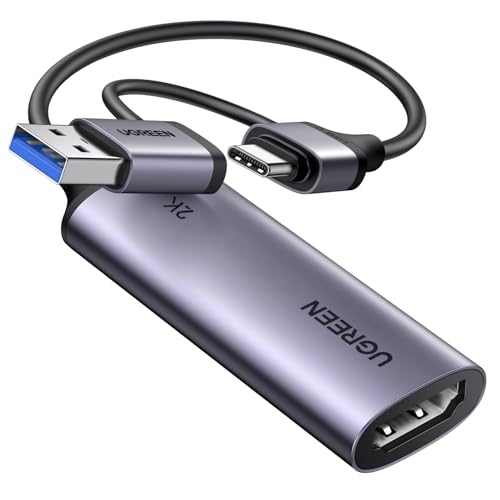
Flexible Midrange Pick – UGREEN 2K HDMI Capture Card
The UGREEN 2K HDMI Capture Card is a practical capture card for dual PC recording when 1080p60 performance and broad device compatibility matter more than 4K recording. Its HDMI input, USB-A and USB-C connectivity, and driver-free design suit straightforward streaming and recording setups.
Best For: Dual-PC users who want 1080p60 capture with USB-A and USB-C flexibility.
Pros:
- Supports 4K input, 2K output at 30 fps, and 1080p output at 60 fps.
- Provides USB 3.0 transfer speeds with backward compatibility to USB 2.0.
- Includes both USB-A and USB-C interfaces for computers, tablets, and other devices.
- Works with OBS Studio, XSplit, PotPlayer, QuickTime Player, and several operating systems.
Cons:
- Output is limited to 2K at 30 fps or 1080p at 60 fps.
- It supports only one-way HDMI input to USB output.
- Some consoles require HDCP to be disabled for capture.
UGREEN offers a balanced option for a dual-PC recording station built around 1080p60. Its flexible USB connections and wide software support make it convenient, while the resolution limits make it less suited to 4K-focused production.
Simple Streaming Option – acer USB 3.0 HDMI Capture Card
The acer USB 3.0 HDMI Capture Card is an accessible capture card for dual PC recording that combines 4K input with 1080p60 output. Its plug-and-play setup, USB Type-A and Type-C ports, and built-in mic input make it useful for uncomplicated gaming and commentary workflows.
Best For: Beginners and streamers who want simple 1080p60 capture with direct microphone connectivity.
Pros:
- Accepts 4K HDMI input and outputs 1080p at 60 Hz.
- Provides YUY2 video for richer colors than MJPEG according to the supplied specifications.
- Includes a 3.5mm mic input for direct voice commentary.
- Offers plug-and-play operation without extra drivers or external power.
Cons:
- Capture output is limited to 1080p, despite 4K input support.
- The supplied notes do not specify HDMI loop-out performance details.
- USB 3.0 is required for USB 3.0 operation.
This acer model is a convenient entry-level choice for a dual-PC recording setup, especially when ease of installation and microphone input are priorities. It is best suited to 1080p streaming rather than high-resolution 4K capture.
Versatile 4K Pass-Through Pick – 1080p60 USB HDMI Capture Card
If you need a capture card for dual PC recording, this XIIXMASK model offers 4K 60Hz HDMI loop-out while sending up to 1080p at 60fps or 1440p at 30fps to the recording computer. Its USB-A/USB-C connectivity and mic input make it practical for streaming, recording, and commentary.
Best For: Gamers and creators who want high-refresh pass-through, flexible computer connectivity, and microphone input.
Pros:
- Supports 4K 60Hz HDMI input and loop-out.
- Captures up to 1080p at 60fps or 1440p at 30fps.
- Includes USB-A/USB-C connectivity and a 3.5mm mic-in.
Cons:
- It does not record party chat through the mic-in.
- OBS may require a restart after audio setup.
With broad Windows, macOS, Linux, and streaming-software compatibility, this is a flexible option for a dual-PC setup. Confirm your computer and software settings before recording, especially if audio commentary is important.
Dual-Source Mixer Pick – j5create Dual HDMI Capture Card
For dual PC recording that also involves two HDMI sources, the j5create JVA06 stands out with dual HDMI inputs and uncompressed 1080p 60Hz capture over USB-C. It also adds picture-in-picture, picture-by-picture, and flexible audio controls for more involved live productions.
Best For: Streamers who need to capture two HDMI channels and manage multiple audio sources.
Pros:
- Captures two HDMI channels at up to 1080p 60Hz.
- Supports six screen configurations, including PIP and PBP.
- Offers HDMI or 3.5mm audio connections with three mixer switches.
Cons:
- It is limited to 1080p capture rather than 4K capture.
- Requires a USB-C 3.1 Gen1-compatible system.
The JVA06 is more production-focused than a basic single-input capture device. Its dual HDMI design and audio mixing features can simplify multi-source streaming, provided your setup meets the stated Windows or Android requirements.
Simple Pass-Through Value Pick – 1080p60 HDMI USB Capture Card
This VIXLW capture card is a straightforward choice for dual PC recording when you want plug-and-play setup, HDMI loop-out, and 1080p capture at 60fps. It accepts 4K input up to 60Hz, while output is limited to up to 2K at 30Hz.
Best For: PC and console streamers seeking an affordable, driver-free capture setup with low-latency pass-through.
Pros:
- Plug-and-play operation without drivers or external power.
- Supports 1080p capture at 60fps.
- Provides HDMI loop-out and 3.5mm mic-in for commentary.
Cons:
- Output is limited to 2K at 30Hz.
- It does not support 4K at 120Hz or 144Hz.
- The listed operating-system support is focused on Windows and Linux.
Its automatic webcam-style detection and USB 3.0 connection make it easy to add to a streaming computer. The main trade-off is output resolution and refresh-rate support, so it is best suited to setups centered on 1080p rather than high-resolution 4K gaming.
How We Picked the Best Capture Card for Dual PC Recording
We focused on the specifications that matter most in a two-computer workflow: capture resolution and frame rate, passthrough performance, input and output standards, connection type, audio handling, and setup flexibility. HDMI 2.1 models can preserve high-refresh 4K gaming signals, while USB 3.0 devices are generally easier to move between systems. Internal PCIe cards can offer a cleaner permanent installation, provided the recording PC has a compatible slot.
We also included practical budget options for creators who record at 1080p60, along with dual-input models for users who need more than one HDMI source.
Quick Comparison
| Best For | Recommended Type | Important Specification |
|---|---|---|
| 4K high-refresh gaming | HDMI 2.1 USB or PCIe card | 4K144 passthrough and low-latency capture |
| Permanent dual-PC setup | Internal PCIe card | Compatible motherboard slot and stable drivers |
| 1080p streaming and recording | USB 3.0 capture card | 1080p60 capture and reliable passthrough |
| Multiple HDMI sources | Dual-input capture card | Two HDMI inputs and suitable software support |
Key Buying Factors for a Capture Card for Dual-PC Recording
Capture Resolution and Frame Rate
Choose a card that matches the quality you intend to record, not only the signal your gaming PC can produce. A 1080p60 model is sufficient for many streams, while 4K60 capture is better for high-detail recordings. If you play at 4K120 or 4K144, prioritize a model with HDMI 2.1 passthrough so the capture card does not force a lower refresh rate on your gaming display.
Passthrough and Latency
Passthrough sends the gaming signal to your monitor or television. Look for passthrough support at your target resolution and refresh rate, plus low latency. Capture latency is less important when you monitor gameplay directly from the gaming PC, but it matters if you plan to play through preview software.
Connectivity, Audio, and Compatibility
USB 3.0 and USB-C models are convenient for laptops and flexible setups, but use a direct high-speed port rather than an overloaded hub. Internal cards require an available PCIe slot. Confirm that your graphics card, monitor, console, recording PC, and chosen software support the intended HDMI standard, HDR mode, and audio configuration.
Who Should Buy Which Capture Card for Dual PC Recording?
Choose an HDMI 2.1 model such as the Elgato 4K X or AVerMedia Live Gamer Ultra 2.1 if you need 4K high-refresh passthrough. An internal option such as the Elgato 4K Pro suits a permanent desktop installation with an available PCIe slot. For straightforward 1080p60 recording, the UGREEN, acer, generic USB 3.0, or similar budget models can be adequate. Choose the Osee GoStream M2 or j5create dual-input design when your workflow includes multiple HDMI sources. Before buying, verify the exact capture limits separately from passthrough limits, since a card may pass through a higher resolution than it can record.