The best capture card with hardware encoder can make streaming, recording, and live production smoother by handling video compression outside your computer’s main CPU. That matters when you are capturing high-resolution gameplay, using multiple sources, or running overlays and broadcast software at the same time.
This roundup compares 10 options ranging from simple USB devices to PCIe cards and dedicated HDMI encoders. Consider resolution, frame rate, passthrough, connection type, compatibility, and workflow before choosing.
Best 10 Capture Card with Hardware Encoder Picks for 2026
Best PCIe Hardware Encoder

- 1080p capture with H.264 hardware encoding
- PCIe design with HDMI pass-through
- TimeShift and low-latency streaming features
Best For: Dedicated Windows gaming PCs
Best External HDR Capture Card
- 1440p60 or 4K30 capture
- HDR high-refresh-rate pass-through
- Built-in mixer and OBS certification
Best For: High-resolution console and PC streaming
Best Standalone Hardware Encoder

- H.265/H.264 encoding at 1080p60
- Broad RTMP, RTSP, SRT, and HLS support
- Browser setup with compact 24/7-ready design
Best For: IP streaming, IPTV, and fixed installations
Best HDMI 2.1 Hardware Encoder

- 4K144 capture and pass-through
- HDMI 2.1 with VRR support
- Up to 1080p240 capture over USB 3.2 Gen 2
Best For: High-refresh-rate PS5, Xbox, and PC streaming
Professional PCIe Capture

- Single-channel HDMI capture with embedded audio
- Supports analog video inputs via breakout cable
- Windows, macOS, and Linux support
Best For: Professional desktop video ingest and production workflows
Easy Hardware Encoding

- Built-in H.264 hardware encoder
- 1080p60 capture and zero-lag pass-through
- Compact USB plug-and-play design
Best For: Console streaming with OBS and similar software
Multi-Input PCIe Capture
ACASIS 4K HDMI PCIe Capture Card

- Four simultaneous HDMI inputs
- 1080p60 capture with ultra-low latency
- Active cooling for extended operation
Best For: Multicam streaming, conferencing, and broadcasting
Best Budget Pass-Through

- 1080p capture with 4K30/60Hz input
- HDMI loop-out for low-delay monitoring
- Plug-and-play with microphone input
Best For: Budget console streaming with commentary
Best Dual-Input Mixer

- Dual 4K60 HDMI inputs
- PIP and PBP source layouts
- 1080p60 USB output with audio ports
Best For: Multi-source streaming and live presentations
Best Simple 4K Pass-Through
- 1080p60 capture from 4K30 input
- 4K HDMI pass-through
- Plug-and-play audio and video capture
Best For: Single-source gaming and camera streaming
Best PCIe Hardware Encoder – Live Gamer HD C985
The AVerMedia Live Gamer HD C985 is a practical capture card with hardware encoder support for Windows gaming PCs. Its H.264 encoding helps reduce CPU usage while capturing 1080p video, and ultra-low latency keeps gameplay and streams responsive.
Best For: Windows users who want an internal PCIe card for 1080p console or PC capture.
Pros:
- H.264 hardware encoding helps reduce CPU load.
- Captures gameplay in full HD 1080p with ultra-low latency.
- Supports HDMI pass-through, TimeShift recording, and popular streaming software.
- Works with consoles including Xbox, PlayStation, Wii U, Switch, and PC.
Cons:
- Requires a Windows PC with an available PCIe x1 slot.
- Its listed operating-system support is centered on Windows 8.
The C985 is best suited to a dedicated Windows streaming setup rather than a portable rig. It offers useful hardware encoding and flexible capture features, but confirm your system requirements before buying.
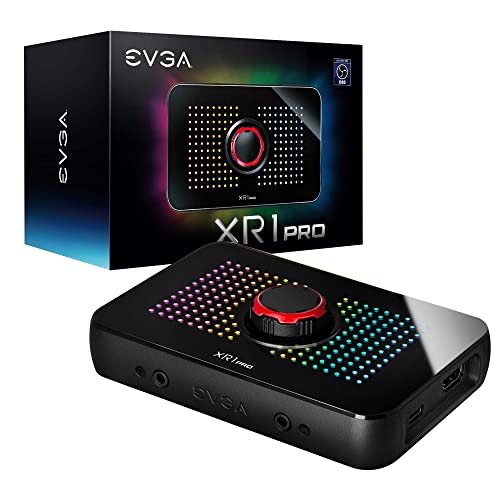
Best External HDR Capture Card – EVGA XR1 Pro
The EVGA XR1 Pro is a USB capture card with hardware-assisted capture capabilities for high-resolution gaming setups. It can capture up to 1440p at 60fps or 4K at 30fps, while supporting HDR pass-through and OBS-certified plug-and-play setup.
Best For: Streamers who need high-resolution HDR pass-through, flexible capture options, and external USB connectivity.
Pros:
- Captures up to 1440p at 60fps or 4K at 30fps.
- Supports 1440p at 144Hz HDR and 4K at 60Hz HDR pass-through.
- Built-in audio mixer and control dial simplify audio adjustments.
- OBS certified with no driver installation required.
Cons:
- Requires a USB 3.1 interface.
- Its external design uses a separate desktop connection rather than an internal PCIe slot.
The XR1 Pro is a strong choice when pass-through quality matters as much as capture resolution. Its audio controls and OBS certification add convenience for streamers, while the USB format makes installation straightforward.
Best Standalone Hardware Encoder – BM1000 1080p60 Encoder
The BM1000 is a standalone capture card with hardware encoder support that sends 1080p60 video directly to streaming and distribution platforms. Browser-based setup, broad network protocol support, and no required PC software make it useful for fixed installations and live workflows.
Best For: Network streaming, IPTV, surveillance, digital signage, and other always-on setups.
Pros:
- Dedicated H.265/H.264 encoding supports 1080p60 output.
- Supports RTMP, RTSP, SRT, HLS, WebRTC, and additional protocols.
- Browser-based configuration avoids driver and operating-system compatibility issues.
- Compact design includes HDMI audio support, external 3.5mm input, and OSD overlays.
Cons:
- Advanced setups require basic networking knowledge.
- It is designed for IP streaming rather than conventional USB capture into a computer.
- The product requires a 12V DC power source.
The BM1000 stands apart from typical gaming capture devices by focusing on direct network distribution and continuous operation. Choose it when protocol flexibility and standalone encoding are more important than a simple OBS capture workflow.
Best HDMI 2.1 Hardware Encoder – Elgato 4K X
The Elgato 4K X is a premium external capture card with ultra-low-latency USB connectivity and HDMI 2.1 support. It captures up to 4K at 144fps, supports up to 1080p240 capture, and provides VRR pass-through for current-generation gaming systems.
Best For: PS5, Xbox Series X, PC, and Mac users building a high-refresh-rate 4K streaming setup.
Pros:
- Supports 4K144 capture and pass-through.
- HDMI 2.1 enables high-frame-rate signals up to 1080p240.
- VRR pass-through helps preserve smooth gameplay without screen tearing.
- Works with OBS, Streamlabs, Twitch Studio, Zoom, Teams, and other applications.
Cons:
- Full performance requires a USB 3.2 Gen 2 port.
- System requirements include a relatively modern CPU and graphics card.
- USB 3.2 Gen 1 supports reduced capture resolution.
The 4K X is the most forward-looking option in this group for high-refresh-rate gaming. Its HDMI 2.1 and VRR features make it a compelling fit for modern consoles and gaming PCs, provided the host system meets the bandwidth requirements.
Professional PCIe Capture – Magewell Pro Capture HDMI
If you need a capture card with hardware encoder capabilities for a desktop production setup, the Magewell Pro Capture HDMI 11040 is built for professional ingest rather than casual gaming. Its PCIe connection supports low-latency HDMI capture, embedded audio, analog inputs, and hardware-based video processing for live streaming, recording, and custom workflows.
Best For: Desktop users who need flexible HDMI and analog capture for production, monitoring, or software-driven encoding.
Pros:
- Captures a single HDMI source up to 2048×2160 with embedded audio.
- Supports HDMI, component, composite, S-video, and analog audio through the breakout cable.
- Offers cropping, scaling, de-interlacing, color conversion, and frame-rate conversion through SDK control.
- Works with Windows, macOS, and Linux and supports multiple cards per system.
Cons:
- Requires an available PCIe slot and a compatible desktop computer.
- It is a single-channel card, so it does not provide multi-input capture by itself.
- Its professional SDK-oriented feature set may be more than basic streaming requires.
The Magewell stands out when broad input support and system-level integration matter more than portability. It is a strong choice for production environments that can accommodate an internal PCIe card.
Easy Hardware Encoding – AVerMedia Live Gamer Mini
The AVerMedia Live Gamer Mini is a practical capture card with hardware encoder support for console streaming and recording. Its built-in H.264 encoder processes video and audio on the device, while HDMI pass-through delivers 1080p60 gameplay to a monitor without added latency.
Best For: Console gamers who want a compact, plug-and-play 1080p60 capture setup for OBS, Streamlabs OBS, or similar software.
Pros:
- Records Full HD video at 1080p60.
- Built-in H.264 hardware encoder reduces capture-related CPU load.
- Provides zero-lag 1080p60 HDMI pass-through for gameplay.
- UVC plug-and-play operation works over USB 2.0 or USB 3.0 without driver installation.
Cons:
- Capture resolution is limited to 1080p.
- Uses USB 2.0 rather than a faster USB interface.
- Compatibility information lists Windows 10/11 and macOS 12, so newer or different systems should be checked.
For straightforward console streaming, the Live Gamer Mini keeps the setup simple while handling encoding internally. It is especially appealing when low-latency pass-through and minimal computer workload are priorities.
Multi-Input PCIe Capture – ACASIS 4K HDMI PCIe Capture Card
The ACASIS 4K HDMI PCIe is designed for multi-source setups that need more than a single input. As a capture card with hardware encoder-style production potential, it provides four HDMI channels for simultaneous 1080p60 capture, ultra-low latency, and multicam workflows for streaming, teaching, conferencing, and broadcasting.
Best For: Windows-based multicam and multi-device production setups that need four HDMI inputs on one internal card.
Pros:
- Captures four HDMI sources simultaneously at up to 1080p60.
- Supports ultra-low-latency, uncompressed capture.
- Fits PCIe x4, x8, or x16 slots and includes active cooling with a built-in turbo fan.
- Works with software including OBS, VLC, Wirecast, and vMix.
Cons:
- Requires an internal PCIe slot and is not a portable capture solution.
- Supplied compatibility details focus on Windows XP/7/8.1/10 and Linux rather than newer operating systems.
- Despite the product name, listed capture output is 1080p60 rather than 4K capture.
The ACASIS is the most suitable option here for users managing several HDMI sources at once. Its four-channel design can simplify multicam production, provided the host system and software meet the stated requirements.
Best Budget Pass-Through – VIXLW V316B-FR
If you want a straightforward capture card with hardware encoder for console streaming, the VIXLW V316B-FR offers plug-and-play USB 3.0 connectivity, HDMI loop-out, and up to 1080p capture. It accepts 4K30/60Hz input, while output supports up to 2K30Hz.
Best For: Budget-minded streamers who need low-latency pass-through, microphone commentary, and broad HDMI-device compatibility.
Pros:
- Captures video up to 1080p and accepts 4K30/60Hz input.
- HDMI loop-out supports playing or monitoring without noticeable delay.
- Plug-and-play setup works with Windows and Mac, with optional microphone input.
Cons:
- It does not support 4K120Hz or 4K144Hz input.
- Output is limited to up to 2K30Hz.
- The 3.5mm microphone input accepts only TRS standard headsets.
The VIXLW is a practical entry-level option when 1080p capture and HDMI pass-through matter more than high-resolution output. Its simple setup and commentary input make it suitable for basic game streaming.
Best Dual-Input Mixer – Osee GoStream M2
The Osee GoStream M2 stands out as a versatile capture card with hardware encoder for streamers who need two HDMI sources. It provides dual 4K60 inputs, 1080p60 output, USB 3.0 connectivity, and built-in switching features for multi-source productions.
Best For: Gamers, presenters, and creators who want to combine two HDMI sources with PIP or PBP layouts.
Pros:
- Two HDMI inputs support 4K60 sources.
- PIP and PBP modes provide multiple layouts and source-switching options.
- Built-in microphone and audio input/output ports support voice commentary.
- Works with Windows, Android, macOS, and Linux without driver installation.
Cons:
- USB capture output is specified up to 1080p60 rather than 4K.
- Its multi-input feature set may be more than needed for a single-source setup.
- The listed minimum system requirement is Windows 7 or later, while platform support varies by use.
Choose the GoStream M2 if your setup involves multiple cameras, consoles, or presentation sources. Its switching and layout tools offer more production flexibility than a basic single-input capture device.
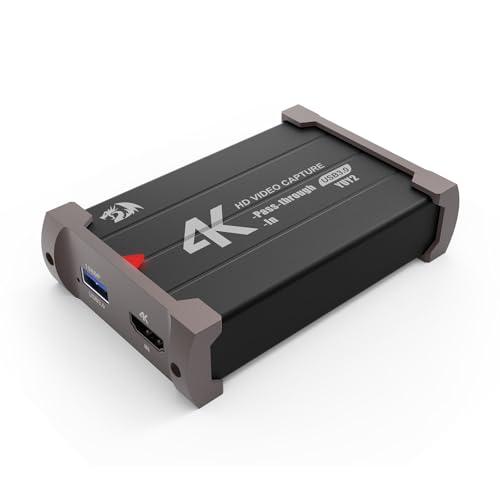
Best Simple 4K Pass-Through – Redragon VC321
The Redragon VC321 is a compact capture card with hardware encoder designed for uncomplicated 1080p60 recording and streaming. It supports 4K30 input, 4K HDMI pass-through, simultaneous audio and video capture, and plug-and-play operation on compatible Windows and Mac systems.
Best For: Console gamers and creators who want 4K pass-through with Full HD capture and a simple setup.
Pros:
- Captures up to 1080p60 from 4K30 input.
- 4K HDMI pass-through is designed for real-time gameplay.
- Captures video and audio simultaneously.
- Compatible with Windows 7 and newer and macOS 10.15 or newer.
Cons:
- Capture resolution is limited to 1080p rather than 4K.
- Input support is specified up to 4K30, not 4K60 or higher.
- Unlike the Osee model, the supplied details list only a single HDMI input.
The VC321 is a good fit for a conventional one-source gaming or camera workflow. It keeps the setup simple while preserving a 4K display path through HDMI pass-through.
How We Picked the Best Capture Card with Hardware Encoder
We focused on capture hardware that supports dependable HDMI video acquisition for gaming, streaming, recording, teaching, conferencing, and live production. The selection includes USB and internal PCIe models, entry-level 1080p60 devices, high-bandwidth HDMI 2.1 hardware, and standalone encoders with network-streaming support.
We also considered features that affect day-to-day use: hardware H.264 or H.265 encoding, passthrough resolution, input and output latency, operating-system compatibility, audio handling, software support, and whether the device is better suited to a simple single-PC setup or a more advanced production environment.
Quick Comparison
- Best for high-end gaming: Choose an HDMI 2.1 model if you need 4K at high refresh rates and want passthrough without compromising gameplay.
- Best for basic streaming: A USB 1080p60 capture card is generally the easiest option for OBS, consoles, and laptops.
- Best for lower CPU usage: Look for dedicated H.264 or H.265 encoding rather than relying entirely on software encoding.
- Best for professional ingest: PCIe cards may offer stronger sustained performance, lower latency, and better integration with production systems.
- Best for network workflows: Standalone HDMI encoders can send streams through protocols such as RTMP, RTSP, SRT, HLS, or WebRTC.
Key Buying Factors for a Capture Card with Hardware Encoder
Resolution, Frame Rate, and Passthrough
Check capture resolution separately from passthrough resolution. A device may pass through 4K video while recording at 1080p60. For most gameplay and live content, 1080p at 60 frames per second is a practical baseline. Competitive gamers and newer consoles may benefit from 4K passthrough or 4K capture, while HDMI 2.1 is important for demanding 4K high-refresh setups.
Encoding and Computer Load
A Capture Card with Hardware Encoder compresses video on the device, which can leave more CPU and GPU resources available for games, overlays, audio processing, and recording. H.264 is widely compatible; H.265 can provide better efficiency but may have more limited software, platform, or hardware support.
Connection, Compatibility, and Latency
USB 3.0 and faster connections are common for external cards and are convenient for laptops or flexible setups. PCIe cards are installed inside a desktop and can be preferable for permanent studios. Confirm support for your operating system, console, camera, and streaming application. Ultra-low-latency monitoring and HDMI passthrough are especially valuable when you play from the captured source.
Audio and Software Features
Look for HDMI audio support, microphone or line-in mixing when needed, and compatibility with OBS or your preferred production software. Standalone network encoders should be evaluated for protocol support, bitrate control, stream reliability, and remote-management features.
Who Should Buy Which Capture Card with Hardware Encoder?
Console streamers and beginners should prioritize a plug-and-play USB model with 1080p60 capture, HDMI passthrough, and broad OBS compatibility. Competitive and high-refresh gamers should choose hardware that preserves their preferred 4K or high-frame-rate signal through passthrough. Desktop creators and production teams may prefer PCIe capture cards for a stable, integrated workflow. Mobile, event, and broadcast users should consider a standalone encoder when direct network streaming is more useful than connecting to a host computer.
Before buying, verify the exact input and output specifications, required USB or PCIe bandwidth, supported HDR and refresh-rate combinations, and whether encoding is performed in hardware at the resolution and bitrate you plan to use.