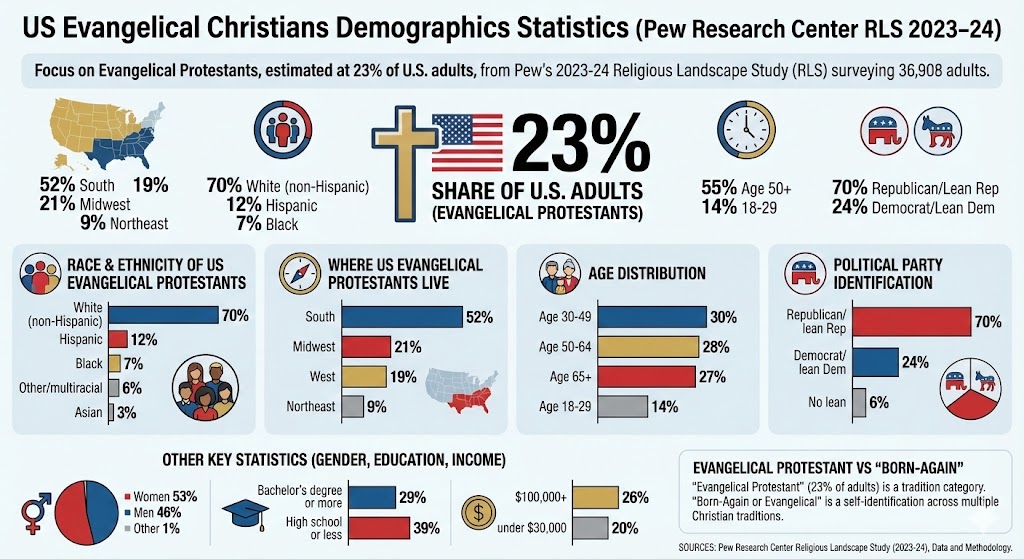
In U.S. survey research, “evangelical Christians” is commonly measured in two ways: (1) people who identify as evangelical Protestants (a Protestant tradition category) and (2) Christians who self-identify as “born-again or evangelical”. The demographics below focus primarily on evangelical Protestants, using Pew Research Center’s 2023-24 Religious Landscape Study (RLS).
US Evangelical Christians demographics statistics
US Evangelical Christians Demographics (Top Highlights)
23% of U.S. adults identify as evangelical Protestants.
52% of evangelical Protestants live in the South (vs. 21% Midwest, 19% West, 9% Northeast).
Evangelical Protestants are 70% White (non-Hispanic), 12% Hispanic, and 7% Black (with smaller shares Asian and multiracial/other).
55% of evangelical Protestants are age 50+ (14% are 18-29).
53% are women and 46% are men (about 1% report another gender identity).
29% have a bachelor’s degree or more.
26% report household income of $100,000+ (20% report under $30,000).
70% identify with or lean toward the Republican Party (24% Democrat/lean Democrat; 6% no lean).
Evangelical Protestant vs “Born-Again or Evangelical”
Evangelical Protestant is a religious tradition category (people affiliated with Protestant denominations in the evangelical tradition). In Pew’s RLS, this group is estimated at 23% of U.S. adults.
Separately, Pew also asks respondents whether they describe themselves as “born-again or evangelical”. This self-description can include people across multiple Christian traditions, not only evangelical Protestants, so it should not be treated as identical to the evangelical Protestant tradition category.
Demographic Profile at a Glance
Metric
Evangelical Protestant estimate
Share of U.S. adults
23%
Women / Men
53% / 46%
Age 50+
55%
White (non-Hispanic)
70%
Bachelor’s degree or more
29%
Household income $100,000+
26%
Live in the South
52%
Republican/lean Republican
70%
Race and Ethnicity of US Evangelical Protestants
Pew’s RLS data shows evangelical Protestants are majority White (non-Hispanic), with Hispanic and Black evangelicals representing notable minorities.
Label
Bar
Value
White (non-Hispanic)
70%
Hispanic
12%
Black
7%
Other/multiracial
6%
Asian
3%
Max = 70. Widths: White (non-Hispanic) 100.00%, Hispanic 17.14%, Black 10.00%, Other/multiracial 8.57%, Asian 4.29%.
Where US Evangelical Protestants Live
Evangelical Protestants are regionally concentrated in the South in Pew’s RLS estimates.
Label
Bar
Value
South
52%
Midwest
21%
West
19%
Northeast
9%
Max = 52. Widths: South 100.00%, Midwest 40.38%, West 36.54%, Northeast 17.31%.
Age Distribution of US Evangelical Protestants
In Pew’s RLS, evangelical Protestants skew older: 55% are age 50+ (28% are 50-64 and 27% are 65+).
Label
Bar
Value
Age 30-49
30%
Age 50-64
28%
Age 65+
27%
Age 18-29
14%
Max = 30. Widths: Age 30-49 100.00%, Age 50-64 93.33%, Age 65+ 90.00%, Age 18-29 46.67%.
Political Party Identification Among US Evangelical Protestants
Pew’s RLS finds evangelical Protestants are one of the most Republican-leaning major religious groups by party identification.
Label
Bar
Value
Republican/lean Rep
70%
Democrat/lean Dem
24%
No lean
6%
Max = 70. Widths: Republican/lean Rep 100.00%, Democrat/lean Dem 34.29%, No lean 8.57%.
Other Demographic Stats Worth Knowing
Gender: 53% women, 46% men (about 1% report another gender identity).
Education: 29% have a bachelor’s degree or higher; 39% have a high school diploma or less.
Income: 26% report $100k+ household income; 20% report under $30k.
Methodology Snapshot
Pew Research Center’s 2023-24 Religious Landscape Study surveyed 36,908 U.S. adults and was conducted from July 17, 2023 to March 4, 2024.
Sources
Pew Research Center — Religious Landscape Study (2023-24): Evangelical Protestant tradition estimates.
Pew Research Center — Religious Landscape Study (2023-24): Demographic profiles by religious tradition (age, race/ethnicity, gender, education, income, region).
Pew Research Center — Religious Landscape Study (2023-24): Religion and political party identification breakdowns.
Pew Research Center — Religious Landscape Study (2023-24): Topline and methodology documentation.
Immerse yourself in the elegance of large angel figurines that could transform your home decor; discover the top ten options that inspire serenity and beauty.
Get inspired by our selection of the 10 best Bible verse nightstand lamps that beautifully blend faith and function—discover the perfect piece for your space!
Make your entryway festive with the 10 best outdoor holiday welcome signs that will elevate your home decor this season and leave your guests wanting more.