Large-print Bible dictionaries make it easier to look up biblical people, places, terms, events, and historical context without straining to read small reference text.
These 10 options range from illustrated study references and KJV-focused editions to compact dictionaries and combined dictionary-concordance volumes, giving different readers practical ways to deepen Bible study.
Best 10 Large Print Bible Dictionaries Picks for 2026
Best Overall Large-Print Companion

- Large, comfortable type for easier reference reading
- A-to-Z coverage of biblical people, places, and terms
- Plain-English explanations for everyday study
Best For: Readers who want an accessible Bible dictionary for devotion, teaching, and group study
Best for KJV Word Definitions

- Defines over 2,000 uncommon and doctrinal KJV terms
- Uses Noah Webster’s 1828 definitions
- Readable font with a spacious layout
Best For: KJV readers seeking focused definitions of unfamiliar biblical vocabulary
Best Illustrated Reference
Holman Illustrated Bible Dictionary
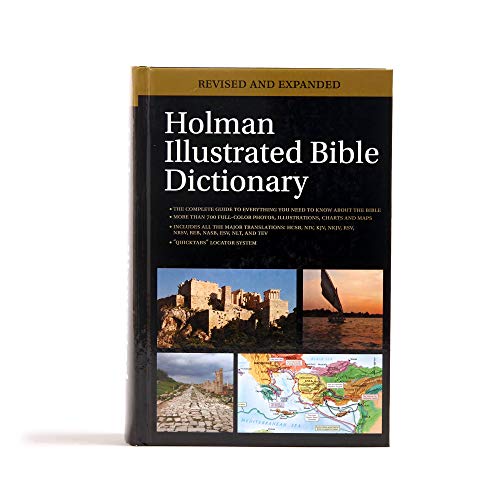
- Over 6,500 articles across biblical topics
- Around 700 photos, maps, charts, and reconstructions
- Detailed linguistic, historical, and cultural background
Best For: Students and teachers wanting a comprehensive visual Bible reference
Best for Original-Language Word Studies
Vine’s Complete Expository Dictionary

- Covers more than 6,000 biblical words
- Explores usage, frequency, and meaning
- Combines dictionary, commentary, and concordance features
Best For: Students and pastors pursuing deeper Greek and Hebrew word studies
Comprehensive Study

- More than 1,000 scholarly articles
- Maps, illustrations, and cross-references
- 1,352-page single-volume reference
Best For: Detailed study, sermons, and Bible-reference collections
Accessibility Pick
KJV Super Giant Print Dictionary & Concordance

- 17.5-point APHont type
- More than 5,000 dictionary entries
- 40,000 KJV Scripture references
Best For: KJV readers who prioritize highly readable type
Portable Visual Guide

- Concise definitions for quick lookups
- Hundreds of colorful visual aids
- Compact 512-page format
Best For: Beginners and mobile personal or group study
Compact Reference Pick
Nelson's New Compact Illustrated Bible Dictionary

- Short definitions with Scripture references
- Topical guide for names, cities, and terms
- Lightweight 314-page format
Best For: Portable everyday Bible reference
Comprehensive Study Volume
Strong's Concise Concordance and Vine's Concise Dictionary

- Concordance and dictionary combined
- Includes Strong's numbers and transliterations
- 1,200 pages of reference material
Best For: In-depth word study and Scripture lookup
Everyday Pocket Choice

- Defines 2,500 key Bible entries
- Includes illustrations and phrase entries
- Cross-references modern translations
Best For: Portable daily Bible study
Best Overall Large-Print Companion – Bible Dictionary Large Print
For readers specifically searching for large print Bible dictionaries, this 305-page A-to-Z guide emphasizes clear explanations and comfortable reading. It covers biblical people, places, events, books, and terms in plain English, making it a practical reference for everyday Bible reading, teaching, and group study.
Best For: Seniors, new believers, devotional readers, parents, Sunday school teachers, and anyone who prefers generous type and straightforward explanations.
Pros:
- Large-print format designed to be easier on tired eyes.
- Alphabetical coverage of Old and New Testament people, places, events, books, and terms.
- Plain-language explanations aimed at readers without seminary training.
- Useful for personal devotion, lesson preparation, and small-group study.
Cons:
- Its independently published format may offer less visual material than illustrated reference works.
- Readers wanting extensive original-language word studies may need a more specialized resource.
This is the most directly targeted option for shoppers prioritizing readability. Its approachable scope makes it a convenient Bible-side reference, especially when standard dictionary type feels difficult to read.
Best for KJV Word Definitions – The KJV Dictionary
This compact choice stands out among large print Bible dictionaries for readers focused on the King James Version. It compiles more than 2,000 uncommon, doctrinal, and thematic KJV terms using Noah Webster’s 1828 definitions, with a spacious layout and readable font.
Best For: KJV readers who want focused definitions of unfamiliar biblical vocabulary without articles, opinions, or unrelated meanings.
Pros:
- Concentrates specifically on uncommon, doctrinal, and thematic KJV terms.
- Uses Noah Webster’s 1828 Dictionary as its stated source.
- Readable font and spacious layout support quick lookups.
- Lightweight 222-page softcover is easy to keep beside a Bible.
Cons:
- It is narrower in scope than a general Bible dictionary covering people, places, and events.
- The 1828 source may not suit readers seeking contemporary English definitions.
- It is most relevant to King James Version users.
If your main challenge is understanding older KJV wording, this focused dictionary may be more useful than a broad reference work. It is less suitable as an all-purpose Bible encyclopedia, but its streamlined approach keeps word lookups simple.
Best Illustrated Reference – Holman Illustrated Bible Dictionary
For shoppers comparing large print Bible dictionaries with more comprehensive visual references, the Holman Illustrated Bible Dictionary offers over 6,500 articles from Aaron to Zuzite. Its concise definitions, expanded explanations, and approximately 700 full-color photos, maps, charts, and reconstructions support deeper study of biblical history and context.
Best For: Bible students, teachers, pastors, small-group leaders, lifelong learners, and readers who benefit from visual aids and broad coverage.
Pros:
- More than 6,500 articles cover a wide range of biblical topics.
- Approximately 700 full-color photos, maps, charts, and reconstructions add context.
- Combines concise definitions with more thorough topic development.
- Addresses linguistic, historical, geographical, and cultural background.
Cons:
- The supplied details do not identify it as a large-print edition.
- Its breadth and visual content may make it less convenient for quick, lightweight lookups.
- Readers seeking only simple word definitions may find it more extensive than necessary.
This is the strongest choice here for readers who want a substantial, image-rich reference library rather than a strictly large-print format. It can add valuable background for study, teaching, and sermon preparation.
Best for Original-Language Word Studies – Vine’s Complete Expository Dictionary
Vine's Complete Expository Dictionary of Old and New Testament Words: Super Value Edition
Check Price On AmazonAmong large print Bible dictionaries, Vine’s Complete Expository Dictionary is the specialist option for readers who want to explore biblical word meanings. It covers more than 6,000 key words, discussing frequency, usage, and meaning while providing dictionary, commentary, and topical concordance features in one volume.
Best For: Bible students, pastors, and serious readers interested in Greek and Hebrew word studies without years of formal language training.
Pros:
- Includes over 6,000 key biblical words from the Old and New Testaments.
- Explains word frequency, usage, and meaning.
- Includes the numbering system used in The New Strong’s Exhaustive Concordance.
- Combines dictionary, commentary, and topical concordance functions.
Cons:
- The supplied details do not identify it as a large-print edition.
- At 1,184 pages, it is substantially less compact than a basic lookup dictionary.
- Its specialized focus may be more than casual readers need.
This resource is best viewed as a deeper word-study tool rather than a general A-to-Z Bible dictionary. Choose it when original-language background and detailed usage matter more than large type or quick, simple definitions.
Comprehensive Study – Tyndale Bible Dictionary
For shoppers comparing large print bible dictionaries, the Tyndale Bible Dictionary is a substantial single-volume reference designed for detailed study. Its more than 1,000 articles, cross-references, maps, illustrations, and contributions from 139 scholars make it particularly useful when you want broad biblical context in one book.
Best For: Sermon preparation, Bible study leaders, and readers who want in-depth evangelical scholarship covering biblical books, theology, history, cultures, places, and objects.
Pros:
- More than 1,000 informative articles with thousands of cross-references.
- Includes hundreds of pictures, maps, and illustrations.
- Covers biblical manuscripts, translations, theology, ancient cultures, canonical books, and additional writings.
- Provides an extensive 1,352-page reference in a single volume.
Cons:
- At 4.05 pounds, it is less convenient to carry than a compact reference.
- Its depth may be more than beginners need for quick lookups.
This is a strong choice if comprehensiveness matters more than portability. Although the supplied details do not specify a special large-print type size, its illustrated format and broad coverage make it a capable desk reference for serious Bible study.
Accessibility Pick – KJV Super Giant Print Dictionary & Concordance
Among large print bible dictionaries, the KJV Super Giant Print Dictionary & Concordance stands out for its accessibility-focused design. It uses 17.5-point APHont type created specifically for people with visual impairments and combines more than 5,000 dictionary entries with 40,000 Scripture references.
Best For: KJV readers who need very large type for more comfortable Bible reference work, including people with visual impairments or eyestrain concerns.
Pros:
- Uses 17.5-point APHont type designed for visually impaired readers.
- Includes more than 5,000 dictionary entries.
- Provides 40,000 Scripture references based on the KJV.
- Offers both dictionary and concordance functions in one volume.
Cons:
- Its usefulness is tied to readers who use the King James Version.
- At 1,288 pages and 3.88 pounds, it is a substantial book to transport.
If readability is your primary buying criterion, this is the clearest match in the group. The combination of very large type, dictionary entries, and extensive KJV references makes it practical for accessible home study and lookup.
Portable Visual Guide – Ultimate Bible Dictionary
For readers seeking large print bible dictionaries in a more portable format, the Ultimate Bible Dictionary offers concise, accessible definitions in a 512-page volume. Colorful maps, photos, and reconstructions appear alongside many entries, helping explain biblical people, places, objects, and events without the bulk of a larger reference work.
Best For: Beginners, students, homeschoolers, small groups, and readers who want quick, visually supported Bible lookups.
Pros:
- Uses clear definitions that begin with quick explanations and may add detail.
- Includes hundreds of colorful maps, photos, and reconstructions.
- Compact 4.8-by-7.1-inch format is easier to carry to study sessions.
- Revised and expanded edition covers biblical people, places, objects, and events.
Cons:
- Its 512 pages provide less coverage than the larger reference volumes here.
- The supplied details do not specify a dedicated large-print type size.
This is the practical choice for accessible, introductory reference work when portability and visual context matter. It is better suited to quick study and group use than to exhaustive scholarly research.
Compact Reference Pick – Nelson's New Compact Illustrated Bible Dictionary
For shoppers comparing large print bible dictionaries, this compact illustrated volume is a practical choice when you want quick definitions and Scripture references in a small format. It covers personal names, cities, and other biblical terms, with a topical guide for easier lookup.
Best For: Readers who want a lightweight, straightforward Bible dictionary for basic lookups and reference on the go.
Pros:
- Includes short definitions and Scripture references.
- Topical guide helps identify people, places, and other Bible terms.
- Compact 314-page format is easy to carry.
Cons:
- Short entries may not provide extensive discussion.
- Its compact dimensions may not suit readers seeking a large-format reference book.
Choose this edition if portability and fast, uncomplicated lookup matter more than extensive word-study detail or a substantial page size.
Comprehensive Study Volume – Strong's Concise Concordance and Vine's Concise Dictionary
Among large print bible dictionaries and related study tools, this combined volume stands out for its breadth. It pairs a concise concordance with Vine’s concise dictionary, offering definitions, explanations, concordance entries, transliterations, Strong’s numbers, and cross-referencing support in a 1,200-page reference book.
Best For: Bible students, ministry workers, and readers who want concordance and word-study resources together without needing Hebrew or Greek knowledge.
Pros:
- Combines two established Bible reference tools in one volume.
- Includes Strong’s numbers, transliterations, parts of speech, and concise definitions.
- Concordance entries accommodate modern translations by grouping variant spellings of proper names.
- Alphabetical organization supports searches by English biblical vocabulary.
Cons:
- At 1,200 pages and 3.05 pounds, it is less portable than a pocket dictionary.
- Its concise format may not replace more extensive original-language resources.
This is the strongest option for buyers prioritizing coverage and cross-referenced study features over a lightweight design.
Everyday Pocket Choice – Pocket Bible Dictionary
For readers comparing large print bible dictionaries for everyday use, this pocket-sized option focuses on concise, accessible explanations. It defines 2,500 important people, places, things, and ideas, while adding cross-references to modern translations, black-and-white illustrations, and selected phrase entries.
Best For: Readers who want a lightweight daily Bible-study aid with many brief entries and convenient cross-references.
Pros:
- Covers 2,500 biblically significant people, places, things, and ideas.
- Offers concise, no-nonsense explanations for quick study.
- Includes black-and-white illustrations and helpful phrase entries.
- Cross-references the King James Version with more modern translations.
Cons:
- Its pocket dimensions are not designed for a large-format reading experience.
- Brief entries may be limited for readers seeking detailed commentary.
This 352-page dictionary is a practical pick when portability, broad basic coverage, and quick explanations are more important than extended analysis.
How We Picked the Best Large Print Bible Dictionaries
We evaluated these reference books according to the features that matter most during real Bible study: print readability, scope of coverage, organization, denominational or translation focus, illustrations, cross-references, and portability. We also considered whether each book works best as a general reference, a word-study aid, a concordance companion, or a quick lookup guide.
Because “large print” can vary by edition and publisher, check the product listing for the exact format, dimensions, page count, and font specifications before ordering. A book described as easy to read may not use the same type size as a dedicated giant-print edition.
Quick Comparison
| Best For | Look For |
|---|---|
| General Bible study | Broad A-to-Z coverage of people, places, events, and terms |
| Visual learners | Maps, photographs, charts, and other illustrations |
| KJV readers | King James Version terminology, references, and concordance support |
| Word studies | Original-language explanations and definitions |
| Travel or church use | Compact size, lighter weight, and fast alphabetical lookup |
Key Buying Factors for Large-Print Bible Dictionaries
Print Size and Physical Format
Prioritize the actual font size, page dimensions, binding, and weight. Larger pages may improve readability but can make a reference harder to hold. A hardcover often withstands frequent use, while a paperback may be lighter and less expensive.
Coverage and Depth
A concise dictionary is useful for quick definitions, while an expanded reference provides more historical, cultural, geographical, and theological context. Choose depth based on whether you need fast answers or material for serious study and teaching.
Translation and Word-Study Focus
KJV-focused dictionaries can clarify older wording and terminology. Expository dictionaries and concordances are better suited to readers researching how Hebrew or Greek words are used across Scripture. Make sure the book’s translation orientation matches your Bible.
Illustrations and Reference Tools
Maps, diagrams, photographs, pronunciation help, cross-references, and concordance entries can make a dictionary more useful. However, added features may increase the book’s size and price, so select only the tools you will regularly use.
Who Should Buy Which Large Print Bible Dictionaries?
Choose a broad, easy-to-read A-to-Z dictionary if you want one approachable volume for family study, new Bible readers, or everyday reference. An illustrated dictionary is a strong choice for visual learners, teachers, and readers who want historical or geographical context alongside definitions.
KJV readers should look for a KJV dictionary or a dictionary-and-concordance combination designed around that translation. Those conducting detailed word studies may prefer Vine’s or Strong’s-based resources, while students who need a lighter book for church, travel, or quick lookups may be happier with a compact or pocket edition.
Before buying, compare the listed dimensions and edition details rather than relying on the title alone. The best Large Print Bible Dictionaries are the ones you can read comfortably, navigate quickly, and use consistently with your preferred Bible translation and study goals.