Legal offices need more than a scanner that simply captures pages. The right model should handle contracts, filings, exhibits, receipts, and mixed document batches quickly while producing searchable, organized digital files.
We compared 10 scanners across speed, duplex performance, paper handling, connectivity, portability, and day-to-day usability to help you choose a dependable fit for your workflow.
Best 10 Document Scanner for Legal Documents Picks for 2026
Best High-Volume Pick

- 50-sheet ADF for batch scanning
- Duplex capture with OCR support
- Double-feed detection and skew correction
Best For: Law offices processing stacks of case files
Best Portable Pick
Brother DS-640 Compact Scanner

- Lightweight, under-one-foot design
- USB-powered for outlet-free use
- OCR and multi-platform support
Best For: Mobile legal work and single-page scanning
Best Connected Office Pick

- 100-page ADF for larger batches
- 45-ppm duplex scanning
- Wi-Fi and touchscreen workflows
Best For: Connected legal teams with high scanning volume
Best Lightweight Single-Sheet Pick

- 9.44-ounce portable design
- USB-powered single-sheet scanning
- OCR and long-document support
Best For: Solo practitioners with light scanning needs
Best Overall

- 45 ppm duplex scanning with a 100-sheet feeder
- Wi-Fi 6, USB-C, mobile, and cloud connectivity
- Touchscreen profiles and automatic file organization
Best For: Busy firms and shared office workflows
Best Simple One-Touch Model
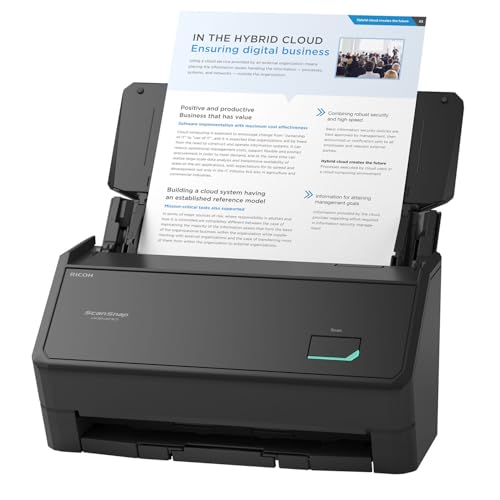
- One-touch 45 ppm duplex scanning
- 100-sheet feeder for larger batches
- Automatic cleanup, blank-page removal, and deskewing
Best For: Fast, uncomplicated wired scanning
Best with Extra Features
HPPS100 Mobile Document Scanner

- Lightweight USB-powered design
- 15 ppm simplex scanning
- Windows and macOS compatible
Best For: Traveling legal professionals and small document batches
Best Heavy-Duty Pick

- 100-sheet automatic document feeder
- 35 ppm duplex scanning
- OCR and wireless cloud workflows
Best For: Busy law offices scanning larger document batches
Best Flexible Desk Scanner
ScanSnap iX1300 Wireless Duplex Scanner

- Compact space-saving design
- 30 ppm duplex scanning
- USB and Wi-Fi connectivity
Best For: Small offices scanning documents, cards, receipts, and photos
Best High-Volume Pick – Epson WorkForce ES-400 II
For firms needing a dependable document scanner for legal documents, the Epson WorkForce ES-400 II is designed to process stacks efficiently. Its 50-sheet feeder, duplex scanning, OCR, and double-feed detection support everyday office workflows.
Best For: Law offices scanning batches of case files, forms, and correspondence.
Pros:
- 50-sheet ADF supports productive batch scanning.
- Duplex scanning captures both sides efficiently.
- OCR creates searchable PDFs and editable Word or Excel files.
- Ultrasonic double-feed detection and skew correction help prevent missed pages.
Cons:
- USB is the listed connection type, with no wireless connectivity noted.
- Its desktop design is less convenient for mobile use.
The ES-400 II is a practical choice when scanning volume and document organization matter more than portability. Epson ScanSmart, cloud destinations, and TWAIN support make it easy to fit into established office systems.
Best Portable Pick – Brother DS-640 Compact Scanner
The Brother DS-640 is a compact document scanner for legal documents when attorneys or staff need to digitize papers away from the office. It scans at up to 16 pages per minute, connects through micro USB, and weighs about one pound.
Best For: Mobile professionals scanning receipts, forms, IDs, and individual legal pages on the go.
Pros:
- Compact design fits easily in a bag or small workspace.
- USB-powered operation works without a wall outlet.
- Supports OCR and scan-to-PC, cloud, email, and other destinations.
- Works with Windows, Mac, and Linux environments.
Cons:
- Single-sheet capacity is slower for large case-file batches.
- Requires a computer connection for operation.
This scanner prioritizes mobility over high-volume automation. It is a useful companion for courtroom visits, client meetings, or fieldwork, but a desktop ADF model is better for sustained office scanning.
Best Connected Office Pick – Epson WorkForce ES-590W
The Epson WorkForce ES-590W is a document scanner for legal documents suited to busy teams that want speed, wireless access, and computer-free workflows. It combines a 100-page feeder with duplex scanning up to 45 pages per minute and a color touchscreen.
Best For: Larger legal teams scanning substantial workloads directly to email, cloud storage, or USB drives.
Pros:
- 100-sheet ADF supports larger document batches.
- Single-step duplex scanning reaches up to 45 ppm.
- Wi-Fi enables scanning from a computer or mobile device.
- Touchscreen supports direct scanning to email, cloud storage, or USB.
Cons:
- Its larger desktop format is less portable than mobile scanners.
- Listed minimum system requirements specify Windows.
The ES-590W offers the most connected workflow in this group. Its capacity, touchscreen, and wireless features can reduce computer-dependent steps, while AI-ready data support adds flexibility for newer document workflows.
Best Lightweight Single-Sheet Pick – Epson WorkForce ES-50
The Epson WorkForce ES-50 is a lightweight document scanner for legal documents when desk space and portability are priorities. Its USB-powered design scans one sheet at a time, handles documents up to 8.5 by 72 inches, and includes OCR for searchable files.
Best For: Solo practitioners and staff who need an easy scanner for occasional pages, receipts, IDs, or long documents.
Pros:
- Weighs only 9.44 ounces and is easy to carry.
- USB power requires no battery or external power supply.
- OCR creates searchable PDFs and editable Word or Excel files.
- Automatic feeding mode combines successive sheets into one file.
Cons:
- Single-sheet capacity is not ideal for large case-file batches.
- USB is the listed connectivity option, with no wireless feature noted.
The ES-50 is a straightforward choice for light-duty legal scanning and portable document capture. Choose it for convenience and small workloads; offices processing frequent stacks should consider an ADF-equipped desktop model instead.
Best Overall – ScanSnap iX2500
For firms seeking a document scanner for legal documents, the ScanSnap iX2500 combines fast duplex scanning with flexible wireless or USB connectivity. Its 45-page-per-minute speed, 100-sheet feeder, and automatic image and file organization make it well suited to high-volume paperwork.
Best For: Law offices that need fast, shareable scanning with wireless connectivity and customizable workflows.
Pros:
- Scans up to 45 pages per minute and handles both sides of a page.
- 100-sheet feeder with multi-feed and skew detection to help reduce jams and paper damage.
- Wi-Fi 6 and USB-C connectivity support computers, mobile devices, and cloud services.
- Automatic optimization, naming, and sorting simplify document organization.
Cons:
- Its advanced features may be more than needed for occasional scanning.
- Wireless and cloud features depend on compatible devices and services.
The iX2500 is the most feature-rich option here, especially for teams that share a scanner or want to scan without being tied to one computer. Its large touchscreen and profile support also make recurring legal-document workflows easier to manage.
Best Plug-and-Scan Pick – Canon imageFORMULA R30
The Canon imageFORMULA R30 is a practical document scanner for legal documents when simple setup matters. It connects by USB and uses software embedded in the device, so users can scan searchable files without installing separate scanning software.
Best For: Users who want straightforward USB scanning for contracts, invoices, and mixed document batches.
Pros:
- Duplex scanning reaches up to 25 pages per minute.
- 60-sheet automatic document feeder supports longer batches.
- Handles documents, invoices, contracts, and business cards individually or in mixed batches.
- Embedded software requires no installation and updates automatically.
Cons:
- USB is the only listed connection type.
- TWAIN and ISIS drivers are not supported.
- Its 25-page-per-minute speed is lower than the ScanSnap options.
The R30 emphasizes convenience over extensive connectivity. It is a sensible fit for a workstation where plug-and-scan operation, searchable digital files, and mixed-paper handling are more important than wireless access.
Best Simple One-Touch Model – ScanSnap iX2400
The ScanSnap iX2400 is a straightforward document scanner for legal documents, offering one-touch operation and speeds up to 45 pages per minute. Its 100-sheet feeder and automatic cleanup features make it useful for converting paper files, receipts, business cards, and other office records.
Best For: Offices that prefer fast wired scanning with minimal setup and automatic image cleanup.
Pros:
- One-touch, duplex scanning reaches up to 45 pages per minute.
- 100-sheet feeder supports substantial document batches.
- Automatically detects size and color depth, removes streaks and blank pages, and corrects skew.
- USB provides a stable wired connection, while ScanSnap Home helps manage scanned data.
Cons:
- Only USB connectivity is listed; there is no built-in Wi-Fi.
- One-touch operation offers less workflow customization than the iX2500’s touchscreen profiles.
The iX2400 is a strong middle ground for legal offices that value speed and consistent results but do not need wireless scanning. Its automatic cleanup and broad media support reduce the manual work involved in everyday intake.
Best with Extra Features – HPPS100 Mobile Document Scanner
The HPPS100 is a practical document scanner for legal documents when portability and simple one-sided scanning matter most. Its USB-powered design fits easily in a bag or briefcase, while the 15-page-per-minute speed handles contracts, invoices, letters, receipts, and other small to medium batches.
Best For: Traveling legal professionals, home offices, tax preparers, and anyone who needs a lightweight scanner for occasional or mobile document capture.
Pros:
- Compact 3-ounce design with USB 2.0 connectivity for easy travel.
- 15-page-per-minute simplex scanning for quick one-sided jobs.
- Works with Windows and macOS and supports PDF, JPG, and other file formats.
- HP WorkScan includes previewing, cropping, image optimization, and background cleanup tools.
Cons:
- Scans one side at a time rather than duplex scanning.
- Its 10-sheet standard capacity is better suited to small batches than large case files.
- USB connectivity requires a computer or compatible device.
Choose the HPPS100 if you value a small footprint and easy transport over high-volume automation. It is especially convenient for scanning individual legal forms and documents away from a permanent desk setup.
Best Heavy-Duty Pick – Epson WorkForce ES-580W
The Epson WorkForce ES-580W is a strong document scanner for legal documents when a busy office needs fast, hands-off processing. Its 100-sheet auto document feeder, 35-page-per-minute duplex scanning, and wireless workflows are designed for digitizing larger stacks efficiently.
Best For: Law offices and administrative teams processing sizable batches of contracts, case paperwork, and correspondence.
Pros:
- 100-sheet ADF supports larger scanning jobs and varied paper types and sizes.
- Duplex scanning captures both sides at up to 35 pages per minute.
- Can scan directly to USB, email, smartphones, tablets, and cloud services without a computer.
- OCR creates searchable PDFs and converts scans to editable Word or Excel files.
Cons:
- Desktop footprint and 3.7 kg weight make it less portable than compact models.
- Wireless and cloud features may require setup with compatible services.
- The supplied specifications list a one-year limited warranty.
For firms that routinely scan multi-page files, the ES-580W offers the most substantial paper-handling capacity in this roundup. Its duplex capture and OCR support can also make digital legal records easier to search and organize.
Best Flexible Desk Scanner – ScanSnap iX1300 Wireless Duplex Scanner
The ScanSnap iX1300 is a versatile document scanner for legal documents that balances duplex speed with a space-saving design. It supports USB or Wi-Fi connections, scans documents and cards, and uses automatic image adjustments to simplify everyday office workflows.
Best For: Small legal offices that need a compact desktop scanner for documents, receipts, photos, and plastic cards.
Pros:
- Space-saving design fits small desks and work areas.
- Up to 30 pages per minute with automatic double-sided scanning.
- USB and Wi-Fi support enables scanning to computers, mobile devices, cloud services, or Chromebook through the mobile app.
- Automatic de-skew, color optimization, and blank-page removal improve scan consistency.
Cons:
- Its 20-sheet capacity is smaller than the Epson model’s 100-sheet feeder.
- At 4.4 pounds, it is portable within an office but not as lightweight as the HPPS100.
- Some newer operating-system requirements may limit compatibility with older devices.
The iX1300 is a well-rounded choice for offices that need duplex scanning without dedicating much desk space. Its flexible connectivity and support for cards and mixed everyday media make it useful beyond standard legal paperwork.
How We Picked the Best Document Scanner for Legal Documents
We focused on features that matter in legal and professional document workflows: reliable automatic document feeders, double-sided scanning, optical resolution, scan speed, connectivity, software support, and compatibility with common computers and cloud services. We also considered whether each scanner suits high-volume office work, occasional scanning, remote work, or mobile use.
For legal records, duplex scanning is especially valuable because many agreements and case files use both sides of the page. We also favored models with straightforward controls and software that can create searchable PDFs, organize files, or send scans directly to a destination.
Quick Comparison
| Best For | Recommended Type | Key Advantage |
|---|---|---|
| Busy law offices | Desktop duplex scanner | Higher throughput and larger feeders |
| Wireless workflows | Network-enabled desktop scanner | Flexible placement and cloud connectivity |
| Remote professionals | Compact mobile scanner | Easy transport and minimal desk space |
| Simple shared use | Plug-and-scan office scanner | Fast setup with fewer software requirements |
| Occasional home scanning | Basic USB sheetfed scanner | Lower cost and straightforward operation |
Key Buying Factors for a Document Scanner for Legal Documents
Duplex Scanning and Feeder Capacity
Choose automatic duplex scanning when you regularly process contracts, pleadings, discovery materials, or forms printed on both sides. A larger feeder reduces interruptions during batch jobs, but compact models may be preferable when volume is limited.
Speed and Daily Volume
Pages-per-minute ratings are useful for comparing models, but real-world performance also depends on paper condition, resolution, color settings, and file format. High-volume offices should prioritize a desktop scanner designed for continuous batches rather than a portable single-sheet unit.
Connectivity and Software
USB is dependable for a dedicated workstation. Wi-Fi provides more flexibility for shared offices and cloud-based workflows. Look for software that supports searchable PDFs, customizable scan profiles, automatic file naming, and direct destinations such as email or cloud storage.
Paper Handling and Image Quality
Legal documents can include thin pages, mixed sizes, receipts, and occasional fragile originals. A dependable feeder, paper-skew correction, blank-page removal, and document-size detection can save time. For most text records, standard optical resolution is sufficient; higher settings are more useful for diagrams, photographs, or fine signatures.
Who Should Buy Which Document Scanner for Legal Documents?
Choose a fast desktop duplex model if your firm scans case files every day or needs efficient batch processing. Select a wireless desktop scanner if multiple users need convenient access or your workflow relies on network and cloud storage. A compact mobile scanner is better for attorneys who work between offices, in court, or from home. If setup simplicity is the priority, a plug-and-scan model can minimize installation and training. For light personal use, a basic USB scanner may provide all the necessary functionality without taking up much space.
Before buying, estimate your typical daily page count, confirm your computer and operating-system compatibility, and verify whether the scanner’s feeder supports the paper sizes and document condition you handle most often.