Accounting firms need more than fast scanning—they need dependable paper handling, accurate duplex capture, and workflows that keep client documents organized and accessible.
We compared 10 leading desktop scanners across speed, connectivity, automation, ease of use, and office fit to help you choose the right model for tax documents, receipts, invoices, IDs, and records.
Best 10 Document Scanner for Accounting Firms Picks for 2026
Most Productive

- 45 ppm double-sided scanning
- 100-page automatic feeder
- Wi-Fi and touchscreen scan workflows
Best For: Busy accounting offices processing large document batches
Best Compact Office Pick

- Space-saving upright design
- 25 ppm duplex scanning
- Supports QuickBooks Online and cloud services
Best For: Small offices scanning varied documents from limited desk space
Best Network Flexibility

- 40 ppm duplex scanning
- Wi-Fi, Ethernet, and USB connectivity
- 2.8-inch touchscreen and mobile app support
Best For: Small offices sharing a scanner across wired and wireless networks
Best Shared-User Workflow
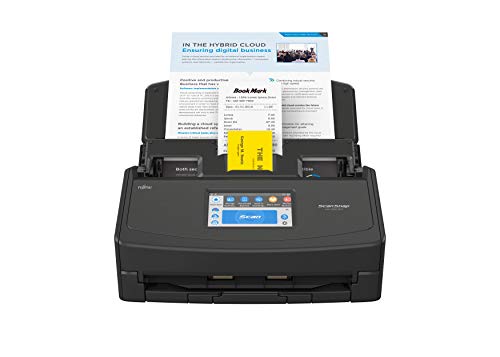
- 4.3-inch touchscreen
- Personalized user profiles
- Wi-Fi and cloud scanning
Best For: Shared accounting offices needing simple personalized document routing
Best Overall

- 40 ppm duplex scanning with a 50-sheet feeder
- DirectScan supports email and network folders
- OCR and image enhancement help create editable files
Best For: Busy accounting offices needing fast, network-ready scanning
Best Wireless Option

- 45 ppm duplex scanning and a 100-sheet feeder
- Wi-Fi 6, USB-C, and cloud connectivity
- Touchscreen profiles simplify shared workflows
Best For: Multi-user firms using wireless, mobile, or cloud workflows
Compact Choice

- Compact design for small workspaces
- Up to 30 ppm duplex scanning
- USB, Wi-Fi, mobile, and cloud support
Best For: Small offices scanning varied paperwork
Workflow-Friendly Choice

- 50-sheet automatic document feeder
- Duplex scanning with OCR support
- Cloud sharing and TWAIN integration
Best For: Routine multi-page office scanning
High-Volume Choice

- Up to 70 ppm or 140 ipm duplex
- 100-sheet ADF for large batches
- Handles cards and extra-long documents
Best For: High-throughput accounting departments
Most Productive – Epson WorkForce ES-590W
For accounting firms handling large batches of invoices, statements, and tax documents, the Epson WorkForce ES-590W is a high-capacity document scanner for accounting firms. It combines 45 ppm duplex scanning, a 100-page feeder, Wi-Fi, USB, and a 4.3-inch color touchscreen.
Best For: Busy accounting offices that need fast batch scanning and computer-free scan-to-cloud or scan-to-email workflows.
Pros:
- Scans both sides in one pass at up to 45 ppm.
- 100-page Auto Document Feeder supports larger document batches.
- Wi-Fi, USB, touchscreen, cloud, email, and USB-flash-drive scanning options.
- AI-ready scanning technology is designed to convert documents into structured data.
Cons:
- The listed minimum system requirements specify Windows, so Mac workflow details should be verified.
- It is larger and heavier than the more compact options in this group.
Choose the ES-590W when throughput and flexible connectivity matter most. Its combination of speed, feeder capacity, and touchscreen controls makes it particularly practical for recurring accounting paperwork.
Best Compact Office Pick – Canon imageFORMULA DR-C225 II
The Canon imageFORMULA DR-C225 II is a space-conscious document scanner for accounting firms that need dependable receipt, contract, card, and report scanning. Its upright design, 30-sheet feeder, duplex scanning, and cloud-service support suit smaller office workstations.
Best For: Small accounting offices that value a compact footprint, broad media handling, and direct connections to popular cloud and accounting services.
Pros:
- Upright top-feed and top-eject design saves desk space.
- Scans both sides in color at up to 25 ppm.
- Handles receipts, photos, business cards, plastic cards, and varied paper thicknesses.
- Supports cloud destinations including QuickBooks Online, Dropbox, Google Drive, and OneDrive.
Cons:
- The 30-sheet feeder is smaller than the feeders on the Epson and Brother models.
- Connectivity is USB rather than wireless or Ethernet.
The DR-C225 II is a sensible fit when desk space and document variety are bigger concerns than maximum batch speed. Its included software and three-year warranty add practical value for office deployment.
Best Network Flexibility – Brother ADS-3350W
Brother ADS-3350W Wireless High-Speed Desktop Scanner | 2.8-inch Touchscreen | Scans Up to 40ppm1
Check Price On AmazonThe Brother ADS-3350W gives accounting teams a flexible document scanner for accounting firms with wired, wireless, and Ethernet connectivity. It scans at up to 40 ppm, includes a 60-page feeder, and supports multiple document types and scan destinations.
Best For: Small offices and work-from-home users who need shared network access, mobile scanning, and straightforward touchscreen control.
Pros:
- Scans single- and double-sided documents at up to 40 ppm.
- Offers USB, Wi-Fi, and wired Ethernet connectivity.
- 2.8-inch color touchscreen supports one-touch control.
- Handles receipts, business cards, plastic cards, and index cards.
Cons:
- The 60-page feeder is smaller than the Epson model’s 100-page capacity.
- It includes a one-year limited manufacturer warranty.
The ADS-3350W stands out for offices where several connection methods and secure network access are important. It balances useful speed and capacity with support for Windows, macOS, and Linux.
Best Shared-User Workflow – Fujitsu ScanSnap iX1500
The Fujitsu ScanSnap iX1500 is a user-friendly document scanner for accounting firms that want simple one-touch scanning and shared access. Its 4.3-inch touchscreen, Wi-Fi, USB, and user profiles make it easy to route documents to individual folders or cloud services.
Best For: Accounting teams that share one scanner and want personalized scan destinations with minimal setup.
Pros:
- Large 4.3-inch touchscreen enables one-touch scanning.
- User profiles can route scans to user-specific folders.
- Scans to cloud services, desktop folders, and mobile devices.
- Includes ScanSnap Home for capturing, organizing, and managing documents.
Cons:
- The 50-page feeder is smaller than the Epson and Brother capacities.
- Its listed scanning media emphasizes paper, receipts, photos, business cards, and licenses rather than a wider range of specialty media.
- Warranty coverage is a one-year return-to-depot warranty.
The iX1500 is a strong choice for collaborative offices that prioritize ease of use and individualized routing over the highest stated scanning speed. Its touchscreen and profile support can simplify everyday document distribution.
Best Overall – Ricoh fi-8040
For accounting firms that need a document scanner for accounting firms with strong throughput and flexible workflows, the Ricoh fi-8040 scans up to 40 double-sided pages per minute. Its touchscreen, Ethernet connectivity, OCR, and PaperStream software support efficient processing of invoices, receipts, IDs, and other office documents.
Best For: Accounting offices that want fast duplex scanning, network destinations, and advanced image processing.
Pros:
- Scans up to 40 double-sided pages per minute with a 50-sheet feeder.
- DirectScan can send files to email and network folders without a computer.
- Includes OCR, indexing options, and image enhancement for editable, searchable files.
- Supports paper, receipts, business cards, embossed cards, and IDs.
Cons:
- Network connectivity may be more capability than a small office needs.
- Listed system requirements are limited to Windows environments.
The fi-8040 is the strongest fit here for busy accounting workflows that benefit from speed, network scanning, and data capture features. Its three-year manufacturer warranty also adds reassurance for office use.
Best Wireless Option – ScanSnap iX2500
The ScanSnap iX2500 is a practical document scanner for accounting firms that want wireless flexibility alongside high-volume feeding. It scans up to 45 double-sided pages per minute, holds 100 sheets, and can send documents to computers, mobile devices, and cloud services.
Best For: Firms sharing one scanner across multiple users or sending scans directly to cloud and mobile workflows.
Pros:
- Fast 45 ppm duplex scanning with a generous 100-sheet document feeder.
- Built-in Wi-Fi 6 and USB-C provide flexible connection options.
- Touchscreen profiles and Quick Menu simplify recurring scan tasks.
- Brake roller, multi-feed detection, and skew detection help reduce jams and damage.
Cons:
- Its one-year manufacturer warranty is shorter than the Ricoh model’s listed warranty.
- Wireless and cloud features may be unnecessary for a single-user desk setup.
With the fastest rated speed and largest feeder in this group, the iX2500 is well suited to shared accounting offices. Its broad operating-system support and wireless connectivity make it especially adaptable to mixed-device environments.
Best Plug-and-Scan Value – Canon imageFORMULA R30
The Canon imageFORMULA R30 is a straightforward document scanner for accounting firms that prioritize simple setup. It connects by USB, requires no software installation, and scans both sides at up to 25 pages per minute while handling invoices, contracts, business cards, and mixed batches.
Best For: Small offices that want an easy USB scanner with a capable feeder and minimal setup.
Pros:
- Plug-and-scan operation uses software embedded in the device.
- Duplex scanning reaches up to 25 pages per minute.
- 60-sheet automatic feeder handles mixed document types.
- Converts paper documents into searchable digital formats.
Cons:
- USB is the only listed connection type.
- TWAIN and ISIS drivers are not supported.
- Its 25 ppm speed is lower than the Ricoh and ScanSnap models.
The R30 favors convenience over advanced connectivity and maximum throughput. It is a sensible choice for smaller accounting teams that scan moderate batches and value a no-installation setup.
Compact Choice – ScanSnap iX1300
For accounting firms that need a document scanner for accounting firms in a limited workspace, the ScanSnap iX1300 combines a compact design with wireless or USB connectivity. It scans documents, receipts, photos, cards, and other media at up to 30 pages per minute in duplex mode.
Best For: Small accounting offices, flexible desk setups, and teams scanning mixed document types.
Pros:
- Space-saving design fits easily on crowded desks.
- Wireless and USB connectivity supports computers, mobile devices, and cloud services.
- Automatic de-skew, color optimization, and blank-page removal simplify scanning.
- ScanSnap Home helps organize documents, receipts, business cards, and photos.
Cons:
- Its 20-sheet standard capacity is smaller than the other scanners in this roundup.
- Its listed speed is lower than the Fujitsu fi-8170.
The iX1300 is a practical choice when space, connectivity, and ease of use matter more than high-volume batch capacity. Its automatic image adjustments and broad media support make it particularly convenient for everyday accounting paperwork.
Workflow-Friendly Choice – Epson WorkForce ES-400 II
The Epson WorkForce ES-400 II is a capable document scanner for accounting firms handling regular stacks of paperwork. Its 50-sheet automatic document feeder, duplex scanning, OCR, and cloud-sharing features are designed to support productive office workflows.
Best For: Accounting teams that batch-scan invoices, forms, and other multi-page documents.
Pros:
- 50-sheet ADF helps process stacks with less manual feeding.
- ScanSmart software supports previews, email, cloud uploads, and automatic file naming.
- OCR can create searchable PDFs and convert scans to editable Word or Excel files.
- Ultrasonic double-feed detection and dynamic skew correction help protect scan completeness.
Cons:
- USB is the listed connection type, without built-in Wi-Fi noted.
- The listed resolution is 300 dpi, lower than the 600 dpi options here.
Choose the ES-400 II if your firm values straightforward batch scanning and document-management integration. Its ADF, OCR, file-management tools, and TWAIN driver make it well suited to recurring office scanning tasks.
High-Volume Choice – Fujitsu fi-8170
For larger accounting operations, the Fujitsu fi-8170 is a high-volume document scanner for accounting firms that need speed, capacity, and dependable media handling. It scans at up to 70 ppm simplex or 140 ipm duplex and includes a 100-sheet ADF.
Best For: Busy accounting departments processing large batches and varied document sizes.
Pros:
- Fast scanning speeds support demanding workflows.
- 100-sheet ADF reduces interruptions during large jobs.
- 600 dpi optical resolution produces sharp scans.
- Handles cards, passports, IDs, embossed cards, and pages up to 240 inches long.
Cons:
- Its high-volume capabilities may be more than a small office needs.
- The supplied notes do not specify wireless connectivity.
The fi-8170 is the strongest fit when throughput and media flexibility are priorities. Multi-feed detection, paper protection, PaperStream software, and compatibility with Windows, macOS, and Linux add useful support for structured office scanning workflows.
How We Picked the Best Document Scanner for Accounting Firms
We focused on features that matter in real accounting workflows: automatic document feeders, duplex scanning, practical scan speeds, wireless or USB connectivity, touchscreens, receipt and ID-card handling, and compatibility with common Mac and PC setups. We also considered whether each scanner suits occasional document capture, daily client work, or heavier office volume.
Advertised pages-per-minute ratings are useful for comparison, but real throughput depends on document size, resolution, paper condition, software, and whether the scanner is processing both sides. Reliable feeding and straightforward software can matter as much as headline speed.
Quick Comparison
| Best For | What to Prioritize |
|---|---|
| Small firms and home offices | Compact design, simple setup, and wireless connectivity |
| Busy tax-season teams | Fast duplex scanning, a capable feeder, and dependable daily operation |
| Receipt-heavy bookkeeping | Receipt handling, flexible media support, and accurate paper feeding |
| Shared office use | Touchscreen controls, network access, and user-friendly workflows |
| High-volume document departments | Higher duty-cycle hardware, consistent feeding, and business-class software |
Key Buying Factors for a Document Scanner for Accounting Firms
Speed and Feeder Capacity
Choose a scanner that can keep up with your busiest batches. A larger automatic document feeder reduces interruptions, while duplex scanning captures both sides in one pass. For firms processing stacks of tax forms or invoices, these features usually provide more value than occasional single-page speed.
Paper Handling
Accounting records vary widely. Look for dependable feeding across mixed pages, thin receipts, long forms, business cards, and identification documents. A scanner that handles delicate or irregular media well can reduce rescans and manual sorting.
Connectivity and Workflow
USB is often the most direct option, while Wi-Fi can make a scanner easier to share or place near a document intake area. Touchscreen controls, one-touch destinations, cloud support, and bundled software can shorten repetitive tasks, but verify compatibility with your document-management or tax-preparation systems.
Image Quality and Reliability
Clear text, accurate color, blank-page removal, and reliable optical character recognition help create searchable records. For daily professional use, consistent performance and serviceability should outweigh a small difference in maximum resolution.
Who Should Buy Which Document Scanner for Accounting Firms?
Choose a compact wireless model if your firm has limited desk space or several employees need convenient access. Select a faster desktop scanner with a larger feeder for recurring batch work during tax season. Receipt-focused practices should favor flexible media handling, while firms scanning sensitive client records should prioritize secure local workflows and trusted software compatibility. If multiple users share the device, a touchscreen and network features can simplify operation. For the heaviest workloads, invest in a business-class model designed for sustained daily scanning rather than choosing solely by price.