The best book scanners for university students make it easier to digitize textbooks, journal articles, lecture notes, and archival material without repeatedly typing or photographing pages by hand.
This roundup compares 10 options across portability, image quality, OCR, page-flattening performance, document size, and workflow features, helping you choose a scanner that fits your course load, workspace, and budget.
Best 10 Book Scanners for University Students Picks for 2026
Best Portable Book Scanner

- About one-second-per-page scanning
- A3/A4 support with 180+ OCR languages
- Folding design with document-camera mode
Best For: Portable scanning of course materials and thinner books
Best Reading Pen Scanner
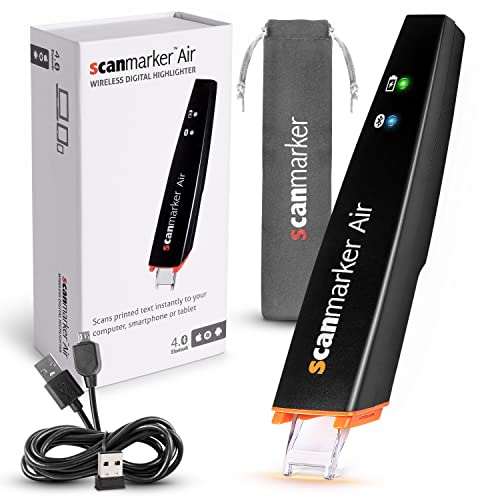
- Scans printed lines into connected devices
- Translates more than 140 languages
- Includes text-to-speech functionality
Best For: Extracting and translating short passages
Best Book Scanner With Reading Lamp

- Scans A3/A4 pages in about two seconds
- Outputs searchable PDFs and editable files
- Includes adjustable glare-free study lighting
Best For: Desk-based scanning and reading of bound materials
Best Large-Format Book Scanner
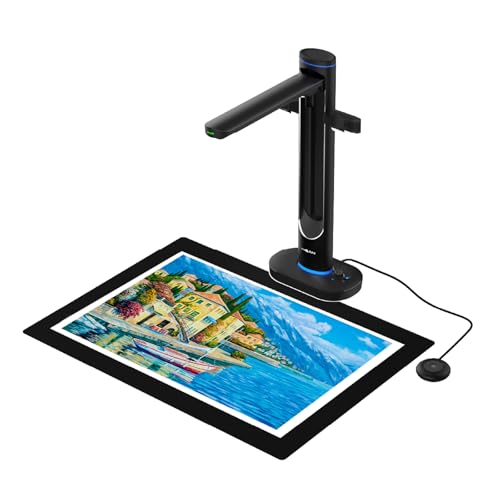
- Handles bound materials up to A2 size
- Dual 48MP cameras with up to 600 DPI
- OCR, text-to-speech, and UVC camera modes
Best For: Large, fragile, archival, and teaching materials
Best Portable Pick
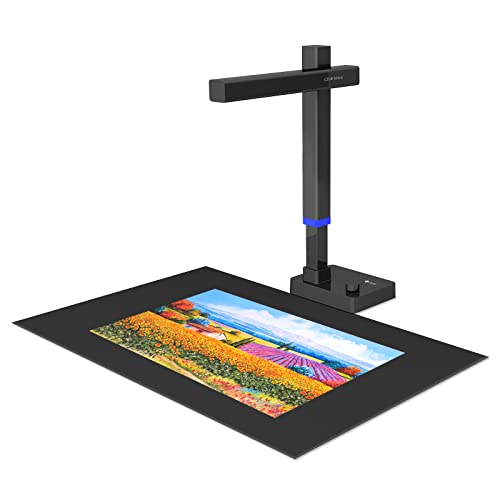
- 24MP sensor with curved-page flattening
- Foldable 2-pound design
- Exports searchable PDFs, Word, and Excel files
Best For: Students needing a lightweight scanner for mobile study spaces
Best High-Resolution Pick

- 38MP sensor with 410 DPI capture
- A3 scanning area for larger materials
- Fast scanning and 180+ language OCR
Best For: Students scanning large books or substantial academic projects
Best Feature-Rich Desk Option

- Laser-based curved-page flattening
- About 2 seconds per page
- Auto scanning, side lights, and desk lamp
Best For: Students building a convenient scanning station at home
High-Resolution Power User

- 48MP capture and up to 600 DPI support for detailed pages
- Page flattening, splitting, OCR, and text-to-speech features
- 4K USB document-camera mode for teaching and presentations
Best For: Large textbook digitization projects and accessibility-focused study workflows
Fast Book Digitization Pick

- Curved-page flattening technology for bound books
- Stated 1.5-second-per-page scanning speed
- OCR supports more than 180 languages
Best For: Large textbook collections and mixed document scanning
Portable Study Companion
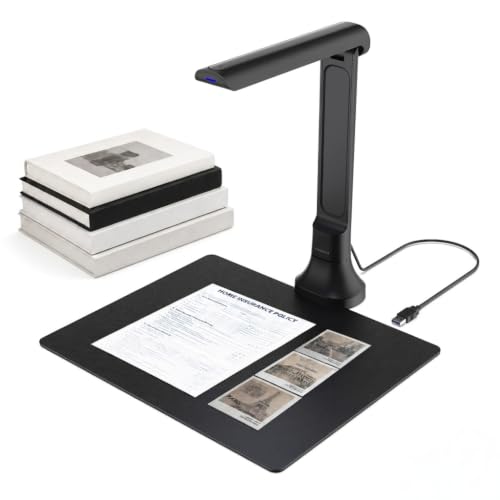
- Foldable 350-gram design for easy transport
- 16MP autofocus camera with OCR and text-to-speech
- Supports remote learning and conferencing on Windows and macOS
Best For: Mobile students who scan, present, and collaborate across locations
Best Portable Book Scanner – CZUR Shine Ultra
For students comparing book scanners for university students, the CZUR Shine Ultra is a portable option for digitizing A3 and A4 materials at about one second per page. Its OCR, automatic cropping, and book-page flattening features help turn course readings into editable or searchable files, though the flattening technology is intended for thinner books.
Best For: University students who need fast scanning for loose pages, thinner textbooks, and remote-learning presentations.
Pros:
- Scans pages in about one second and supports A3 and A4 documents.
- OCR recognizes more than 180 languages, with searchable and editable file workflows.
- Works as both a document scanner and USB document camera for Zoom and Google Meet.
- Folds to 90 degrees, weighs about 4 pounds, and includes a foot pedal.
Cons:
- Not compatible with Android or iOS.
- Curved-page flattening is suited to thinner books; CZUR recommends its ET series for thicker books.
- Thai, Hebrew, and Arabic are not supported for OCR.
The Shine Ultra balances speed, portability, and study-friendly OCR. It is a practical choice when most scanning involves loose sheets or thinner books and you use Windows or macOS.
Best Reading Pen Scanner – Scanmarker Air
The Scanmarker Air takes a different approach to book scanners for university students: instead of capturing full pages, it scans individual lines as you slide the pen across printed text. The accompanying software can transfer text for editing, translate more than 140 languages, and read text aloud.
Best For: Students who need quick excerpts, translation, text-to-speech support, or a highly portable scanning tool.
Pros:
- Transfers scanned text instantly through the web app or compatible applications.
- Supports multilingual OCR and translation across more than 140 languages.
- Text-to-speech can support reading comprehension and students with dyslexia or reading difficulties.
- Lightweight wireless design connects through Bluetooth 4.0 or higher.
Cons:
- Scans one line of text at a time rather than complete book pages.
- Requires a computer or mobile device to operate.
- The listed minimum system requirement is Windows 7.
For extracting quotations, definitions, and short passages, the Scanmarker Air is more convenient than a full-page scanner. It is less suitable for creating complete digital copies of textbooks or lengthy chapters.
Best Book Scanner With Reading Lamp – CZUR Aura Pro
The CZUR Aura Pro is a full-page choice among book scanners for university students, capturing A3 and A4 materials in about two seconds per page. It combines curved-page flattening with OCR and a built-in, glare-free reading lamp, making it useful for both digitizing assigned readings and working at a desk.
Best For: Students who want a full-page book scanner that also provides adjustable lighting for reading and study.
Pros:
- Scans to JPG, Word, PDF, and searchable PDF formats.
- OCR supports more than 180 languages.
- Three laser lines help flatten curved book pages and improve image clarity.
- Four color-temperature settings, 32 LEDs, and supplemental side lights support reading and scanning.
Cons:
- Uses a USB connection and does not require Wi-Fi or Bluetooth.
- Weighs about 1.5 kg, so it is less portable than a lightweight pen scanner.
- Thai, Hebrew, and Arabic are not supported for OCR.
The Aura Pro is a strong desk-based option for students who scan complete pages and appreciate integrated lighting. Its A3 support also gives it flexibility beyond standard textbook pages.
Best Large-Format Book Scanner – VIISAN S48 Duo
For oversized materials, the VIISAN S48 Duo is a specialized option among book scanners for university students. Its overhead design handles books and documents up to A2 size without pressing on bindings, while dual 48MP cameras, AI processing, OCR, and text-to-speech support more demanding academic and archival workflows.
Best For: Universities, libraries, and students working with large, fragile, or bound materials and distance-learning presentations.
Pros:
- Captures oversized books, maps, and documents up to A2 without flattening them.
- Dual 48MP cameras provide up to 600 DPI detail.
- AI processing can flatten curved pages, remove finger marks, correct distortion, and clean backgrounds.
- Supports OCR, text-to-speech, and UVC camera use for Zoom and Teams.
Cons:
- At about 2.8 kg, it is less convenient for carrying between classes.
- Requires a USB 2.0 port, at least 4GB RAM, and 20GB of available hard-drive space.
- Its large-format capabilities may be more than needed for routine A4 coursework.
The S48 Duo is best viewed as a high-capability overhead scanner rather than a casual student gadget. It makes the most sense for large-format, fragile, archival, accessibility, or teaching applications.
Best Portable Pick – Shine Ultra Pro
For students comparing book scanners for university students, the CZUR Shine Ultra Pro is a practical portable option. Its 24MP sensor, foldable design, and page-flattening software support scanning books and documents into JPG, PDF, searchable PDF, Word, or Excel files.
Best For: Students who need a lightweight scanner for dorm rooms, libraries, or study spaces.
Pros:
- Foldable, height-adjustable design weighs only 2 pounds.
- Can flatten curved book pages through pixel transformation.
- Exports scans to common document and editable file formats.
- Works with Windows and supported macOS versions, including Apple Silicon Macs.
Cons:
- Requires a USB connection.
- Mac support requires macOS 12 or later on Intel systems and macOS 13 or later on Apple Silicon.
The Shine Ultra Pro balances portability and useful file conversion, making it a convenient choice for students who scan intermittently and need to move the device between locations.
Best High-Resolution Pick – ET MAX
Among book scanners for university students, the CZUR ET MAX stands out for demanding projects. Its 38MP sensor, A3 scanning area, curve-flattening technology, and OCR support are suited to detailed captures and larger-format academic materials.
Best For: Students handling large books, bulk scanning assignments, or high-detail archival work.
Pros:
- 38MP CMOS sensor provides 7168 × 5376 resolution and 410 DPI.
- Scans pages in as little as 1.5 seconds with practiced operation.
- Supports A3 documents up to 16.5 × 11.7 inches.
- OCR supports editable and searchable files in more than 180 languages.
Cons:
- Not recommended for glossy or highly reflective materials.
- Some OCR language limitations apply, including Thai and Hebrew; Arabic support varies by system.
- Linux compatibility is limited to Ubuntu 20.04 through 24.04.
The ET MAX is the strongest fit here for high-volume or oversized scanning, provided your materials are not highly reflective and your operating system meets the stated requirements.
Best Feature-Rich Desk Option – Aura Pro
The CZUR Aura Pro combines book scanning with desk-friendly conveniences, making it an appealing choice when shopping for book scanners for university students. It offers curved-page flattening, automatic page-turn detection, supplemental lighting, and a built-in multifunction desk lamp.
Best For: Students who want a dedicated study-desk scanner with hands-free scanning features.
Pros:
- Three laser lines help flatten curved book pages.
- Scans single sheets and double-page books in about 2 seconds per page.
- Supports materials smaller than A3 and includes supplemental side lights.
- Offers auto page-turn detection, automatic scanning, and a foot-pedal trigger.
Cons:
- Weighs 3 kg, making it less portable than the Shine Ultra Pro.
- OCR does not currently support Thai, Hebrew, or Arabic.
- Sound-control performance can be affected by environmental noise and distance.
The Aura Pro is a versatile desk setup for regular scanning, especially if automatic page detection and built-in lighting are more valuable to you than minimum weight.
High-Resolution Power User – VIISAN K48 Book Scanner
For university students scanning textbooks, reports, and archive materials, the VIISAN K48 is a high-resolution overhead option built for detailed pages and larger digitization projects. Its page-flattening, page-splitting, OCR, and text-to-speech features can reduce cleanup while creating searchable study files.
Best For: Students digitizing bound textbooks, diagrams, reference books, and accessibility-focused study materials at a desk.
Pros:
- 48MP capture with support for detailed documents and up to 600 DPI scanning.
- AI-assisted page flattening and automatic page splitting help streamline book scanning.
- OCR and text-to-speech support searchable files and audio playback.
- Also functions as a 4K USB document camera for teaching and presentations.
Cons:
- At 2.8 kg, it is less portable than compact foldable models.
- Its broader feature set may be more than needed for occasional single-page scans.
The K48 is a strong fit when image detail, bound-book handling, and study accessibility matter more than minimum size. Windows and Mac compatibility also makes it practical for varied university setups.
Fast Book Digitization Pick – CZUR ET16 Plus Scanner
The CZUR ET16 Plus is designed for university students who need to digitize substantial bound materials efficiently. Its 16MP camera, curved-page flattening technology, rapid scanning workflow, and broad OCR language support make it suited to textbooks, binders, and mixed document collections.
Best For: Students scanning long books or varied paper materials who want a dedicated book scanner with fast multi-page handling.
Pros:
- Patented technology flattens curved book pages after image processing.
- Its stated 1.5-second-per-page speed can help process a 300-page book quickly.
- Scans books, binders, business cards, vouchers, and physical objects.
- OCR supports more than 180 languages, with Windows and Mac compatibility.
Cons:
- Very glossy paper is not recommended for scanning.
- OCR support varies by language and operating system; Thai and Hebrew are not supported.
- At 4.4 pounds, it is not the lightest choice for frequent campus transport.
The ET16 Plus stands out for speed and book-focused processing, especially when a student has a large reading archive to convert. Check the language limitations and workspace requirements before buying.
Portable Study Companion – VIISAN DB8401 Book Camera
Students looking for portable book scanners for university work may prefer the foldable VIISAN DB8401. It combines a 16MP autofocus document camera with OCR, text-to-speech, automatic edge correction, and conferencing support, making it useful for scanning notes as well as sharing pages remotely.
Best For: Students moving between home, classrooms, and remote-learning sessions who need a compact scanner and document camera.
Pros:
- Lightweight 350-gram foldable design is easy to carry and store.
- 16MP autofocus captures textbooks, notes, receipts, photos, and 3D objects.
- OCR converts scans into editable or searchable files, while text-to-speech reads content aloud.
- Works with Windows and macOS for video conferencing and remote learning.
Cons:
- Its 16MP camera is lower resolution than the K48’s stated 48MP capture.
- Gemini translation, summaries, and voice features require the VisualCam Lite Web UI in Chrome.
The DB8401 is the most travel-friendly option in this group and offers useful study and accessibility tools in a small footprint. It is particularly appealing for students who also need live document sharing or remote collaboration.
How We Picked the Best Book Scanners for University Students
We focused on the features that matter most in academic workflows: reliable page capture, readable text, OCR support, compatibility with common computers and mobile devices, and practical software tools for saving or converting research material. We also considered portability, capture speed, document-size support, and whether a scanner can handle curved book pages without damaging bindings.
The selection includes compact portable scanners, overhead book scanners, document-camera hybrids, and large-format models. Specifications such as camera resolution and advertised DPI are useful indicators, but real-world results also depend on lighting, software, page condition, and how steadily the scanner is positioned.
Quick Comparison
| What to Compare | Best For | Why It Matters |
|---|---|---|
| Portable design | Students moving between home, campus, and library | Reduces setup time and makes scanning easier in shared spaces |
| Overhead capture | Textbooks, bound books, and delicate materials | Scans pages without forcing them flat against a glass bed |
| OCR | Research, quotations, and searchable notes | Converts captured pages into editable or searchable text |
| Large-format support | Maps, art books, posters, and oversized references | Prevents cropping and reduces the need for multiple scans |
| Document-camera mode | Online classes, presentations, and live demonstrations | Adds flexibility beyond ordinary book scanning |
Key Buying Factors for Book Scanners for University Students
Portability and Setup
Choose a slim USB-powered model if you regularly scan in libraries or travel between locations. Larger overhead scanners can offer better page handling and faster workflows, but they need dedicated desk space and are less convenient to carry.
OCR and Software Compatibility
OCR is especially valuable when you need to search readings, copy short quotations, or turn scanned material into study notes. Check support for your operating system before buying, and confirm whether the included software exports to searchable PDF, Word, or other formats you use.
Image Quality and Page Handling
Higher-resolution cameras can preserve small print, diagrams, and footnotes, but lighting and alignment are equally important. Features such as automatic page flattening, laser positioning, edge detection, and deskewing can significantly reduce editing time.
Book Size and Scanning Speed
For standard textbooks, A3-capable scanners are often sufficient. If your coursework involves oversized books, artwork, maps, or archival sources, consider a large-format model. A dual-camera or rapid-capture design can be worthwhile when scanning entire chapters or long reading lists.
Who Should Buy Which Book Scanners for University Students?
- Choose a compact portable scanner if you need a lightweight tool for occasional textbook pages, receipts, notes, or library research.
- Choose an overhead book scanner if you scan bound books frequently and want better page-flattening and hands-free capture.
- Choose an OCR-focused model if searchable documents, accessible study materials, or editable notes are central to your workflow.
- Choose a document-camera hybrid if you also need to present pages during online classes or record demonstrations.
- Choose a large-format scanner if your subjects involve maps, oversized references, design work, or archival documents.
Before purchasing, verify included accessories, software licensing, operating-system support, warranty coverage, and the scanner’s required desk space. The right choice is the model that matches how often you scan and how much post-processing you are willing to do.