A heavy microphone can quickly expose the weaknesses of a basic boom arm. If the arm slowly drops, the clamp shifts, or adjustments feel rough, even a well-equipped recording or streaming setup becomes frustrating.
We selected 10 microphone boom arms for heavy mic setups, focusing on load support, stability, reach, adjustment control, and compatibility with popular microphones such as the Shure SM7B, RØDE PodMic, Blue Yeti, and HyperX QuadCast.
Best 10 Microphone Boom Arm for Heavy Mic Picks for 2026
Top Heavy-Mic Pick
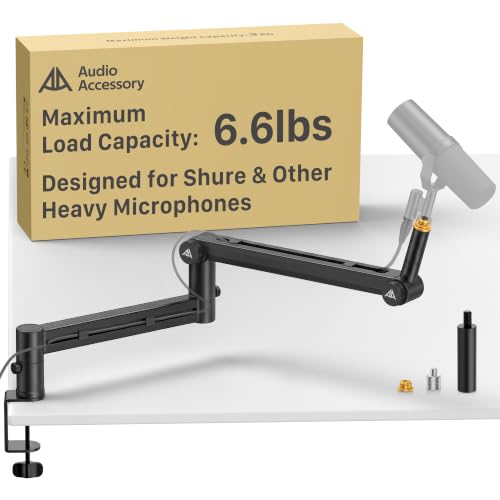
- 6.6 lb load capacity for heavy microphones
- Gear-lock design helps prevent sagging
- 780 mm reach with built-in cable channels
Best For: Shure SM7B owners and heavy studio microphone setups
Professional Studio Choice
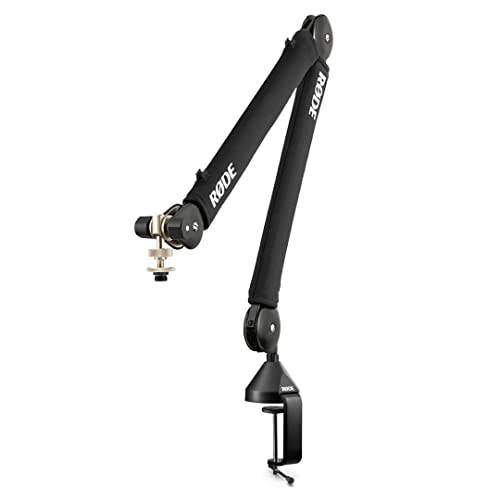
- Quiet internal spring damping
- Supports microphones up to 1.2 kg
- 360° rotation with integrated cable management
Best For: Podcasters and streamers seeking quiet, polished operation
Heavy-Duty Value Pick

- All-metal arm supports up to 2 kg
- Smooth one-hand, creak-free movement
- Cable channels and broad thread compatibility
Best For: Gamers, podcasters, and vocal creators using heavier microphones
Adjustable Low-Profile Option

- Pneumatic damping supports up to 5.5 lb
- 30.2-inch reach with broad adjustment range
- Fits desks up to 3.1 inches thick
Best For: Creators needing compact, adjustable support for heavy mics and accessories
Best Value Heavy-Duty Pick
Adjustable 4.4 lb Mic Boom Arm

- Supports up to 4.4 pounds
- Includes shock mount and pop filter
- Clamp fits desks up to 2.7 inches thick
Best For: Accessory-rich home podcasting and streaming setups
Best Low-Profile Design

- Keeps the arm below the monitor
- Offers 29 inches of reach
- Includes three thread sizes and cable management
Best For: Gaming and streaming desks where screen clearance is important
Best Stable Clamp

- Supports microphones up to 3.3 pounds
- Clamp fits desks up to 2.36 inches thick
- Includes mic clip, adapter, and cable ties
Best For: Stable recording, podcasting, and gaming setups
Best Overhead Reach
High-Riser Microphone Boom Arm

- 31.5-inch riser clears monitors
- Supports microphones up to 2.6 pounds
- Clamp fits desks up to 4.2 inches thick
Best For: Overhead recording and monitor-friendly setups
Best Podmic Kit
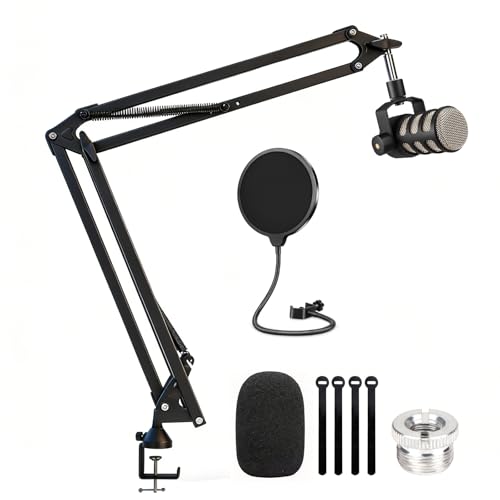
- Supports microphones up to 3.5 pounds
- Designed for Rode PodMic and Shure SM7B setups
- Includes pop filter, foam cover, and adapter
Best For: Heavy dynamic microphones and podcast studios
Top Heavy-Mic Pick – Gear-Lock Low-Profile Mic Arm
If you need a microphone boom arm for heavy mic setups, this low-profile desk mount stands out with a 6.6-pound load rating and a gear-lock mechanism designed to resist sagging. Its long reach, tool-free adjustments, and cable channels suit podcasting, streaming, and studio desks.
Best For: Heavy microphones such as the Shure SM7B, SM7dB, MV7, RØDE PodMic, and Blue Yeti.
Pros:
- Supports up to 6.6 pounds with reinforced aluminum-alloy arms.
- Gear-lock design is intended to stay stable without long-term sagging.
- Offers 780 mm of reach, 360° horizontal rotation, and 120° vertical adjustment.
- Deep cable channels help route multiple cables neatly.
Cons:
- Its 1.63 kg weight may be more than some basic desk arms.
- The low-profile design may provide less vertical height than traditional articulated arms.
For especially heavy microphones, the high load capacity and locking design make this a compelling stability-first option. The included thread adapters also broaden compatibility with common studio microphones.
Professional Studio Choice – RØDE PSA1+ Boom Arm
The RØDE PSA1+ is a practical microphone boom arm for heavy mic users who need smooth, quiet positioning rather than maximum load capacity. Its internal spring damping, 360-degree rotation, and hidden cable management make it well suited to polished podcast and streaming desks.
Best For: Broadcast, podcast, and streaming setups using microphones and shock mounts weighing up to 1.2 kg.
Pros:
- Internal spring damping enables quiet repositioning during recordings.
- Rotates 360 degrees and offers full extension for flexible placement.
- Integrated cable management keeps XLR runs concealed.
- Clamps to desks up to 70 mm thick and includes 3/8-inch and 5/8-inch adapters.
Cons:
- Its 1.2 kg capacity is lower than the other heavy-duty arms in this roundup.
- May not be suitable for very heavy microphones paired with substantial shock mounts.
The PSA1+ prioritizes refined, quiet operation and a clean broadcast appearance. It is a strong choice for moderately heavy microphones, but users with a particularly weighty setup should verify the total microphone-and-accessory weight first.
Heavy-Duty Value Pick – FIFINE BM66 Metal Boom Arm
The FIFINE BM66 is a microphone boom arm for heavy mic setups that combines an all-metal build with a 4.4-pound load rating. Its smooth one-hand movement, protective arm sleeve, and concealed cable channels make it useful for gaming, podcasting, and vocal recording.
Best For: Users who want a sturdy metal arm for microphones such as the Shure SM7B, FIFINE TANK1, Blue Yeti, or RØDE PodMic.
Pros:
- All-metal construction supports up to 2 kg.
- One-hand movement is designed to be smooth and creak-free.
- Built-in channels and rubber covers help organize and protect cables.
- Includes 1/4-inch, 3/8-inch, and 5/8-inch thread support.
Cons:
- The listed version does not include an extension tube.
- Its 180-degree arm extension may offer less positioning range than some 360-degree designs.
With a solid metal construction and straightforward compatibility, the BM66 offers a useful balance of strength and ease of use. It is particularly appealing for creators who want heavy-mic support without a complicated adjustment process.
Adjustable Low-Profile Option – NEEWER MS002 Pneumatic Arm
The NEEWER MS002 is a microphone boom arm for heavy mic applications that uses adjustable pneumatic damping to balance microphones up to 5.5 pounds. Its low-profile format, wide clamp range, and broad adjustment range are useful when desk space and precise positioning matter.
Best For: Creators who want a low-profile arm for heavy microphones, cameras, lights, or monitors.
Pros:
- Adjustable pneumatic balancing supports up to 5.5 pounds.
- Extends horizontally to 30.2 inches and provides 360-degree base rotation.
- Supports 360-degree swivel and 160-degree microphone tilt.
- Fits desks from 0.4 to 3.1 inches thick and includes cable channels.
Cons:
- Damping tension requires hex-key adjustment.
- The arm cannot be fully locked, according to the supplied notes.
- The product listing cautions users to avoid facing the arm while adjusting the pneumatic system.
The MS002 is a flexible choice for users who value a compact desktop footprint and highly adjustable positioning. Its pneumatic system offers useful control for heavier microphones, though it requires more careful setup than a fully locking arm.
Best Value Heavy-Duty Pick – Adjustable 4.4 lb Mic Boom Arm
If you need a microphone boom arm for heavy mic setups without adding separate accessories, this Luling Arts model supports up to 4.4 pounds and includes a shock mount, pop filter, and mounting adapters. Its thicker steel arm tubes and upgraded desk clamp are designed to help keep the microphone positioned without dipping or sinking.
Best For: Podcasters, streamers, and home-studio users who want an accessory-rich arm for compatible microphones weighing up to 4.4 pounds.
Pros:
- Supports microphones up to 4.4 pounds with five-piece steel construction.
- Includes a shock mount, two-screen pop filter, cable ties, and multiple adapters.
- Desk clamp fits surfaces up to 2.7 inches thick and includes an integrated headset hook.
Cons:
- The included shock mount is not designed for Blue Yeti microphones and fits microphones with a 52mm support-hole diameter.
- The included accessories may be unnecessary if you already own a compatible mount and pop filter.
With its broad accessory package and 4.4-pound rating, this is a practical all-in-one option. Confirm your microphone’s mounting requirements before buying, especially if you plan to use the included shock mount.
Highest Load Capacity Pick – Never-Sag 6.6 lb Gear-Lock Arm
For a microphone boom arm for heavy mic models, this gear-lock design offers the highest stated capacity in the group: up to 6.6 pounds. Instead of relying on spring tension, it uses a rigid locking system intended to maintain a set position without the sag associated with some spring-loaded arms.
Best For: Studio users, podcasters, and streamers working with heavier microphones such as the Shure SM7B, SM7dB, MV7 series, Blue Yeti, or Rode PodMic.
Pros:
- Rated to support microphones up to 6.6 pounds.
- Gear-lock mechanism provides rigid positioning with 15-degree adjustment steps.
- Offers 37.4 inches of reach, 360-degree rotation, and built-in cable channels with six clips.
Cons:
- Positioning is less continuously adjustable because the locking system adjusts in 15-degree steps.
- The gear knob must be fully tightened for best stability.
- Its longer reach may be more than smaller desks require.
This is the strongest choice when load capacity and resistance to sag matter most. The mechanical locking system and long reach suit substantial studio microphones, though users should be comfortable making indexed adjustments and tightening the knob securely.
Best Low-Profile Design – FIFINE BM88 Gaming Boom Arm
The FIFINE BM88 is a low-profile microphone boom arm for heavy mic users who want to keep the arm below the monitor. Its all-metal construction, stable C-clamp, hidden cable management, and broad angle adjustment make it well suited to gaming and streaming desks where screen visibility matters.
Best For: Gamers and streamers who want a low-profile arm that preserves monitor visibility and supports common microphone thread sizes.
Pros:
- Low-profile design can extend beneath the bottom of a computer screen.
- Provides up to 29 inches of reach, 220 degrees of vertical adjustment, and 360 degrees of horizontal adjustment.
- Includes 1/4-inch, 3/8-inch, and 5/8-inch thread adapters plus concealed cable management.
Cons:
- The microphone is not included.
- The section nearest the C-clamp cannot be adjusted vertically.
- The clamp fits desks from 0.8 to 2.4 inches thick, so thicker desks may not be compatible.
The BM88 emphasizes desk visibility and tidy cable routing rather than a published maximum microphone weight. It is a sensible choice for compatible gaming or streaming microphones, but verify the desk thickness and microphone hardware before treating it as a heavy-mic solution.
Best Stable Clamp – Heavy-Duty Scissor Boom Arm
If you need a microphone boom arm for heavy mic setups, this model focuses on dependable desk stability and vibration control. Its reinforced clamp fits desks up to 2.36 inches thick, while the suspension arm supports microphones weighing up to 3.3 pounds.
Best For: Recording, podcasting, gaming, and users who want a compact arm with broad microphone compatibility.
Pros:
- Supports up to 3.3 pounds with a strong suspension spring.
- Reinforced clamp helps reduce slipping and protects the desk surface.
- Offers 360-degree rotation, 135-degree reach, and 180-degree vertical tilt.
- Includes a large mic clip, thread adapter, and cable ties.
Cons:
- Clamp opening is limited to desks up to 2.36 inches thick.
- Maximum height is 70 centimeters.
This is a practical choice for heavier microphones when desk space and straightforward adjustment matter. The included adapters and clip make it flexible for popular dynamic and USB microphones.
Best Overhead Reach – High-Riser Microphone Boom Arm
This microphone boom arm for heavy mic setups is designed for overhead positioning, with a 31.5-inch riser that can clear monitors and help preserve screen space. Its steel construction and clamp support microphones up to 2.6 pounds.
Best For: Overhead desk mounting, standing or seated recording, and setups that need extra height over monitors.
Pros:
- 31.5-inch extension riser provides substantial overhead clearance.
- Heavy-duty steel construction and clamps fit desks up to 4.2 inches thick.
- Tool-less joints allow quick height and angle changes.
- Includes multiple thread adapters for microphones such as the SM7B, MV7+, Blue Yeti, and AT2020.
Cons:
- Maximum supported weight is 2.6 pounds, lower than some heavy-duty arms.
- The larger overhead structure may require more desk and vertical space.
Choose this arm when clearance and positioning flexibility are more important than a compact footprint. The tall riser is especially useful for keeping a microphone above a monitor while recording or streaming.
Best Podmic Kit – 3.5-Pound Heavy-Duty Boom Arm
For a microphone boom arm for heavy mic use, this stand offers a 3.5-pound load capacity and reinforced internal springs. It is built for heavier dynamic microphones such as the Rode PodMic and Shure SM7B, with a clamp that fits desks up to 2.75 inches thick.
Best For: Rode PodMic owners, podcast studios, and users who want a high-capacity arm with included audio accessories.
Pros:
- Supports up to 3.5 pounds for heavy microphones.
- Provides 360-degree rotation, 180-degree vertical movement, and 135-degree extension.
- Includes a PodMic foam cover, pop filter, thread adapter, and cable ties.
- Silicone-protected clamp helps grip desks while limiting scratches.
Cons:
- Clamp opening is limited to desks up to 2.75 inches thick.
- Accessories are especially tailored to the Rode PodMic.
- No warranty is listed in the supplied details.
This is the strongest load-capacity option in the group and a compelling package for PodMic users. Its included pop filter and custom foam cover add value, while the adjustable arm supports precise positioning for podcasting and streaming.
How We Picked the Best Microphone Boom Arm for Heavy Mic
We prioritized arms designed to handle heavier microphones and shock mounts without constant repositioning. Our comparison considers stated load capacity, construction, spring or pneumatic damping, clamp strength, adjustment range, and whether the arm supports common 3/8-inch and 5/8-inch microphone threads.
Low-profile designs received extra attention because they keep the workspace clear, while longer or riser-equipped models can be more useful for overhead placement. Features such as cable management, smooth movement, and a broad desk clamp also matter for daily recording and streaming.
Quick Comparison
| Best For | Look For | Main Advantage |
|---|---|---|
| Very heavy microphones | High load rating and rigid joints | Better resistance to sagging |
| Podcasting and studio work | Spring damping and smooth adjustment | Controlled, quiet positioning |
| Gaming and streaming | Low-profile design and cable routing | Cleaner desk space |
| Overhead positioning | Extended reach or riser | More flexible microphone placement |
Key Buying Factors for a Microphone Boom Arm for Heavy Mic
Load Capacity and Sag Control
Check the arm’s rated capacity, but do not count only the microphone’s weight. Include the shock mount, pop filter, cable strain, and any adapter. A model rated around 6.6 pounds offers more useful headroom for demanding setups than an arm that barely supports the microphone itself. Locking joints, tension controls, or reinforced sections can further reduce sag.
Clamp and Desk Compatibility
Measure your desk thickness and check for a solid underside before buying. A wide, metal clamp distributes pressure better than a small contact plate, while a reinforcement pad can protect softer surfaces. Avoid mounting a heavy arm to glass, hollow panels, or desks with weak edges unless the manufacturer specifically permits it.
Reach, Rotation, and Adjustment
Confirm that the arm can reach your preferred speaking position without extending beyond the desk. A 360-degree rotating base is useful, but joint range and vertical travel matter just as much. Pneumatic or spring-damped systems typically make repositioning smoother, while low-profile arms are better when you want the microphone close to the desk.
Thread Adapters and Cable Management
Most microphones use either 3/8-inch or 5/8-inch mounting threads, so verify that the required adapter is included. Built-in cable channels or clips help prevent cable drag from pulling the arm downward and keep the setup tidy.
Who Should Buy Which Microphone Boom Arm for Heavy Mic?
Choose a high-capacity, locking arm if you use a Shure SM7B, RØDE PodMic, or a heavy shock mount and want maximum resistance to sag. Pick a spring-damped studio arm for frequent recording sessions where quiet, precise adjustments are important. A low-profile arm suits streamers and gamers who need clear monitor and keyboard space. If your microphone must sit above the desk or move across a large workspace, select an extended or riser-equipped model.
Before ordering, compare the arm’s capacity with your complete microphone assembly, measure the desk, and confirm the thread adapter. Those checks usually matter more than appearance or the number of included accessories.