US Christian population trends statistics show a long-run decline in Christian identification since the 2000s, alongside evidence that the drop has slowed in recent years (depending on the survey and methodology).
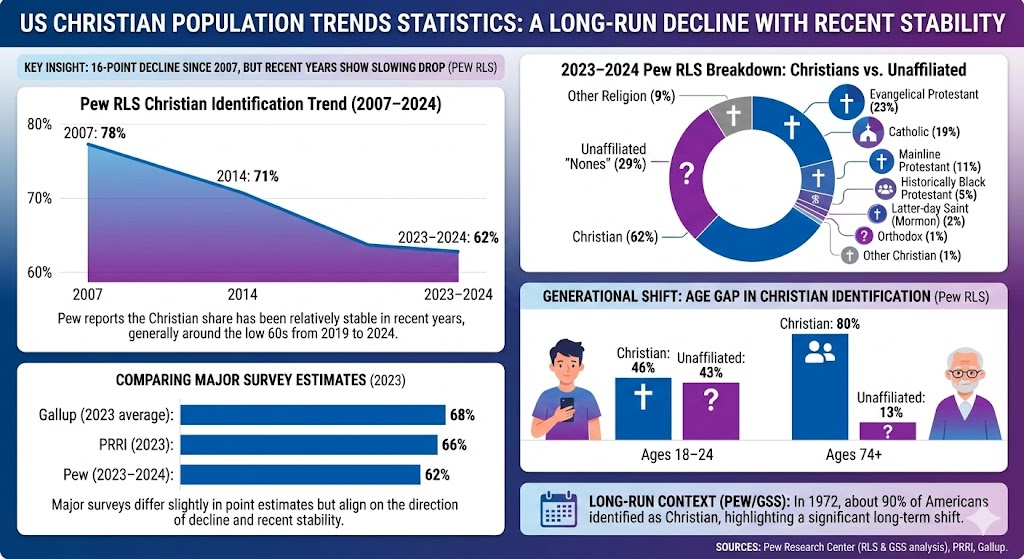
US Christian Population Trends (Top Highlights)
- Pew Research Center’s 2023–2024 Religious Landscape Study (RLS) estimates 62% of U.S. adults identify as Christian.
- Pew’s RLS trend shows 78% Christian (2007), 71% (2014), and 62% (2023–2024), a 16-point decline since 2007.
- Pew reports the Christian share has been relatively stable in recent years, generally around the low 60s from 2019 to 2024.
- In Pew’s latest RLS, 29% of U.S. adults are religiously unaffiliated (“nones”).
- Pew’s latest RLS estimates Christians as roughly 40% Protestant, 19% Catholic, and about 3% other Christian groups.
- Pew’s latest RLS shows a large age gap: 46% of ages 18–24 identify as Christian vs. 80% of ages 74+.
- Pew reports 80% of U.S. adults say they were raised Christian, and 22% of all U.S. adults were raised Christian but no longer identify as Christian.
- PRRI’s 2023 Census of American Religion estimates 66% Christian and 27% unaffiliated.
- Gallup’s 2023 average finds 68% of Americans identify as Christian.
- For long-run context, Pew (drawing on the General Social Survey) notes that in 1972, about 90% of Americans identified as Christian.
Christian Identification Trend (Pew RLS: 2007 vs. 2014 vs. 2023–2024)
Pew’s large Religious Landscape Studies provide a widely used benchmark for how Christian identification has changed over time.
| Label | Bar | Value |
|---|---|---|
| 2007 | 78% | |
| 2014 | 71% | |
| 2023–2024 | 62% |
Max = 78%. Widths: 2007 100.00%, 2014 91.03%, 2023–2024 79.49%.
Several major surveys also indicate that while Christian identification has fallen over the long term, year-to-year changes have been smaller recently than they were in the early 2010s.
Denomination Mix in the Latest Pew Religious Landscape Study
Pew’s latest RLS shows Evangelical Protestants and Catholics as the two largest Christian groups, followed by Mainline Protestants and Historically Black Protestant traditions.
| Label | Bar | Value |
|---|---|---|
| Evangelical Protestant | 23% | |
| Catholic | 19% | |
| Mainline Protestant | 11% | |
| Historically Black Protestant | 5% | |
| Latter-day Saint (Mormon) | 2% | |
| Orthodox Christian | 1% | |
| Other Christian | 1% |
Max = 23%. Widths: Evangelical Protestant 100.00%, Catholic 82.61%, Mainline Protestant 47.83%, Historically Black Protestant 21.74%, Latter-day Saint (Mormon) 8.70%, Orthodox Christian 4.35%, Other Christian 4.35%.
Generational Shift: Younger Adults Are Much Less Likely to Identify as Christian
One of the clearest drivers of change is age: younger adults are substantially less likely to identify as Christian and more likely to be unaffiliated than older cohorts.
- Pew RLS: 46% of ages 18–24 identify as Christian vs. 80% of ages 74+.
- Pew RLS: 43% of ages 18–24 are unaffiliated vs. 13% of ages 74+.
Different Surveys, Different Totals (But Similar Direction)
Major surveys often produce slightly different estimates because of sampling, question wording, and weighting, but they generally align on the same direction over time.
| Label | Bar | Value |
|---|---|---|
| Gallup (2023 average) | 68% | |
| PRRI (2023) | 66% | |
| Pew (2023–2024) | 62% |
Max = 68%. Widths: Gallup (2023 average) 100.00%, PRRI (2023) 97.06%, Pew (2023–2024) 91.18%.
Even where point estimates differ, the shared takeaway is that the U.S. has a smaller Christian share than it did in the 2000s, and a larger unaffiliated share.
Sources
- Pew Research Center, “Decline of Christianity in the U.S. Has Slowed, May Have Leveled Off” (Religious Landscape Study reporting). https://www.pewresearch.org/religion/
- Pew Research Center, Religious Landscape Study interactive database. https://www.pewresearch.org/religious-landscape-study/
- PRRI, 2023 PRRI Census of American Religion. https://prri.org/research/census-2023-american-religion/
- Gallup, “How Religious Are Americans?” https://news.gallup.com/poll/358364/religious-americans.aspx
- Pew Research Center, “How U.S. religious composition has changed in recent decades” (GSS-based context). https://www.pewresearch.org/religion/