Choosing the right wireless video receivers for a multi-camera setup means balancing range, latency, image quality, receiver capacity, and installation simplicity. The best systems can distribute a camera feed to several displays without forcing you to run long HDMI or SDI cables.
This roundup compares ten options ranging from straightforward 1080p multi-TV extenders to professional 4K wireless video systems with dual-band transmission, loop-through outputs, and camera-control features.
Best 10 Wireless Video Receivers for Multi Camera Setups Picks for 2026
Best All-in-One Monitoring Hub
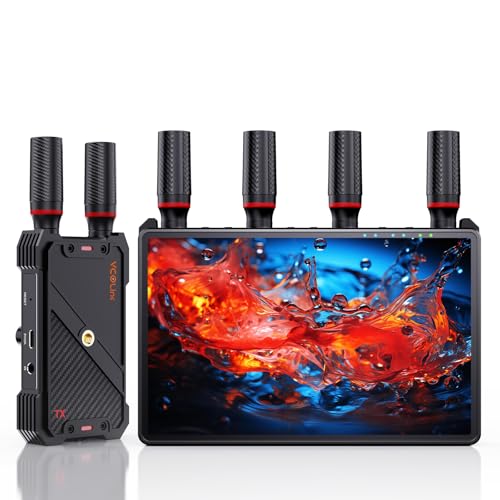
- Built-in 7-inch monitor
- Supports up to five receivers
- 1080p60 with HDMI loop-out
Best For: Film crews and live events needing shared monitoring
Best Multi-TV Value
Dual-Receiver Wireless HDMI Kit

- Includes two receivers
- Expandable to six receivers
- 165-foot open-range claim
Best For: Multi-screen homes, classrooms, and venues
Best Professional Production Pick

- 4K30 and 1080p60 support
- Up to four receivers
- UVC live streaming and loop-out
Best For: Film, broadcast, and live-streaming crews
Best Plug-and-Play Expansion

- Includes four receivers
- Expandable to eight receivers
- 1080p output with 4K decoding
Best For: Multi-display camera and presentation setups
Long-Range Pick
Vrriis 1080p Wireless HDMI System

- 1,300-foot claimed open-field range
- Loop out and dual receiver HDMI outputs
- Supports up to five receivers
Best For: Long-distance Full HD monitoring
Multi-Display Value
WELUSOPU HDMI Transmitter with 4 Receivers

- Includes four receivers
- Supports up to six displays
- 4K input with 1080p output
Best For: Short-to-medium-range multi-screen distribution
Best for Comfort

- 4K HDMI and 1080p 3G-SDI support
- Up to five monitoring destinations
- Camera-control and app-monitoring features
Best For: Professional film and live-production monitoring
Top Multi-Display Pick

- One transmitter supports up to six receivers
- LED status display simplifies setup and troubleshooting
- 1080p at 60Hz output from 4K input decoding
Best For: Synchronized home, office, and commercial multi-screen displays
Best Four-Display Bundle
G9R Pro Wireless HDMI Extender

- Includes one transmitter and four receivers
- Pre-paired plug-and-play operation
- 1080p at 60Hz with 165-foot open-area range
Best For: Four-screen presentations, classrooms, events, and commercial spaces
Best Portable Option
G7R Pro Multi-TV Wireless HDMI Kit

- Portable kit includes one transmitter and four receivers
- Pre-paired dual-band operation needs no Wi-Fi or apps
- 1080p at 60Hz with listed 0.1-second latency
Best For: Mobile presentations and temporary multi-display setups
Best All-in-One Monitoring Hub – 7" Multi-Receiver HDMI System
For crews comparing wireless video receivers for multi camera setups, this system stands out by combining a built-in 7-inch monitor with support for up to five receivers. It delivers 1080p at 60Hz, supports HDMI loop-out, and offers a claimed 1,312-foot line-of-sight range with less than 0.05-second latency.
Best For: Film crews, studios, and live-event teams that need several viewers plus built-in monitoring.
Pros:
- Built-in 7-inch screen reduces the need for an additional monitor.
- One transmitter can broadcast to up to five receivers.
- Supports HDMI output, loop-out, IR remote control, and multiple power options.
- Offers 1080p60 transmission and a claimed 1,312-foot line-of-sight range.
Cons:
- The stated long range depends on line-of-sight conditions.
- An HDMI cable is required for external-display output and is not included.
- Smartphone or tablet use requires a Type-C-to-HDMI cable.
Its integrated display and expandable receiver design make it a practical collaboration tool when multiple crew members need to monitor the same feed without assembling separate monitoring equipment.
Best Multi-TV Value – Dual-Receiver Wireless HDMI Kit
This kit is a flexible option for wireless video receivers for multi camera setups when the goal is sending one HDMI source to several displays. It includes one transmitter and two receivers, supports expansion to as many as six receivers, and uses dual-band 2.4GHz/5.8GHz transmission over a claimed 165 feet in open environments.
Best For: Homes, classrooms, conference rooms, churches, bars, and other spaces using multiple TVs or projectors.
Pros:
- Includes two receivers and can expand to up to six large screens.
- Supports laptops, cameras, consoles, set-top boxes, and other HDMI sources.
- Includes USB-C-to-HDMI, micro-HDMI, and mini-HDMI accessories.
- Plug-and-play design with dual-band wireless transmission.
Cons:
- Transmission distance may drop to about 50 feet through walls.
- It cannot transmit from one TV to another TV.
- Apple TV output must be set to 1080p at 60Hz for use with the kit.
With two receivers included and additional units available separately, this is a sensible choice for distributed displays where simple setup matters more than professional production features.
Best Professional Production Pick – Hollyland Pyro H 4K System
For production teams seeking wireless video receivers for multi camera setups, the Hollyland Pyro H adds professional-oriented features to a 4K-capable system. It supports transmission to up to four receivers, offers HDMI input, output, and loop-out, and includes smart channel scanning across 2.4GHz and 5GHz bands.
Best For: Film production, live streaming, ENG/EFP work, and teams needing coordinated on-set monitoring.
Pros:
- Supports video input and output up to 4K30, plus 1080p60.
- Transmits to up to four receivers for multi-user monitoring.
- Claims up to 1,300 feet of range and 60ms latency.
- Includes Hollyview app support, HDMI loop-out, and UVC live streaming.
Cons:
- This package includes only one transmitter and one receiver.
- The listed 1,300-foot range is a maximum claim for suitable conditions.
- Its 4K transmission support is specified at up to 30 frames per second.
Smart channel scanning, app-based monitoring, and UVC support give the Pyro H a broader workflow than basic HDMI extenders, especially for crews balancing production monitoring with live-streaming needs.
Best Plug-and-Play Expansion – 4-Receiver Multi-TV Extender
This upgraded wireless HDMI extender is designed for multi-display distribution, making it useful when evaluating wireless video receivers for multi camera setups. It includes four receivers, supports expansion to as many as eight, and sends 1080p output over a claimed 165-foot range using 2.4GHz and 5GHz dual-band transmission.
Best For: Users who want to mirror a camera, laptop, or other HDMI source across several TVs or monitors with minimal setup.
Pros:
- Includes four receivers and supports up to eight receivers total.
- Promises plug-and-play connection without Wi-Fi, apps, or Bluetooth.
- Decodes up to 4K while outputting 1080p video.
- Includes mini-HDMI and USB-C-to-HDMI connectivity accessories.
Cons:
- Output is specified as 1080p even though decoding supports up to 4K.
- The 165-foot distance is a stated maximum and can vary by environment.
- Stable 5V/1A power and attached antennas are required for proper operation.
Its generous receiver count and straightforward pairing make this a strong fit for synchronized displays, particularly when you prefer a dedicated wireless link instead of app-based casting.
Long-Range Pick – Vrriis 1080p Wireless HDMI System
For buyers comparing wireless video receivers for multi camera setups, the Vrriis system stands out for its long stated range, loop-out monitoring, and support for up to five receivers. It is a practical fit when you need Full HD HDMI distribution without adding network software or extensive configuration.
Best For: Long-distance 1080p monitoring from a camera, laptop, set-top box, or other HDMI source.
Pros:
- Claimed 1,300-foot open-field transmission range with dual antennas and 2.4/5G transmission.
- 1080p at 60Hz with stated 0.05-second latency.
- Transmitter loop out, dual HDMI output on the receiver, IR support, and multiple power options.
- Can switch between up to one transmitter and five receivers.
Cons:
- Walls, metal, brick, and glass can substantially reduce range.
- Batteries are not included.
- Transmission distance decreases as additional receivers are added.
This is a flexible Full HD solution for distributed monitoring, especially where cable runs are inconvenient. Its multi-receiver capability is useful, but the advertised range should be treated as an unobstructed, open-field figure.
Multi-Display Value – WELUSOPU HDMI Transmitter with 4 Receivers
The WELUSOPU kit is designed for wireless video receivers for multi camera setups and other multi-display installations, bundling one transmitter with four receivers. Its dual-band transmission, plug-and-play setup, and support for up to six receivers make it convenient for classrooms, conference spaces, venues, and home theaters.
Best For: Mirroring one HDMI source across several displays over short-to-medium open-space distances.
Pros:
- Includes four receivers and supports up to six receivers simultaneously.
- Supports 4K input and 1080p output with stereo audio.
- Uses 2.4G/5.8G dual bands, auto frequency hopping, and a stated range up to 165 feet.
- Plug-and-play design requires no Bluetooth, Wi-Fi, or app for the core screen-sharing setup.
Cons:
- Output is limited to 1080p even when the source input is 4K.
- The stated 165-foot range applies to open spaces and may vary with interference.
- Mobile-device monitoring uses an app and supports mirroring only, without reverse control.
With four receivers included, this is one of the more straightforward choices for distributing a single feed to several screens. It is less suited to long-range outdoor links, but its receiver count and broad HDMI compatibility offer strong installation flexibility.
Best for Comfort – Accsoon CineView SE 4K
For professional wireless video receivers for multi camera setups, the Accsoon CineView SE 4K adds 4K support, HDMI and 3G-SDI connectivity, camera-control features, and monitoring through compatible receivers or mobile devices. Its long claimed range and low latency make it appropriate for film, live production, and other demanding monitoring workflows.
Best For: Filmmakers and production teams needing 4K/1080p wireless monitoring with compatible camera control.
Pros:
- Supports 4K input/output through HDMI and 1080p through 3G-SDI or HDMI.
- Claims up to 1,312 feet of range, with latency down to 0.05 seconds at 1080p.
- One transmitter can connect to up to four wireless destinations plus one wired USB-C video connection.
- Supports compatible camera-control functions and Accsoon SEE app monitoring.
Cons:
- 4K latency is stated at 0.1 seconds, higher than the 1080p figure.
- Mobile and receiver compatibility is specific; Mac and PC computers are not supported for the listed monitoring connection.
- USB-C video output does not support UVC capture or computer webcam input.
This is the most production-focused option in the group, particularly for users who need SDI, 4K, and camera-control capabilities. Check camera, receiver, mobile-device, and cable compatibility carefully before purchasing.
Top Multi-Display Pick – 6-Screen Wireless HDMI Kit
For wireless video receivers for multi camera setups, this kit stands out when you need one HDMI source distributed across several displays. It includes one transmitter and two receivers, supports up to six receivers, and delivers 1080p at 60Hz from 4K input decoding.
Best For: Home entertainment, office presentations, video conferences, and commercial displays requiring synchronized screens.
Pros:
- One transmitter can connect with up to six receivers for multi-screen expansion.
- LED displays show connection status, signal strength, output mode, and power information.
- Supports 1080p at 60Hz with up to 100 meters of line-of-sight transmission according to the listing.
- Includes a carrying case and works with HDMI devices such as cameras, laptops, projectors, and game consoles.
Cons:
- Both transmitter and receivers require wired 5V/2A power.
- Walls and other obstacles can reduce range and transmission speed.
- The output is 1080p even though the system accepts 4K input.
The built-in status display makes this a practical choice for setups where quick troubleshooting matters. It is especially useful when you want synchronized output across multiple screens without adding HDMI cables.
Best Four-Display Bundle – G9R Pro Wireless HDMI Extender
Among wireless video receivers for multi camera setups, the G9R Pro is a convenient bundle for sending one HDMI source to four screens at once. Its pre-paired transmitter and receivers use dual-band 2.4GHz and 5.8GHz transmission and support 1080p at 60Hz.
Best For: Conference rooms, classrooms, churches, restaurants, banks, and presentations using four simultaneous displays.
Pros:
- Includes one transmitter and four receivers for immediate four-screen expansion.
- Pre-paired, plug-and-play setup requires no apps, drivers, Wi-Fi, or Bluetooth.
- Offers a listed 165-foot range in open areas and ultra-low 0.1-second latency.
- Includes a USB-C-to-HDMI adapter for compatible newer laptops.
Cons:
- The transmitter must connect to an HDMI output device, not directly to a TV.
- Transmission through walls is listed at about 50 feet, and barriers can affect performance.
- The transmitter supports 1080p output only, despite receiver-side 4K decoding support.
This bundle is a strong fit when four displays are the immediate goal and fast installation is more important than advanced configuration. Its heat-control technology and dual-band operation are useful for longer presentations or events.
Best Portable Option – G7R Pro Multi-TV Wireless HDMI Kit
If portability matters in wireless video receivers for multi camera setups, the G7R Pro combines four receivers with a compact design intended for mobile users and temporary events. It supports dual-band transmission, 1080p at 60Hz, and a listed 165-foot open-area range.
Best For: Mobile presentations, classrooms, churches, conference rooms, restaurants, home theaters, and temporary multi-display installations.
Pros:
- Portable four-receiver kit can support up to six screens with additional compatible connections.
- Pre-paired operation needs no app, driver, or Wi-Fi network.
- Provides 1080p at 60Hz with listed 0.1-second latency.
- Includes a USB-C-to-HDMI adapter and heat-control technology.
Cons:
- The listed 165-foot range applies to open environments without barriers.
- Through-wall transmission is listed at up to 50 feet and may be reduced by thick walls or obstacles.
- Both transmitter and receivers require a USB 5V/1A power source.
The G7R Pro is a practical choice when the system needs to move between rooms or venues. Its included adapter broadens compatibility with newer laptops, while the receiver count keeps multi-TV deployments straightforward.
How We Picked the Best Wireless Video Receivers for Multi Camera Setups
We focused on systems that support multiple receivers from one transmitter, since that is the core requirement for multi-camera monitoring and multi-display installations. We also considered advertised transmission range, supported input and output resolutions, latency, signal stability, receiver expansion limits, and whether the system includes useful features such as HDMI loop-out, dual-band operation, status displays, or SDI connectivity.
Specifications can vary with walls, interference, line of sight, and connected equipment. Treat stated range as an ideal maximum rather than a guaranteed indoor distance.
Quick Comparison
- Best for professional camera workflows: Hollyland Pyro H and Accsoon CineView SE 4K, with higher-end video formats and more production-oriented features.
- Best for multi-TV distribution: The four-receiver and six-receiver HDMI kits, which are designed to send one source to several screens.
- Best for simple 1080p installations: Plug-and-play systems with dedicated receivers, loop-out ports, and straightforward HDMI connections.
- Best for longer advertised range: Models listing ranges around 1,300 feet, although real-world performance depends heavily on obstacles and wireless congestion.
Key Buying Factors for Wireless Video Receivers for Multi-Camera Setups
Receiver Capacity and Expansion
Check the maximum number of receivers supported by one transmitter. A two-receiver kit may suit a small monitoring station, while a four- or six-receiver system provides more flexibility for production control rooms, classrooms, conference spaces, and distributed displays. Confirm whether additional receivers are sold separately and whether every receiver can display the same source simultaneously.
Resolution, Refresh Rate, and Compatibility
“4K input” does not always mean 4K output. Some extenders accept a 4K signal but deliver 1080p to remote displays. Match the system to your cameras, switchers, monitors, and recorders, and verify support for the refresh rate you use. Professional cameras may also require SDI, HDMI format compatibility, or reliable handling of 1080p60.
Latency and Signal Reliability
Low latency matters for live switching, directing, sports, presentations, and camera operators who need immediate feedback. Dual-band systems can help manage interference, while line-of-sight placement generally improves reliability. Loop-out is valuable because it lets you keep a local monitor connected while transmitting wirelessly to remote receivers.
Range, Power, and Installation
Measure the actual distance between cameras, transmitter locations, and displays, including walls and floors. Review how each unit is powered and whether receivers can be mounted conveniently behind monitors. Compact plug-and-play kits are easier to deploy, while professional systems may offer stronger performance but require more careful configuration.
Who Should Buy Which Wireless Video Receivers for Multi Camera Setups?
Choose a multi-receiver HDMI extender if your priority is sending one camera, laptop, or switcher output to several televisions with minimal setup. These are practical for events, signage, training rooms, and home or business installations.
Choose a professional 4K wireless system if you are producing live video, need better format support, or want a more dependable workflow for cinema, broadcast, or event production. Look closely at latency, monitoring options, and SDI or HDMI connectivity.
Choose a longer-range 1080p system when remote viewing distance matters more than native 4K output. For any option, test the complete setup before a live production and keep a wired backup available for critical shoots.