Choosing among wireless video receivers for beginners can be difficult when product listings emphasize different ranges, resolutions, and wireless bands. The right model depends on how far the signal must travel, which HDMI sources and displays you use, and whether you need one receiver or several.
This roundup focuses on practical setup, dependable picture transmission, latency, audio support, and useful extras such as loop-out ports, remote controls, and multi-receiver compatibility. Use the guide below to narrow the options before comparing the individual products.
Best 10 Wireless Video Receivers for Beginners Picks for 2026
Best Plug-and-Play Pick

- No Wi-Fi, Bluetooth, or app required
- 4K@30Hz receiver support
- Includes mini- and micro-HDMI adapters
Best For: Simple home, classroom, meeting, and gaming setups
Best for Camera Monitoring
SYNCO XVision Wireless HD System

- 1080P/60fps transmission with 40ms latency
- Up to 300m claimed range
- Fanless 2W design with automatic pairing
Best For: Camera shoots, live events, and team monitoring
Best Long-Range Value
Upgraded 328FT Wireless HDMI Kit

- Up to 328 feet in open conditions
- Plug-and-play setup without Wi-Fi or apps
- 1080P/60Hz output with 4K decoding
Best For: Presentations, classrooms, home theaters, and outdoor use
Best for Multi-Display Monitoring

- Loop-out and dual receiver HDMI outputs
- IR remote extension for source control
- Multiple power options, including NP-F batteries
Best For: Camera monitoring, multi-display, and multi-room setups
Easy Setup Pick
Compact 1080p Wireless HDMI Extender

- Plug-and-play connection without Wi-Fi or apps
- 1080p/60Hz output with 4K decoding
- Portable design with Micro and Mini HDMI adapters
Best For: Beginners needing simple wireless HDMI for presentations, classrooms, or home viewing
Multi-Display Pick

- One transmitter sends to two receivers
- Supports 1080p/60Hz and 4K decoding
- Direct 2.4G/5G connection without apps or drivers
Best For: Beginners building two-screen presentations, classroom, meeting-room, or home-theater setups
Long-Range Upgrade
4K Wireless HDMI Transmission System

- UHD 4K/30Hz transmission with H.265 encoding
- Pre-paired setup with under-0.1-second stated latency
- Up to 1,150 feet open-field range and multi-receiver expansion
Best For: Beginners seeking a longer-range 4K link for home theater, cameras, projectors, or expandable displays
Best Long-Range Pick
Futureagle S8 Wireless HDMI Kit

- Pairs in about three seconds without Wi-Fi or apps
- 328-foot open-space range with 1080p/60Hz output
- LED status display and included device adapters
Best For: Beginners needing simple, long-distance home or office streaming
Best for On-Set Monitoring
Wireless HDMI Kit with 7-Inch Receiver
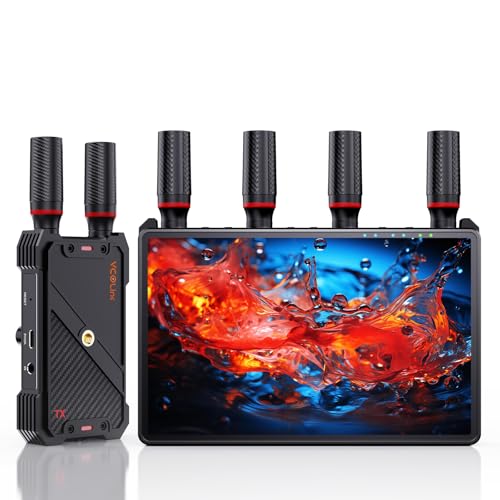
- Built-in 7-inch monitor reduces extra equipment
- Up to five receivers can share one transmitter
- Loop out, IR control, and flexible portable power
Best For: Beginner filmmakers and streamers needing portable real-time monitoring
Best for Flexible Home Setups
Dual-Band 110M Wireless HDMI Extender

- 360-foot open-space range with dual-band transmission
- Supports mirror and extended-screen modes
- One receiver can connect with up to eight transmitters
Best For: Beginners building adaptable home, classroom, or event setups
Best Plug-and-Play Pick – AIMIBO 4K Wireless HDMI Kit
For beginners comparing wireless video receivers for beginners, the AIMIBO kit is a straightforward option for sending video and audio from laptops, TV boxes, game consoles, and other HDMI sources to a TV, projector, or monitor. It requires no Wi-Fi, Bluetooth, or app, and supports up to 4K at 30Hz on the receiver.
Best For: Home theaters, classrooms, meetings, gaming, and users who want simple wireless HDMI mirroring.
Pros:
- Plug-and-play setup with no network or app required.
- Supports 4K@30Hz on the receiver and 1080P@60Hz transmission.
- Up to 165 feet in a barrier-free environment, with 2.4GHz/5GHz dual-band support.
- Includes mini-HDMI and micro-HDMI adapters and can pair up to eight transmitters with one receiver.
Cons:
- Range can drop to about 32 feet through walls or floors.
- The receiver’s 4K support is limited to 30Hz.
- The transmitter and receiver must be distinguished during setup.
This is a flexible beginner-friendly kit with useful adapters and multi-transmitter support. Its simple setup and broad application range make it a practical choice when convenience matters more than professional production features.
Best for Camera Monitoring – SYNCO XVision Wireless HD System
The SYNCO XVision is aimed at camera users who need a wireless monitor feed. Among wireless video receivers for beginners, its color display, automatic memory pairing, compact design, and 40ms latency help make real-time monitoring easier to manage.
Best For: Camera operators, interviews, weddings, live music, drone work, and small production teams.
Pros:
- Transmits 1080P video at 60fps with claimed 40ms latency.
- Supports transmission up to 300 meters in suitable conditions.
- Fanless 2W design helps reduce operating noise and power use.
- Receiver supports real-time monitoring for up to nine endpoints, while the transmitter provides HDMI loop-out.
Cons:
- NP-F battery is not included.
- Designed around cameras, video recorders, and monitors rather than general home entertainment devices.
- Its feature set may be more than needed for basic TV-to-projector use.
Beginners moving into camera monitoring may appreciate the status display and automatic pairing. The system is especially compelling for longer-range shoots and collaborative monitoring, though buyers should budget for compatible power options.
Best Long-Range Value – Upgraded 328FT Wireless HDMI Kit
This upgraded wireless HDMI kit offers a beginner-friendly way to connect a laptop, camera, TV box, or compatible mobile device to a larger display. It uses plug-and-play pairing without Wi-Fi, Bluetooth, or an app, while supporting 1080P at 60Hz and a claimed range of up to 328 feet in open conditions.
Best For: Home theaters, business presentations, classrooms, churches, and outdoor gatherings needing an extended wireless link.
Pros:
- Simple setup that establishes a connection in under 10 seconds according to the supplied notes.
- Claims up to 328 feet of transmission range in suitable conditions.
- Supports 1080P/60Hz output and 4K decoding.
- Includes a 12-month quality replacement guarantee.
Cons:
- Walls and other obstacles can reduce range and signal stability.
- Both TX and RX require power through the included USB-to-USB-C cables.
- Mobile compatibility is limited to specified newer devices, and the source must support HDMI output.
The kit is a sensible choice for beginners who prioritize distance and uncomplicated setup. Its power requirements are important to plan for, but the 1080P/60Hz capability suits presentations, lessons, and everyday viewing.
Best for Multi-Display Monitoring – Vrriis 1080P Wireless System
The Vrriis WL082 combines wireless 1080P video transmission with loop-out, dual receiver HDMI outputs, IR control, and several power options. For beginners exploring wireless video receivers for beginners, it is a versatile choice when a setup needs local monitoring or more than one display.
Best For: DSLR and camera users, sports or gaming displays, multi-room setups, and installations requiring remote source control.
Pros:
- Supports 1080P at 60Hz with claimed 0.05-second latency.
- Transmitter loop-out supports a local monitor, while the receiver can connect two screens.
- IR extension allows remote commands to reach the HDMI source.
- Supports NP-F batteries, USB-C power, adapters, and portable power banks.
Cons:
- The advertised 1300-foot range applies to open, interference-free conditions and can be reduced by walls or other materials.
- Batteries are not included.
- Adding receivers can reduce transmission distance.
This system offers more installation and monitoring flexibility than a basic wireless HDMI pair. Its loop-out, IR support, and multiple power choices are useful for more involved setups, though beginners should expect a little more configuration than with a minimal plug-and-play kit.
Easy Setup Pick – Compact 1080p Wireless HDMI Extender
For beginners comparing wireless video receivers for beginners, this compact HDMI transmitter-and-receiver kit keeps setup straightforward: connect both units to power, plug them into the source and display, and transmit without Wi-Fi, an app, or Bluetooth. It supports 1080p at 60Hz and can decode 4K sources.
Best For: Presentations, classrooms, home theaters, church displays, and portable setups where simple 1080p wireless HDMI is the priority.
Pros:
- Plug-and-play operation without software, Wi-Fi, or Bluetooth.
- Supports 1080p/60Hz output, duplicate mode, and extended mode.
- Rated for up to 328 feet outdoors and 165 feet indoors, with dual-band transmission.
- Compact 0.3-pound design includes Micro HDMI and Mini HDMI adapters.
Cons:
- Both the transmitter and receiver need separate power connections.
- Walls and other obstacles can reduce range and transmission speed.
- Output is limited to 1080p even though the system supports 4K decoding.
This is a practical entry point for beginners who want a no-app wireless HDMI setup and do not need native 4K output. Its portable size and broad source compatibility add flexibility for work or home use.
Multi-Display Pick – Dual-Receiver 1080p HDMI Kit
This dual-receiver kit is a useful choice for beginners comparing wireless video receivers for beginners who need one source displayed in two locations. The transmitter and two receivers use a direct 2.4G/5G connection, require no drivers or Wi-Fi, and support smooth 1080p at 60Hz.
Best For: Multi-screen presentations, classrooms, meeting rooms, churches, home theaters, bars, and restaurants.
Pros:
- Includes one transmitter and two receivers for simultaneous viewing on two displays.
- Supports 4K decoding and 1080p/60Hz playback.
- Plug-and-play design needs no software, drivers, Wi-Fi, or Bluetooth.
- Includes Micro HDMI and Mini HDMI adapters and supports up to six connected displays according to the supplied notes.
Cons:
- Transmission through walls may be limited to about 100 feet.
- Each transmitter and receiver requires an independent 5V/1A-or-higher USB power supply.
- TV-to-TV transmission is not supported.
The included second receiver is the main reason to choose this model. It reduces the need to buy another receiver for a two-screen setup, while its plug-and-play design keeps the learning curve manageable for first-time users.
Long-Range Upgrade – 4K Wireless HDMI Transmission System
For beginners who want more headroom than a basic wireless video receiver, this pre-paired system combines plug-and-play setup with UHD 4K transmission at up to 30Hz. It uses dual antennas and 2.4G/5G transmission, while its stated latency of less than 0.1 seconds suits presentations and general entertainment.
Best For: Long-distance home theater links, DSLR or laptop streaming, projectors, TVs, and setups that may expand to multiple receivers.
Pros:
- Supports UHD 4K at 30Hz with H.265 encoding and synchronized audio.
- Pre-paired, plug-and-play operation with no apps or drivers.
- Rated for up to 1,150 feet in an open field without interference.
- Receiver includes dual HDMI outputs, and the system can support up to four receivers; it also provides a 3.5mm audio output.
Cons:
- Walls, metal, brick, and glass can significantly reduce coverage.
- 4K support is limited to 30Hz.
- Adding receivers can shorten the wireless transmission distance.
This model is the most capable option here for users planning a 4K setup or a longer wireless link. Its broader expansion and audio-output features are useful, but beginners should account for environmental obstacles and the system’s 4K/30Hz limit.
Best Long-Range Pick – Futureagle S8 Wireless HDMI Kit
For beginners comparing wireless video receivers for beginners, the Futureagle S8 is a straightforward option for sending video and audio from an HDMI source to a monitor or projector. It pairs automatically in about three seconds without Wi-Fi, apps, Bluetooth, or a complicated setup, while its display helps you check connection status and signal strength.
Best For: Home offices, presentations, classrooms, home theaters, and basic surveillance monitoring where long range and simple setup matter.
Pros:
- Up to 328 feet of wireless coverage in open space.
- Decodes 4K content and outputs 1080p at 60Hz.
- Supports mirror and extended-display modes, plus a transmission cutoff button.
- Includes Mini/Micro HDMI adapters and a USB-C extension cable.
Cons:
- Actual range can be affected by walls and other obstacles.
- Output is limited to 1080p at 60Hz rather than 4K output.
- Designed around HDMI-equipped source and display devices.
The LED status display and plug-and-play pairing make this a beginner-friendly choice, especially if you want a long cable-free reach without adding software or network configuration.
Best for On-Set Monitoring – Wireless HDMI Kit with 7-Inch Receiver
Among wireless video receivers for beginners, this kit stands out because the receiver includes its own 7-inch monitor. That lets you start monitoring without buying a separate screen, while HDMI output, loop out, remote control, and multiple power options add flexibility for filming and live production.
Best For: Camera operators, small film crews, live-streaming setups, and users who need portable monitoring with the option to share the feed on larger displays.
Pros:
- Built-in 7-inch HD screen with brightness, volume, headphone, and sleep controls.
- Claims 1080p at 60Hz transmission up to 1,312 feet in line of sight with under 0.05-second latency.
- One transmitter can broadcast to up to five receivers.
- Supports loop out, IR remote control, tripod or rig mounting, and NP-F, power-bank, or USB-C power.
Cons:
- External HDMI cable for the larger display is not included.
- Smartphone and tablet use requires a USB-C-to-HDMI cable.
- Its production-focused features may be more than casual home users need.
The integrated screen makes this a practical all-in-one solution for beginners who want immediate visual feedback, while the multi-receiver design leaves room to expand a small production workflow.
Best for Flexible Home Setups – Dual-Band 110M Wireless HDMI Extender
For beginners shopping for wireless video receivers for beginners, this dual-band extender offers automatic pairing and a broad range of supported uses. It can decode 4K input for 1080p/60Hz output, supports duplicate and extended displays, and includes an LED display for checking operating status.
Best For: Home theaters, classrooms, conference rooms, events, and users who want a portable HDMI kit with support for multiple transmitters.
Pros:
- Up to 360 feet outdoors or 165 feet indoors under the stated conditions.
- Uses 2.4G and 5.8G dual-band transmission for improved interference handling.
- Plug-and-play operation with mirror and extended-screen modes.
- One receiver can connect with up to eight transmitters, and up to three sets can operate in the same environment.
Cons:
- Walls can reduce transmission distance and speed.
- It decodes 4K but outputs at 1080p/60Hz.
- Multiple-transmitter features may be unnecessary for a simple one-source setup.
Its combination of automatic setup, status feedback, portability, and expansion options makes it a versatile starting point for users who may later add more HDMI sources or displays.
How We Picked These Wireless Video Receivers for Beginners
We evaluated the selected systems against the features that matter most in a first wireless HDMI setup: advertised transmission distance, supported input and output resolutions, connection simplicity, latency claims, audio and video stability, and compatibility with common sources such as laptops, cameras, streaming devices, and game consoles.
We also considered practical design details. Plug-and-play pairing can reduce installation problems, while dual-band 2.4GHz and 5GHz support may provide more flexibility in crowded wireless environments. Loop-out ports, infrared control, multiple receivers, and included displays can be valuable when one source must serve several screens.
Quick Comparison
| Feature | What to check | Why it matters |
|---|---|---|
| Resolution | 1080p output versus 4K input or decoding | Determines picture quality and source compatibility. |
| Range | Advertised distance and line-of-sight conditions | Walls and interference can reduce real-world range. |
| Latency | Published delay figures | Lower latency is preferable for presentations, monitoring, and games. |
| Receiver count | One, two, or several receivers | Useful for distributing one source to multiple displays. |
| Connections | HDMI input, output, loop-out, and power | Ensures the system fits your existing equipment. |
Key Buying Factors for Wireless Video Receivers for Beginners
Confirm Resolution Expectations
Many wireless systems accept a 4K signal but transmit or output at 1080p. That can still be suitable for office monitors, classroom projectors, and most televisions, but it is not the same as end-to-end 4K transmission. Check both the source resolution and the receiver’s output specification.
Prioritize Reliable Setup Over Maximum Range
Long-range claims are usually measured in open, unobstructed conditions. Concrete walls, other wireless networks, and nearby electronics can shorten the usable distance. A simple pairing process and clear status indicators may be more valuable than the highest advertised number.
Match Latency and Wireless Bands to the Use Case
For presentations and video playback, modest latency is often acceptable. Gaming, camera monitoring, and live production benefit from lower delay. Dual-band models can offer additional flexibility, but both units must support the same operating mode and remain within a practical signal path.
Check Expansion and Control Features
A loop-out connection lets you keep a local display active while sending the signal wirelessly elsewhere. Multiple receivers are useful for classrooms, signage, or multi-room viewing. IR pass-through or remote-control support matters when the source device must be operated from the receiver location.
Who Should Buy Which Wireless Video Receivers for Beginners?
For a Straightforward Home or Office Setup
Choose a plug-and-play 1080p system with one transmitter and one receiver. It is generally the easiest starting point for connecting a laptop, set-top box, or media player to a TV or projector.
For Longer Room-To-Room Connections
Look for a model with a generous range rating, dual-band wireless support, and clear line-of-sight guidance. Plan the placement before buying, since distance alone does not guarantee a stable signal.
For Presentations and Monitoring
A system with low-latency operation, loop-out, and dependable audio handling is a stronger choice. These features help preserve a local preview while sending video to a remote screen.
For Multiple Displays
Select a transmitter designed to work with two or more receivers, or a package that includes them. Verify whether all displays show the same source and whether adding receivers requires a specific pairing procedure.
For Buyers Expecting 4K
Read the specifications carefully and distinguish 4K input or decoding from 4K wireless output. If native 4K at the display is essential, choose a system that explicitly lists 4K transmission and output at your required refresh rate.