Choosing the right biblical Hebrew narrative reader can make the difference between slow decoding and confident reading. The best options help you move from vocabulary support to real narrative fluency.
Below, we focus on 10 practical picks for learners, teachers, and self-studiers, with an emphasis on readability, guidance, and long-term usefulness.
Best 10 Biblical Hebrew Narrative Reader Picks for 2026
Guided Reading Companion
Graded Reader of Biblical Hebrew

- Structured readings in increasing difficulty
- Notes on grammar, vocabulary, and idioms
- Includes parsing exercises and translation space
Best For: Students ready to move from elementary Hebrew into sustained Bible reading
Pentateuch Narrative Bridge
A Hebrew Reader for the Pentateuch

- Forty pivotal Pentateuch narratives
- Built to bridge classroom Hebrew to longer texts
- Useful for study and teaching
Best For: Learners who want a narrative-heavy Pentateuch reader
Comprehension-First Grammar
Learning Biblical Hebrew: Reading for Comprehension

- Built around reading for comprehension
- Extensive reading starts early in the course
- Supports first- and second-year students
Best For: Beginners who want a comprehension-centered approach to Biblical Hebrew
Reader’s Bible Reference Edition
A Reader's Hebrew Bible: Second Edition

- Hebrew and Aramaic text with NIV translation
- Footnotes define lower-frequency words
- Includes parsing help, maps, and an index
Best For: Students who want a full reader’s Bible for sustained Hebrew study
Literary Structure Guide
Style and Structure in Biblical Hebrew Narrative

- Analyzes symmetry, repetition, and other narrative structures
- Explains boundaries and connections between literary units
- Useful for interpretation, not graded reading practice
Best For: Studying how biblical Hebrew narrative is organized and how style shapes meaning
Readable Text Edition
The Hebrew Old Testament, Reader's Edition

- Running glosses support smoother Hebrew reading
- Large single-column format with helpful parsing notes
- Good for beginners and experienced readers alike
Best For: Reading the Hebrew Old Testament in the original language with fewer interruptions
Graded Reading Workbook
Learning Biblical Hebrew Workbook: A Graded Reader with Exercises

- Guided readings and exercises build Hebrew reading skills
- Starts with grammar practice, then moves to real narrative
- Notes gradually decrease as comprehension improves
Best For: Students who want structured practice leading into biblical Hebrew narrative reading
Visual Hebrew Reader
Jonah: A Biblical Hebrew Visual Reader

- Full biblical text of Jonah.
- Picture dictionary to reinforce vocabulary.
- Image-based approach for more engaging study.
Best For: Readers who want a visual companion for Jonah in biblical Hebrew.
Intermediate Grammar Reader
Graded Reader of Biblical Hebrew, 2nd Edition

- Built for students beyond elementary Hebrew.
- Ordered readings increase in difficulty.
- Includes parsing, translation space, and notes.
Best For: Readers who want structured intermediate practice with biblical Hebrew texts.
Literary Styles Reader
A Graded Reader of Biblical Hebrew
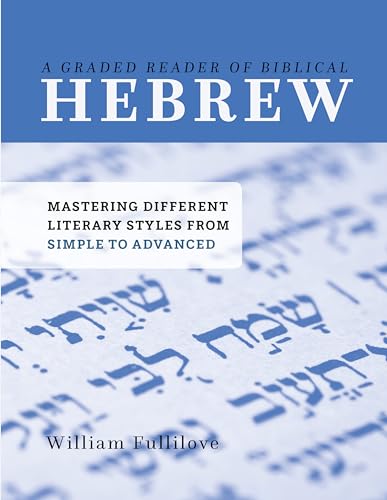
- Guided reading through full biblical texts.
- Moves from narrative to wisdom literature.
- Notes and questions support comprehension.
Best For: Readers who want graded practice across several biblical genres.
Guided Reading Companion – Graded Reader of Biblical Hebrew
If you’re looking for a biblical hebrew narrative reader that helps you move from basic grammar to sustained text reading, this graded reader is built for that transition. It presents selected Old Testament passages in roughly increasing difficulty, with notes that help you review grammar, vocabulary, idioms, and other issues as you work through the text.
Best For: Students, pastors, and scholars who want a structured bridge from elementary Hebrew to reading the Hebrew Bible more confidently.
Pros:
- Arranges readings generally from easier to harder for a clear progression.
- Includes notes on grammar, vocabulary, idioms, and exegetically significant constructions.
- Provides parsing exercises and space for your own English translation.
- Spans important texts across the whole Old Testament.
Cons:
- Best suited to readers who already have a year of elementary Hebrew.
- Not designed as a full introductory grammar.
As a study aid, this volume is strongest when you want guided immersion rather than isolated drills. It is a practical next-step resource for reinforcing Hebrew skills through actual biblical texts.
Pentateuch Narrative Bridge – A Hebrew Reader for the Pentateuch
A Hebrew Reader for the Pentateuch: 40 Pivotal Narratives for Study and Teaching
Check Price On AmazonThis biblical hebrew narrative reader is aimed at the hard step between classroom Hebrew and reading extended passages in the Hebrew Bible. It focuses on forty pivotal Pentateuch narratives, giving you well-known, engaging texts that support study, teaching, and a stronger grasp of the Old Testament story line.
Best For: Hebrew learners who want a narrative-focused reader centered on the Pentateuch and key Old Testament passages.
Pros:
- Features forty selected narratives for focused reading practice.
- Organized around major Pentateuch sections, from creation to the wilderness journey.
- Designed to bridge the gap from early Hebrew study to extended biblical texts.
- Useful for both study and teaching contexts.
Cons:
- Covers only the Pentateuch rather than the whole Hebrew Bible.
- Assumes some prior Hebrew study before use.
If your goal is to build reading confidence with narrative passages rather than a broad anthology, this book keeps the focus tight and purposeful. Its strength is in helping readers practice Hebrew through familiar, pivotal stories.
Comprehension-First Grammar – Learning Biblical Hebrew: Reading for Comprehension
If you want a biblical hebrew narrative reader that emphasizes understanding over memorization, this introductory grammar is built around reading for comprehension. It uses extensive reading in the biblical text to help beginning students learn how Hebrew works, while also supporting second-year review and deeper understanding.
Best For: First-year and second-year Hebrew students who want to learn Hebrew through reading and long-term retention.
Pros:
- Emphasizes reading comprehension rather than decoding.
- Introduces advanced concepts in an accessible way for beginners.
- Uses extensive reading from the third week of class.
- Includes an oral component and support for multiple learning styles.
Cons:
- It is a substantial 504-page grammar, so it is more demanding than a slim reader.
- Written primarily as a course grammar, not just a standalone reading anthology.
This is a strong fit if you want reading to drive your Hebrew progress from the start. It is especially useful for students who prefer pattern recognition and comprehension-based learning over heavy rote study.
Reader’s Bible Reference Edition – A Reader's Hebrew Bible: Second Edition
For readers who want a biblical hebrew narrative reader that keeps the Hebrew text front and center, this second edition is a major study tool. It presents the Hebrew and Aramaic text with English translation support, and footnotes supply definitions for lower-frequency words so you can stay in the flow of reading.
Best For: Hebrew students who want a full reader’s Bible for sustained reading, comprehension, and study.
Pros:
- Includes Hebrew and Aramaic text of the Leningrad Codex alongside NIV translation.
- Footnotes define words that occur 100 times or less, helping reading continuity.
- Notes ketiv/qere readings and provides parsing help in footnotes.
- Adds maps and an index of the Bible’s use of the Bible in this edition.
Cons:
- At 1,744 pages, it is a large and heavy volume.
- The dense format is better for study than casual reading.
This edition is best when you want a single reference Bible that supports slow, careful Hebrew reading. Its extensive footnoting makes it especially useful for students who need help staying oriented in longer passages.
Literary Structure Guide – Style and Structure in Biblical Hebrew Narrative
If you want a biblical hebrew narrative reader that helps you notice how stories are built, this study volume focuses on the literary patterns behind the text. It explores symmetrical organization, unit boundaries, and the linking devices that connect consecutive narrative sections, making it useful for readers who want to move beyond word-by-word reading into structure-aware interpretation.
Best For: Readers studying how biblical Hebrew narrative uses style, repetition, and structural patterns to shape meaning.
Pros:
- Covers reverse symmetry, forward symmetry, and other organizing patterns in narrative
- Explains how boundaries between literary units can affect interpretation
- Includes examples of threads, links, and hinges that connect narrative sections
- Grounded in the Hebrew Bible’s storytelling style rather than a general reading guide
Cons:
- Focuses on analysis of structure, not on graded reading practice
- Not a beginner-friendly vocabulary aid or reader’s Bible
- Best suited to study and interpretation rather than casual reading
This is a strong pick if your goal is to understand how biblical Hebrew narratives are organized and how that organization guides interpretation. It adds analytical depth rather than simplifying the text for easier reading.
Readable Text Edition – The Hebrew Old Testament, Reader's Edition
This biblical hebrew narrative reader is designed to make original-language reading smoother by pairing the Westminster Leningrad Codex with running glosses for words that occur fewer than 75 times in the Hebrew Bible. With large type, a single-column format, and helpful parsing notes for difficult verb forms, it is built for readers who want to stay in the Hebrew text with less interruption.
Best For: Students and readers who want a smoother, more accessible way to read the Hebrew Old Testament in the original language.
Pros:
- Provides glosses for uncommon words to reduce constant reference to outside tools
- Uses a large 13.5-point single-column format for easier reading
- Includes a dictionary in the back and morphological parsing for difficult forms
- Designed to help both beginners and more experienced readers read more fluidly
Cons:
- Focused on reading support rather than detailed literary analysis
- Large format and 2,224 pages make it a substantial hardcover volume
- Glossing is geared to word recognition, not simplified narrative retelling
For readers who want direct access to the Hebrew text with fewer stop-and-look-up moments, this edition is practical and well equipped. It is especially helpful if you want to build reading fluency while staying close to the standard Hebrew Bible text.
Graded Reading Workbook – Learning Biblical Hebrew Workbook: A Graded Reader with Exercises
If you are looking for a biblical hebrew narrative reader that builds skills step by step, this workbook uses guided readings and exercises tied to the Joseph story in Genesis. It starts with grammar reinforcement, then moves into abridged Hebrew texts with notes that supply roots, glosses, and explanation so students can gradually read more of the standard text on their own.
Best For: Learners who want structured reading practice that gradually leads from introductory Hebrew to real biblical narrative.
Pros:
- Uses a graded approach with exercises and guided readings
- Introduces actual Hebrew narrative based on the Joseph story
- Provides root, gloss, and grammar notes to support comprehension
- Progressively reduces help as the reader gains confidence
Cons:
- Requires commitment to a workbook-style learning process
- Focused on a curriculum path rather than a broad anthology of texts
- Best for students following the companion learning sequence
This workbook is a strong choice if your main goal is to practice reading biblical Hebrew in a guided, incremental way. It is less of a reference volume and more of a hands-on training tool for growing from simplified passages toward standard Hebrew Bible reading.
Visual Hebrew Reader – Jonah: A Biblical Hebrew Visual Reader
If you want a biblical hebrew narrative reader that pairs the full text with visual anchors, this Jonah volume is built for that kind of study. The Lingua Deo Gloria Hebrew Readers series emphasizes images to help students lock vocabulary into memory, while keeping the biblical book itself at the center of the reading experience.
Best For: Students and scholars who want a visual, text-first Hebrew reader that makes vocabulary study more memorable.
Pros:
- Pairs the full biblical text of Jonah with a picture dictionary.
- Uses images to help anchor vocabulary in students’ minds.
- Designed to add more joy to Hebrew study for students and scholars.
- Part of a series focused on free, high-quality academic resources.
Cons:
- Focused on one biblical book rather than a broad multi-book selection.
- Very short at 38 pages, so it is a compact reading resource.
This is a distinctive option if you learn best when words are tied to visuals. It is less of a traditional grammar-heavy reader and more of a focused companion for reading Jonah with added memory support.
Intermediate Grammar Reader – Graded Reader of Biblical Hebrew, 2nd Edition
If you need a biblical hebrew narrative reader that pushes beyond the basics, this graded reader is aimed at second-year students, pastors, and scholars who want more practice with the Hebrew Bible. It presents readings in order of increasing difficulty and adds parsing exercises, translation space, and notes to support careful work with the text.
Best For: Second-year Hebrew students and ministry or academic readers who want structured practice with the Hebrew Bible.
Pros:
- Structured for readers who have completed a year of elementary Hebrew.
- Readings progress from easier to harder texts.
- Includes parsing exercises and space for English translation.
- Notes cover grammar, vocabulary, idioms, and exegetically significant constructions.
Cons:
- Best suited to learners who already have a basic Hebrew foundation.
- More of a study tool than a simple reading-only text.
This is a strong next-step resource if you want guided practice with real Hebrew Bible passages. Its strength is in helping you build confidence, review grammar, and move steadily into exegesis.
Literary Styles Reader – A Graded Reader of Biblical Hebrew
A Graded Reader of Biblical Hebrew: Mastering Different Literary Styles from Simple to Advanced
Check Price On AmazonFor a biblical hebrew narrative reader that also broadens you into other genres, this graded reader takes you through full texts from simple to advanced. It includes helpful notes and questions, and it moves from narrative and law to psalms and wisdom literature, giving you a wider workout with actual biblical Hebrew passages.
Best For: Students who want guided reading across multiple biblical genres after finishing a basic Hebrew grammar.
Pros:
- Uses full texts rather than isolated exercises.
- Covers narrative, law, psalms, and wisdom literature.
- Starts with simpler material and progresses to more advanced texts.
- Includes notes and questions to guide study.
Cons:
- Assumes you have already completed a basic grammar of biblical Hebrew.
- Not limited to narrative, so it may be broader than some buyers want.
This is a versatile choice if you want a graded path through real Hebrew texts and not just one literary style. The broad genre coverage makes it useful for building confidence while keeping the focus on reading full passages.
How We Picked These Biblical Hebrew Narrative Reader Options
We prioritized books that genuinely support reading Hebrew narrative rather than simply explaining grammar in isolation. That means graded difficulty, clear formatting, useful glosses, and a path from introductory support to more independent reading. We also looked for options that work well for different study goals, including classroom use, devotional reading, and advanced comprehension.
Quick Comparison
Some titles are built as graded readers with exercises, while others function as reader’s editions of the Hebrew Bible with helps in the margins or footnotes. A few focus on narrative analysis and literary style, which is useful if you want to understand how Hebrew storytelling works as you read. If you want the most guided entry point, choose a graded reader; if you want broader text exposure, choose a reader’s Bible edition.
Key Buying Factors for a Biblical Hebrew Narrative Reader
Reading Level
Match the book to your current ability. Beginners usually need heavier vocabulary support and exercises, while intermediate readers benefit from lighter scaffolding and more continuous text.
Amount of Help Provided
Look for glosses, parsing aids, translation notes, and exercise sets if you want structured learning. If you already know the basics, too much support can slow you down.
Scope of Text
Some readers focus on the Pentateuch or a single book like Jonah, while others cover a wider range of biblical narrative. Narrower scope can be ideal for mastery; broader scope is better for exposure.
Learning Style Fit
A Biblical Hebrew Narrative Reader with exercises suits active learners. A reader’s edition suits those who want to spend more time in the text itself. Literary-style guides help if you want to read with better awareness of structure and discourse.
Who Should Buy Which Biblical Hebrew Narrative Reader?
Beginners should start with a graded reader or workbook-based option that builds confidence step by step. Seminary students and teachers may prefer editions that balance readable Hebrew with helpful notes for class preparation. Advanced readers who want more continuous exposure should choose a reader’s Bible or a literary-focused study resource.
If your goal is to read biblical Hebrew narratives more smoothly, the best choice is the one that matches your current level and gives you just enough support to keep moving forward.