Choosing your first encoder can feel complicated when product listings mix video resolutions, codecs, network protocols, and production features. The right model depends less on having the longest specification list and more on matching your camera, connection type, streaming platform, and comfort level.
This roundup covers 10 streaming encoders for beginners, from straightforward HDMI-to-IP units to more capable systems with NDI, recording, vertical video, and multi-input production features. Use the guide below to narrow the choices before comparing prices and availability.
Best 10 Streaming Encoders for Beginners Picks for 2026
Feature-Rich Starter
URayCoder 4K HDMI Streaming Encoder

- 4K H.265/H.264 encoding
- Supports multiple streaming protocols
- Up to four simultaneous outputs
Best For: Beginners seeking flexible HDMI streaming and multistream support
All-in-One Production Pick
YoloBox Ultra Live Streaming System

- Built-in switcher, encoder, recorder, and monitor
- Supports horizontal and vertical streaming
- Handles four HDMI sources plus USB inputs
Best For: Beginners creating multicamera or mobile live productions
Protocol Flexibility Pick
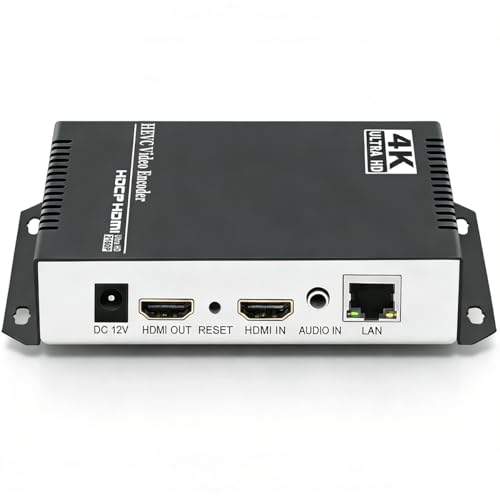
- 4K H.265/H.264 HDMI encoding
- Broad RTSP, RTMP, SRT, HLS, and UDP support
- Supports up to four protocol outputs
Best For: Beginners setting up flexible Ethernet-based streaming
Compact Gaming Pick

- 4K HDMI passthrough for gameplay
- Supports NDI, SRT, RTMP(S), and RTSP
- Compact design with USB-C power and PoE
Best For: Beginners streaming console gameplay or compact IP video setups
Best Plug-and-Play 4K Pick
4K30 DisplayPort Streaming Encoder

- 4K30 input and output
- Four simultaneous protocol-based streams
- Built-in overlays and video adjustments
Best For: DisplayPort-based 4K beginners
Best Advanced All-in-One

- HDMI and SDI input flexibility
- Streams to up to six destinations
- Simultaneous recording and streaming
Best For: Growing live-production setups
Best Budget 1080p Option
URayCoder HDMI Network Encoder

- 1080p60 H.264/H.265 encoding
- Four simultaneous output streams
- HDMI and 3.5 mm audio input
Best For: First-time HDMI streamers
Best Plug-and-Play Pick

- Browser-based setup with no PC software
- H.264/H.265 encoding up to 1080p60
- Supports RTMP, SRT, HLS, WebRTC, and more
Best For: Beginners needing a compact 1080p HDMI encoder
Best for SDI Sources

- Accepts SDI video sources
- Outputs up to four streams simultaneously
- Includes broad protocol and overlay controls
Best For: SDI cameras and multi-destination broadcast setups
Best for 4K Flexibility

- Accepts 4K HDMI input at up to 30fps
- Supports four simultaneous protocol outputs
- Includes overlays, audio controls, and image adjustments
Best For: HDMI streamers planning for 4K and multi-platform workflows
Feature-Rich Starter – URayCoder 4K HDMI Streaming Encoder
For beginners comparing streaming encoders for beginners, the URayCoder UHE265-1L-4K offers a capable HDMI-to-network setup without requiring a full production system. It supports 4K input, common streaming protocols, and management through a computer or mobile device.
Best For: Beginners who want flexible HDMI streaming and room to expand into multistreaming.
Pros:
- Supports H.265/H.264 encoding with 4K at up to 30 fps.
- Works with RTMP(S), RTSP, SRT, HLS, UDP, WebRTC, and other protocols.
- Can output up to four streams using different protocols.
- Includes overlays, captions, logos, timestamps, and adjustable video settings.
Cons:
- Its extensive settings may feel less straightforward than a basic plug-and-play encoder.
- It is an encoder rather than an all-in-one switcher or touchscreen production system.
The intuitive interface, instruction manual, and lifetime warranty make this a strong value for beginners who want more control than a simple capture device provides. Verify your HDMI source and preferred platform protocol before buying.
All-in-One Production Pick – YoloBox Ultra Live Streaming System
The YoloBox Ultra is a practical choice for beginners who want to stream without assembling a laptop, capture card, and separate switcher. Its touchscreen combines encoding, recording, source switching, and monitoring in one portable unit.
Best For: New streamers producing multicamera events, vertical social content, or live broadcasts away from a desk.
Pros:
- Combines a 4K encoder, switcher, recorder, and 8-inch touchscreen.
- Accepts four HDMI sources plus USB-C and USB-A inputs.
- Supports horizontal and vertical streaming for platforms including YouTube, Facebook, TikTok, and Instagram.
- Offers NDI, SRT, ISO recording, overlays, scoreboards, and instant replay.
Cons:
- Its one-year manufacturer warranty is shorter than the lifetime warranty listed for some competing options.
- Cellular bonding and some related services may involve additional charges.
- Its larger feature set may be more than needed for a single-camera beginner setup.
For beginners who value an integrated workflow, the YoloBox Ultra minimizes extra hardware and adds room for multicamera production. Its broad feature set is especially useful for events, churches, schools, sports, and creators working in both landscape and portrait formats.
Protocol Flexibility Pick – URayCoder 4K IP Video Encoder
This URayCoder hardware encoder is suited to beginners who want to send HDMI video over Ethernet to platforms such as YouTube, Facebook, or OBS-compatible workflows. It offers 4K support and a broad protocol list, while retaining controls for bitrate, resolution, audio, and overlays.
Best For: Beginners building a network-based streaming setup with multiple delivery options.
Pros:
- Encodes 4K HDMI video using H.265 or H.264.
- Supports RTSP, RTMPS, HLS, UDP, SRT, HTTP, FLV, MP4, WebRTC, and more.
- Can deliver up to four streams through different protocols.
- Provides text, logo, timestamp, cropping, rotation, and audio-adjustment options.
Cons:
- The wide range of network protocols can require more setup knowledge than a basic encoder.
- It does not include the touchscreen switcher and multi-input production features of an all-in-one system.
This is a good fit when protocol compatibility matters more than built-in production controls. The web-based management approach and supplied instruction manual help beginners get started, while the configuration options support more advanced workflows later.
Compact Gaming Pick – Zowietek ZowieBox 4K Encoder
The Zowietek ZowieBox is a compact option for beginners who want to stream gameplay or HDMI video without a full computer-based setup. It combines HDMI passthrough, IP encoding, and decoding, with control available from a PC, phone, or tablet.
Best For: Beginners streaming console gameplay, webcam feeds, or compact NDI and IP video workflows.
Pros:
- Supports up to 4K capture with zero-lag HDMI passthrough for gameplay.
- Works with RTMP(S), RTSP, SRT, and NDI|HX workflows.
- Can operate as an encoder or decoder for flexible HDMI-to-IP use.
- Offers USB-C power, PoE, tripod mounting, and a compact 5.9-ounce design.
Cons:
- Encoder and decoder modes cannot run simultaneously.
- Full NDI signals are not supported.
- USB capture-card functionality is not currently supported.
Its small footprint and passthrough design make the ZowieBox appealing for gaming and portable setups, while NDI, SRT, and PoE add professional flexibility. Beginners should note the mode limitations and confirm that their intended workflow does not require USB capture-card operation.
Best Plug-and-Play 4K Pick – 4K30 DisplayPort Streaming Encoder
For beginners comparing streaming encoders for beginners, this compact UNISHEEN model is a practical choice when your source uses DisplayPort. It supports 4K30 input and output, H.264/H.265 encoding, and several common streaming protocols without requiring a computer-based encoder.
Best For: Beginners who want a small DisplayPort encoder for 4K30 live streaming to platforms or servers such as YouTube, Facebook, Twitch, RTMP, RTSP, or SRT.
Pros:
- Supports 4K UHD video at up to 30 frames per second.
- Can output up to four streams simultaneously using different protocols.
- Includes useful processing tools such as cropping, rotation, noise reduction, sharpening, and text or image overlays.
- Includes lifetime technical support and complimentary firmware upgrades, plus a one-year limited warranty.
Cons:
- Uses DisplayPort input, so HDMI and SDI sources require compatible conversion hardware.
- Its 4K support is specified at 30 fps rather than 60 fps.
- Beginners may need time to learn the range of protocol and overlay settings.
This is a capable entry point for a DisplayPort-based setup, especially if you want multiple simultaneous outputs and built-in image adjustments. Confirm your source connection and desired frame rate before buying.
Best Advanced All-in-One – Magewell Ultra Encode AIO 4K
Although it is more advanced than many streaming encoders for beginners, the Magewell Ultra Encode AIO gives new users room to grow. It accepts HDMI or SDI, supports 4K encoding, and combines streaming, recording, overlays, and input mixing in one device.
Best For: Beginners entering live production who want a flexible HDMI/SDI system that can handle multiple destinations, recording, and future workflow expansion.
Pros:
- Accepts HDMI and SDI inputs, with picture-in-picture and side-by-side mixing.
- Streams to up to six destinations using protocols including RTMP, RTMPS, SRT, NDI|HX, HLS, and UDP/RTP.
- Can stream and record simultaneously to SD cards, USB storage, or network drives.
- Offers onboard scaling, cropping, de-interlacing, and up to eight text, image, or clock overlays.
Cons:
- Its broad feature set may be more than a first-time streamer needs.
- At 3.6 pounds and with a rack-mount form factor, it is less compact than simpler encoders.
- The supplied details list HDMI 4K up to 60p and SDI 4K up to 30p, so input choice affects maximum 4K frame rate.
The Ultra Encode AIO is a strong long-term option if your beginner setup may become a more serious production workflow. Its HDMI/SDI flexibility and recording features help justify choosing it over a basic single-input encoder.
Best Budget 1080p Option – URayCoder HDMI Network Encoder
For beginners searching streaming encoders for beginners, this URayCoder model keeps the setup focused on HDMI-to-network streaming. It supports 1080p up to 60 fps, H.264/H.265 encoding, and a range of protocols for platforms, local networks, and NVR workflows.
Best For: New streamers with an HDMI source who want a straightforward 1080p encoder with multi-platform output and basic branding controls.
Pros:
- Supports 1920×1080 input and output at up to 60 fps.
- Can send four video streams simultaneously using different protocols.
- Offers static text, scrolling captions, logos, timestamps, cropping, rotation, flipping, and mirroring.
- Accepts embedded HDMI audio or separate 3.5 mm line-in audio.
Cons:
- It is limited to 1080p rather than 4K resolution.
- Requires an HDMI source and network connection; the supplied details do not list wireless connectivity.
- The product details identify lifetime support but do not specify a standard warranty duration.
This is a sensible starting point for HDMI cameras, consoles, and other 1080p sources. Its interface and instruction manual are aimed at easy setup, while the multi-protocol support leaves room for more advanced distribution later.
Best Plug-and-Play Pick – 1080p60 HDMI Encoder
For beginners comparing streaming encoders for beginners, this compact HDMI model offers a relatively approachable starting point. Its browser-based setup requires no PC software or drivers, while hardware H.264/H.265 encoding supports 1080p at 60 frames per second. Advanced network configurations still require basic IP and streaming-protocol knowledge.
Best For: Beginners who want a compact HDMI encoder for YouTube, Facebook Live, monitoring, or IPTV workflows.
Pros:
- Hardware encoding supports 1080p60 in H.264 or H.265.
- Browser-based configuration avoids installing software or drivers.
- Supports RTMP, RTMPS, RTSP, SRT, HLS, WebRTC, and other protocols.
- Includes HDMI audio, 3.5mm audio input, and built-in text, logo, and timestamp overlays.
Cons:
- Advanced setups require basic networking and protocol knowledge.
- It has one HDMI input and is limited to 1080p60 rather than 4K.
This is the most beginner-oriented option in the group because its small design and browser interface simplify initial setup. Choose it when 1080p streaming is sufficient and you value straightforward installation over higher-resolution input.
Best for SDI Sources – HEVC SDI-to-IP Encoder
Among streaming encoders for beginners, this URayCoder model is best considered when your camera or production equipment has an SDI output. It supports H.264/H.265 encoding and can send up to four streams using different protocols, but its broad configuration options may take more time to learn than a basic single-stream device.
Best For: Beginners moving into SDI-based broadcasting, IPTV, event production, or multi-destination streaming.
Pros:
- Designed for devices with SDI output, including HD-SDI sources.
- Can output four video streams simultaneously using different protocols.
- Supports HTTP, RTSP, RTMP(S), SRT, HLS, UDP, RTP, Multicast, and other formats.
- Offers adjustable resolution, frame rate, bitrate, audio, cropping, and overlay options.
Cons:
- It uses an SDI connector, so it is not the natural choice for HDMI-only equipment.
- The many stream and customization settings may feel less beginner-friendly.
- The supplied details specify an Australian/Chinese Type I power plug.
This encoder makes sense if SDI compatibility and simultaneous stream outputs matter more than a minimal setup. For a simple HDMI source, another product in this roundup should be easier to match and configure.
Best for 4K Flexibility – 4K HDMI Network Encoder
If you want streaming encoders for beginners with room to grow, this HDMI model combines an intuitive management interface with 4K input support. It can encode H.264 or H.265, output multiple protocol types, and stream to platforms such as YouTube, Facebook, Twitch, and Vimeo. Its extensive controls are useful, though beginners may need time to explore them.
Best For: New streamers using HDMI equipment who want 4K capability, multi-platform output, and advanced customization.
Pros:
- Supports 4K input up to 30fps and up to 120fps at 2K and lower resolutions, according to the supplied notes.
- Can simultaneously output four streams using different protocols.
- Works with RTSP, RTMPS, SRT, HLS, WebRTC, ONVIF, and other streaming formats.
- Supports captions, logos, timestamps, audio input options, and image adjustments.
Cons:
- Its broad feature set can be more complex than a basic encoder.
- 4K operation is limited to a maximum of 30fps.
- The supplied product details do not specify the complete included power or accessory package.
This is the strongest growth-oriented choice for an HDMI user who may eventually need 4K sources or several simultaneous destinations. Beginners can start with the guided interface, then expand into its bitrate, overlay, and multi-stream controls as their workflow develops.
How We Picked These Streaming Encoders for Beginners
We focused on the features that matter most when setting up a reliable first live stream: input compatibility, supported output resolutions, codec options, streaming protocols, setup complexity, and room to expand. The selection includes HDMI, SDI, DisplayPort, NDI, and all-in-one production devices so beginners can compare different approaches rather than being limited to one type of workflow.
We also considered practical platform support. RTMP and RTMPS are widely useful for services such as YouTube and Facebook, while RTSP, SRT, HLS, UDP, WebRTC, and NDI can be valuable for IPTV, local networks, remote contribution, or more advanced production setups.
Quick Comparison
- Simple HDMI streaming: Look for a compact encoder with HDMI input, H.264 or H.265 support, and RTMP or RTMPS output.
- Higher-resolution workflows: A 4K-capable model is useful if your source is 4K, although your platform, bandwidth, and computer or camera must also support that resolution.
- Remote or professional contribution: SRT support can improve reliability over less predictable networks.
- Network production: NDI-equipped devices are better suited to studios using network video and compatible production software.
- All-in-one production: Integrated switching, recording, vertical layouts, or dual-input mixing can reduce the need for additional hardware.
Key Buying Factors
Input and Source Compatibility
Start with the connector on your camera, switcher, or computer. HDMI is common for consumer and prosumer equipment, while SDI is preferred for longer cable runs and many professional cameras. DisplayPort models are designed for computer or graphics sources. If you plan to use several sources, check whether the encoder supports switching or multiple inputs rather than assuming it does.
Resolution, Frame Rate, and Codecs
Confirm both the input and encoded output specifications. “4K” does not always mean 4K60; many affordable units support 4K30 input or pass-through while producing a lower-resolution stream. H.264 offers broad compatibility, while H.265 can reduce bandwidth at similar quality but may have more limited platform or software support.
Protocols and Network Setup
For beginners, RTMPS is often the easiest route to major streaming platforms. Check that the device supports the exact protocol and authentication method your service requires. Ethernet is generally more dependable than Wi-Fi for fixed installations, and SRT is worth prioritizing for unstable or long-distance connections.
Ease of Use and Monitoring
Look for a clear web interface, visible status information, audio controls, and firmware updates. A device that supports preview, stream health monitoring, or local recording can make troubleshooting much easier. Also verify whether power, HDMI cables, storage, or a capture accessory are included.
Who Should Buy Which Streaming Encoders for Beginners?
Choose a basic HDMI encoder if you want to stream one camera or computer source with minimal setup. Choose a 4K model if you already own 4K equipment and want a path to higher-quality production, but avoid paying extra if your platform or internet connection is limited to 1080p.
Choose an SDI encoder for professional cameras, long cable runs, or installations where connector durability matters. Choose an NDI model if your workflow already uses network-based video production. Choose an all-in-one system if you need switching, recording, horizontal and vertical layouts, or fewer separate devices.
Before buying, confirm your source connector, target platform, upload speed, desired resolution, and power arrangement. For most first-time streamers, dependable 1080p output, RTMPS support, wired Ethernet, and a simple setup are more valuable than an advanced feature list you may never use.