Finding the right DMX controller under $300 means balancing channel capacity, programming flexibility, fixture compatibility, and ease of use. The best option depends on whether you run a simple party setup, a mobile DJ rig, or a more advanced stage system.
We compared 10 budget-friendly controllers across control layouts, scene storage, MIDI support, wireless features, and practical usability to help you choose a console that fits your lights and workflow.
Best 10 Dmx Controllers Under 300 Picks for 2026
Best Software-Integrated Pick

- Two DMX universes with Thru support
- Engine DJ plug-and-play compatibility
- Tactile pads, encoders, and touch strip
Best For: DJs using SoundSwitch or Engine DJ lighting workflows
Best Wireless-Capable Value

- 384 channels for up to 12 fixtures
- Wired and 2.4G wireless modes
- Stores 240 scenes and six chases
Best For: Event DJs and operators managing multiple intelligent fixtures
Best Standalone Multi-Universe Option

- Standalone DMX lighting control
- Four universes and four output sockets
- 37 backlit buttons and four encoders
Best For: Operators needing compact multi-universe control
Best Traditional Scene Controller

- 192 channels for up to 12 fixtures
- Stores 240 scenes and six chases
- Includes fog, strobe, and MIDI control
Best For: Operators who prefer programmed scenes and physical sliders
Compact 384-Channel Control

- 384 DMX channels for detailed control
- 30 banks of eight programmable scenes
- LED gooseneck lamp and compact design
Best For: Programmable club, bar, and small-stage lighting
Simple 192-Channel Option

- Controls up to 192 DMX channels
- Supports up to 12 intelligent lights
- Includes MIDI and blackout controls
Best For: Smaller intelligent-lighting setups
Feature-Rich 384-Channel Pick

- Controls 24 fixtures across 384 channels
- Stores scenes and six programmable chases
- Adds MIDI, music mode, and built-in microphone
Best For: DJs and stage shows needing flexible live control
Compact MIDI-Compatible Control
Stage Right 16-Channel DMX Controller

- Controls up to 12 lights with 16 channels each
- Stores 240 scenes across 6 chase sets
- Adds MIDI, USB, tap sync, and Auto Run
Best For: Compact DJ and small-stage lighting setups
Voice-Controlled Scene Programming

- Controls 12 fixtures and up to 240 scenes
- Programs up to 40 steps per scene
- Adds voice control and 3-pin DMX output
Best For: Event, club, wedding, and church lighting shows
Beginner-Friendly Manual Control
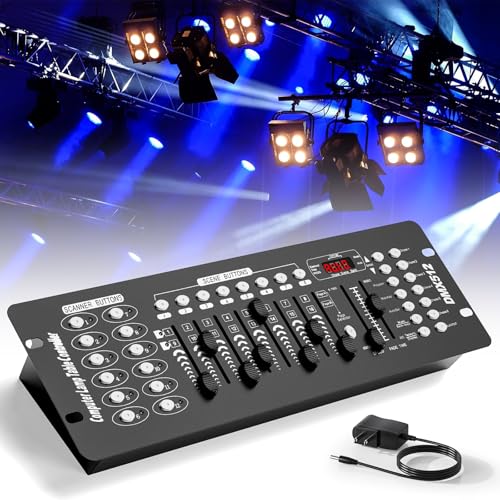
- Controls 12 devices across 192 channels
- Offers 240 scenes and 6 programmable chases
- Includes 8 manual sliders and 3-pin connectivity
Best For: Beginners and small parties or stage shows
Best Software-Integrated Pick – SoundSwitch Control One
For DJs seeking DMX controllers under 300 with software integration, the SoundSwitch Control One combines tactile hardware control with SoundSwitch lighting software. It offers two DMX universes, dual USB connections, and direct compatibility with Engine DJ devices for computer-free performance.
Best For: DJs who want hands-on lighting control, SoundSwitch integration, and flexible music-source compatibility.
Pros:
- Two DMX universe inputs and outputs with a Thru option for installations.
- Direct plug-and-play support for Denon DJ and Numark Engine DJ hardware.
- Touch strip, encoders, and RGB performance pads provide responsive control.
- Supports live audio BPM detection and control of color, brightness, strobe, moving heads, and gobos.
Cons:
- Some AlphaTheta PRO DJ LINK Bridge setups require a laptop running SoundSwitch.
- Its feature set is most useful when paired with SoundSwitch-compatible workflows.
The Control One is a strong choice for performance-focused users who want more than basic fader control. Its hardware is especially appealing for DJs already using SoundSwitch or Engine DJ equipment.
Best Wireless-Capable Value – 384Ch DMX512 Controller
This 384-channel console is a practical option among DMX controllers under 300 for users who want physical faders, scene storage, and both wired and wireless operation. It can control up to 12 intelligent fixtures and includes MIDI and sound-activated modes.
Best For: DJs, wedding operators, and small event productions using multiple fixtures and needing hands-on scene control.
Pros:
- 384 channels and 16 physical faders support control of up to 12 fixtures.
- Offers both standard 3-pin XLR wired operation and built-in 2.4G wireless capability.
- Stores up to 240 scenes across 30 banks and supports six chases.
- Includes MIDI input, speed and fade-time faders, music mode, and blackout control.
Cons:
- Wireless mode requires fixtures equipped with a compatible 2.4G receiver.
- Its 4.16-pound metal console may be more equipment than casual users need.
With extensive memory and dedicated live-performance controls, this controller suits operators who prefer a conventional console layout. Confirm wireless compatibility with your fixtures before relying on that mode.
Best Standalone Multi-Universe Option – ADJ WMX1 Mk2
The ADJ WMX1 Mk2 stands out among DMX controllers under 300 for its standalone design and compact control surface. It provides 37 backlit silicone buttons, four rotary encoders, and support for up to four DMX universes through four output sockets.
Best For: Lighting operators who want a compact standalone controller with multiple universe outputs.
Pros:
- Standalone operation avoids dependence on a computer during use.
- Four DMX universes and four output sockets support larger lighting configurations.
- Backlit buttons improve visibility during performances.
- Four rotary encoders provide dedicated parameter adjustment.
Cons:
- The supplied notes do not specify scene capacity, fixture count, or chase memory.
- Its multi-universe capability may be unnecessary for very small setups.
The WMX1 Mk2 is worth considering when output expansion and standalone operation matter more than a basic fader-based layout. Its compact dimensions also make it practical for mobile lighting control.
Best Traditional Scene Controller – CHAUVET DJ OBEY40
The CHAUVET DJ OBEY40 is a conventional choice among DMX controllers under 300, offering 192 channels for up to 12 fixtures with as many as 16 channels each. Its scene banks, chase playback, fog and strobe controls, and MIDI compatibility make it suited to organized show programming.
Best For: DJs and small production operators who prefer programmed scenes, chases, and physical slider control.
Pros:
- Controls up to 12 fixtures with 16 channels each.
- Stores up to 240 scenes across 30 banks and supports six chases.
- Dedicated fog and strobe controls expand effect management.
- MIDI compatibility and reversible sliders add integration and operating flexibility.
Cons:
- The 6.7-pound metal chassis is relatively heavy for mobile setups.
- Its listed model year is 2010, so the design is more traditional than newer controllers.
- The supplied notes do not indicate wireless operation.
The OBEY40 remains a capable choice for users who value predictable hardware programming and substantial scene memory. It is particularly suitable when wired DMX and physical sliders fit the production workflow.
Compact 384-Channel Control – 384CH DMX Stage Console
For shoppers comparing DMX controllers under 300, this compact DMX512 console offers 384 channels, control for up to 24 fixtures, and 30 banks of eight programmable scenes. Its LED gooseneck light and side handles make it practical for club, bar, and small-stage programming.
Best For: Users who want extensive scene programming in a lightweight controller.
Pros:
- Provides 384 DMX channels for detailed lighting control.
- Supports 30 banks with eight programmable scenes each.
- Includes an LED gooseneck lamp and protective side handles.
- Accepts 110–240V AC power and uses DMX512 control.
Cons:
- The supplied notes do not mention MIDI or built-in music-triggered operation.
- Its programming-focused layout may be more than needed for very simple setups.
This is a strong option when channel capacity and scene organization matter most. Its compact design and broad power compatibility add convenience, while the feature set is aimed at users ready to program their own stage looks.
Simple 192-Channel Option – Elation DMX Operator
Elation programmable dmx intelligent light controller controls up to 192 DMX channels
Check Price On AmazonAmong DMX controllers under 300, the Elation DMX Operator is an affordable, straightforward choice for controlling up to 12 intelligent lights. It provides 192 channels, with up to 16 channels assigned to each fixture, plus MIDI control and a blackout function.
Best For: Buyers seeking basic programmable control for a small intelligent-lighting rig.
Pros:
- Controls up to 192 DMX channels.
- Supports up to 12 separate intelligent lights.
- Allows up to 16 DMX channels per fixture.
- Includes MIDI control and a blackout feature.
Cons:
- Has less channel capacity than the 384-channel alternatives in this roundup.
- Its supplied details do not list scene-bank or chase capacity.
- Requires one AAA battery according to the product details.
The DMX Operator makes sense for smaller systems where 192 channels are sufficient. It focuses on core fixture control rather than a larger scene-and-chase feature set, making it a practical entry-level pick.
Feature-Rich 384-Channel Pick – Rockville ROCKFORCE 384
For shoppers seeking DMX controllers under 300 with performance-oriented features, the Rockville ROCKFORCE 384 combines 384 channels with 30 scene banks, six programmable chases, MIDI control, and a built-in microphone. It is designed for DJ, club, fog, and stage-lighting applications.
Best For: DJs and stage users who want scenes, chases, MIDI, and music-triggered operation.
Pros:
- Controls up to 24 intelligent lights with 16 channels each.
- Stores 30 banks of eight scenes and six programmable chases.
- Includes MIDI control, a built-in microphone, and music mode.
- Features metal housing, 16 sliders, an LED display, and a gooseneck lamp.
Cons:
- Its larger feature set may take more time to learn than a basic controller.
- The supplied notes specify three-pin XLR DMX connections, which buyers should match to their fixtures.
This is the most versatile choice of the three for programmed shows and live-response effects. The chase memory, MIDI support, and built-in microphone give it more operating modes, while the metal housing and one-year warranty add reassurance.
Compact MIDI-Compatible Control – Stage Right 16-Channel DMX Controller
If you want one of the more versatile DMX controllers under 300 for a compact lighting setup, this Stage Right controller offers DMX-512 control for up to 12 intelligent lights, with each fixture supporting up to 16 channels. MIDI and USB connectivity add flexibility for compatible computer-based setups.
Best For: DJs, small-stage operators, and users who want chase programming with MIDI or USB compatibility.
Pros:
- Controls up to 12 intelligent lights with up to 16 channels each.
- Stores 6 sets of chases containing up to 240 scenes.
- Supports simultaneous chases, beat activation, tap sync, and Auto Run.
- Includes MIDI DIN, USB, and XLR connector options.
Cons:
- Its plastic construction may be less suitable for demanding touring use.
- No warranty is listed in the supplied product details.
This is a practical choice when you need hands-on chase control in a compact format. Its MIDI and USB features are especially useful if your lighting workflow includes a computer or compatible software such as Ableton Live.
Voice-Controlled Scene Programming – 192-Channel DMX Console
This 192-channel console is a strong option among DMX controllers under 300 for users who want extensive scene programming without a complicated layout. It controls up to 12 fixtures, supports up to 240 scenes, and includes a 3-pin DMX output for compatible stage equipment.
Best For: DJs, event operators, clubs, weddings, churches, and other users building multi-fixture lighting shows.
Pros:
- Controls up to 12 intelligent lights with up to 16 channels each.
- Supports up to 240 scenes and up to 40 steps per scene.
- Offers adjustable pause and graduation speeds for customized transitions.
- Includes voice control and a 3-pin XLR DMX512 output.
Cons:
- The corded design requires access to a power source.
- The feature-rich programming layout may take time for beginners to master.
With organized fixture, scene, channel, speed, and function sections, this controller balances broad programming capability with an approachable control surface. The one-year manufacturer warranty is an added benefit for regular event use.
Beginner-Friendly Manual Control – 192-Channel DMX Console
For shoppers comparing DMX controllers under 300, this 192-channel console provides a straightforward way to program stage lighting for parties, music shows, and seasonal events. It controls up to 12 smart devices, offers 16 channels per device, and supports up to 240 scenes.
Best For: Beginners and small-event users who want manual sliders, programmable scenes, and broad 3-pin equipment compatibility.
Pros:
- Controls up to 12 devices with 16 channels each.
- Provides 23 sets of programmable scenarios and 6 programmable chases.
- Includes 8 sliders for manual channel control plus speed and fade controls.
- Connects to compatible 3-pin equipment such as fog machines, moving heads, and PAR lights.
Cons:
- The listed manufacturer warranty details are limited to 90 days.
- Its 12-device capacity may be restrictive for larger lighting rigs.
The clearly divided control sections and manual sliders make this a sensible entry-level console. A 30-day return period and stated 360-day repair service also provide some additional support for first-time buyers.
How We Picked the Best Dmx Controllers Under 300
We focused on controllers that offer useful lighting control without requiring a professional-level investment. Our comparison considers DMX channel capacity, fixture support, scene and chase programming, hands-on controls, MIDI compatibility, wireless operation, and suitability for common applications such as DJ events, clubs, small stages, parties, and mobile entertainment.
Because budget controllers vary widely in design, we also considered setup complexity. A high channel count is valuable only if the interface makes programming manageable. Models with dedicated faders, scene buttons, preset controls, or software integration can be better choices than technically capable consoles with a steep learning curve.
Quick Comparison
| What to Compare | Best For | What to Look For |
|---|---|---|
| Channel count | Larger or expanding rigs | 192 or 384 channels for multiple fixtures |
| Programming controls | Live operation | Dedicated faders, scene keys, and chase controls |
| MIDI support | DJs and show automation | Compatibility with your keyboard, controller, or software |
| Wireless capability | Clean stage setups | Compatible wireless receivers and reliable range |
| Compact design | Mobile performers | Portable construction and straightforward setup |
Key Buying Factors for Dmx Controllers Under 300
Channel Capacity and Fixture Support
Check both the controller’s total DMX channels and the number of fixtures it can address. A 192-channel unit may be enough for basic pars, moving heads, and small effect lights, while a 384-channel model provides more room for fixtures with larger channel profiles. Confirm that your lights use standard DMX512 and that the controller supports the required addressing and fixture modes.
Scenes, Banks, and Chases
For live shows, stored scenes and chases are often more important than raw channel count. Look for enough banks and scenes to organize color looks, movement patterns, dimmer states, and effect sequences. Manual faders are useful for improvising, while programmable scenes help you repeat a polished show.
Interface and Portability
A console with clear labeling and dedicated controls is usually easier to operate in a dark booth or on a crowded stage. Mobile DJs should prioritize compact dimensions, durable construction, and controls that can be reached quickly. If you prefer computer-based programming, check whether the model is designed to work with compatible software or MIDI equipment.
Connectivity and Expansion
Inspect the DMX input and output configuration, MIDI connections, wireless functionality, and power requirements before buying. Make sure you have the correct cables and terminators, and allow room in your setup for future fixtures or additional control devices.
Who Should Buy Which Dmx Controllers Under 300?
Beginners and occasional party hosts: Choose a simple 192-channel controller with direct scene or preset controls. It will be easier to learn than a feature-heavy console.
Mobile DJs and entertainers: Prioritize portability, MIDI support, quick-access faders, and programmable chases. These features make it easier to coordinate lighting with music and changing venues.
Small clubs and event spaces: A 384-channel controller or a model with strong scene storage offers useful flexibility when managing several fixture types and recurring shows.
Wireless-focused setups: Select a controller specifically equipped for compatible wireless DMX operation, but verify receiver compatibility and range before relying on it for critical events.