Choosing among DMX controllers for beginners can be confusing when channel counts, fixtures, scenes, and control methods all vary. The right console should match your lights, venue, and comfort level—not simply have the largest number of channels.
We compared compact basic boards, full 192- and 384-channel consoles, and app-based options to help you find a practical starting point for DJ rigs, small stages, parties, and home lighting setups.
Best 10 Dmx Controllers for Beginners Picks for 2026
Best Versatile Starter
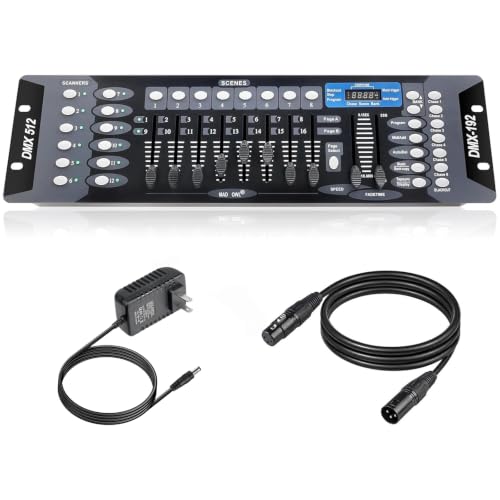
- Controls up to 12 fixtures
- Stores programmable scenes and chases
- Includes a 6.6-foot DMX cable
Best For: Beginners learning scene and chase programming
Best Feature-Rich Pick

- Controls 192 DMX channels
- Stores up to 240 scenes
- Includes fog and strobe controls
Best For: Growing setups with intelligent lights and effects
Best High-Capacity Value

- Provides 384 DMX channels
- Stores 30 banks of scenes
- Includes a gooseneck LED light
Best For: Larger beginner stage and club lighting setups
Best Compact Beginner Option

- Controls up to eight intelligent lights
- Offers 96 DMX channels
- Includes six long-step chases
Best For: Small lighting rigs and first-time operators
Best Programmable Pick
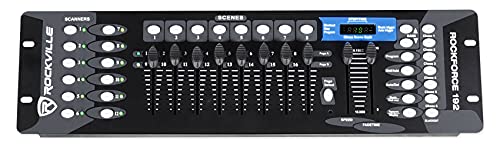
- 192 channels across 12 scanners
- 23 banks and six programmable chases
- Music trigger and power-failure memory
Best For: DJs and event planners building repeatable lighting shows
Best Simple Controller

- 12 channel faders plus master fader
- Portable or wall-mounted design
- Three-pin and five-pin DMX outputs
Best For: Beginners learning direct manual lighting control
Best Voice-Controlled Console

- Controls up to 12 fixtures
- Supports up to 240 scenes
- Voice control for scene switching
Best For: Beginners running multi-fixture party and event setups
Best App-Based Pick

- Tablet-based Wi-Fi and USB control
- 256 channels with two-universe support
- 50 presets and 21 automatic effects
Best For: Beginners who want app-based, low-programming lighting control
Best Traditional Console
192-Channel Stage Lighting Controller

- Controls 12 fixtures with 192 channels
- Stores up to 240 scenes
- Includes voice control and 3-pin DMX output
Best For: Beginners learning hands-on scene programming
Best Compact Beginner Console
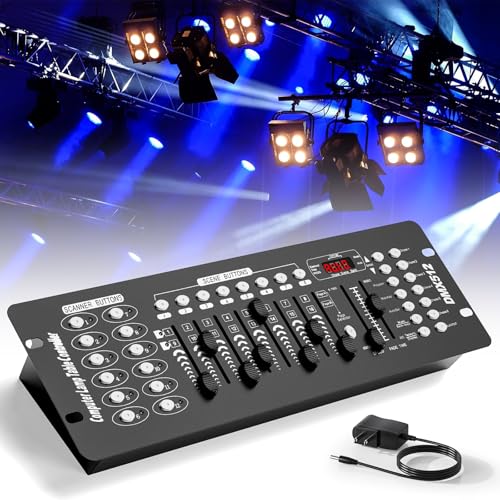
- Controls 12 devices across 192 channels
- Stores scenes and six programmable chases
- Eight sliders provide manual control
Best For: Small events and beginners who want a compact physical panel
Best Versatile Starter – 192-Channel DMX Controller
If you are comparing DMX controllers for beginners, this 192-channel board offers a practical way to learn fixture addressing, scene programming, and chase playback. Its faders and buttons support real-time adjustments, while the included 6.6-foot DMX cable helps you connect compatible lighting equipment.
Best For: Beginners building a small stage, club, or DJ lighting setup with up to 12 fixtures.
Pros:
- Controls up to 12 fixtures with up to 16 channels each.
- Stores 23 banks of 8 programmable scenes.
- Supports six programmable chases with up to 240 steps.
- Includes a 6.6-foot DMX cable.
Cons:
- Its 192-channel layout may be more capacity than needed for a very small setup.
- The rack-mount design and 22.44-inch width may require dedicated space.
This is a straightforward choice for beginners who want hands-on controls and room to expand beyond a basic one- or two-light arrangement.
Best Feature-Rich Pick – CHAUVET DJ OBEY40 Controller
For beginners who want a controller that can remain useful as their setup grows, the CHAUVET DJ OBEY40 combines 192 channels with extensive scene storage and dedicated fog and strobe controls. The reversible sliders and MIDI compatibility add flexibility for more involved lighting systems.
Best For: New operators managing multiple intelligent fixtures, fog effects, and programmed looks.
Pros:
- Controls up to 12 fixtures with up to 16 channels each.
- Provides 30 banks with 8 scenes each, for up to 240 scenes.
- Offers six chases with up to 240 scenes.
- Adds fog, strobe, MIDI, and reversible-slider features.
Cons:
- Its broad feature set may take longer for a first-time user to learn.
- At 6.7 pounds, it is heavier than some compact controllers.
The OBEY40 is a strong learning platform if you expect to add fixtures or effects and prefer dedicated physical controls over a minimal interface.
Best High-Capacity Value – 384-Channel DMX512 Controller
This 384-channel console gives beginners room to experiment with larger lighting designs without immediately outgrowing the controller. It includes 30 banks of 8 programmable scenes, a gooseneck LED light, and a compact housing with side handles for operation at live shows.
Best For: Beginners planning larger stage, bar, club, or live-lighting setups with many fixtures.
Pros:
- Provides 384 DMX channels for detailed fixture control.
- Includes 30 banks of 8 programmable scenes.
- Compact housing includes side handles and an LED gooseneck light.
- Supports 110–240V AC, 50–60Hz power input according to the supplied notes.
Cons:
- The higher channel count can make the control layout more demanding for a complete beginner.
- The supplied notes do not specify the maximum number of fixtures or chase capacity.
Choose this model when expansion matters most; its larger channel count is useful for ambitious setups, but newcomers should expect a steeper programming process than with a compact controller.
Best Compact Beginner Option – CHAUVET DJ Obey 10
The CHAUVET DJ Obey 10 is a simpler entry point for shoppers seeking DMX controllers for beginners. Its 96 channels are arranged for control of up to eight intelligent lights, while sequential chase linking provides a way to build more dynamic shows as your skills develop.
Best For: Beginners with a modest intelligent-lighting rig who want a compact, focused controller.
Pros:
- Controls up to eight intelligent lights.
- Provides 96 DMX channels.
- Includes six sets of chases with up to 999 steps each.
Cons:
- Supports fewer fixtures and channels than the other listed controllers.
- Its capacity may become limiting as a lighting system expands.
With fewer channels to manage, the Obey 10 can make a sensible first controller for small installations, especially when chase sequencing is more important than extensive fixture capacity.
Best Programmable Pick – Rockforce 192
For beginners looking for DMX controllers for beginners that can grow with more ambitious shows, the Rockville ROCKFORCE 192 offers broad control without requiring computer software. It manages 192 channels across 12 scanners and includes programmable scenes, chases, manual sliders, and sound activation.
Best For: DJs, event planners, and small venues that want programmable lighting and fog control.
Pros:
- Controls 192 channels across 12 scanners with 16 channels each.
- Stores 23 banks of eight scenes and six chases of up to 240 scenes.
- Includes music triggering, eight manual sliders, and power-failure memory.
- Its LED display and straightforward layout are approachable for beginners.
Cons:
- The 3U rack-style design is less compact than a basic portable controller.
- Its extensive programming features may take time for first-time users to learn.
The ROCKFORCE 192 is a strong choice when a beginner wants room to build repeatable, music-synced shows. Its 192-channel layout and rack-oriented construction make it better suited to larger or more permanent setups than very simple lighting rigs.
Best Simple Controller – ADJ SDC12
ADJ Products SDC12, 12 Channel Basic DMX Controller, Easily Fade and Dim Multiple Lights
Check Price On AmazonThe ADJ SDC12 is a practical starting point among DMX controllers for beginners because it focuses on direct manual control. Twelve channel faders and a master fader make it easy to fade and dim multiple fixtures without navigating complex programming menus.
Best For: Beginners, demos, portable setups, and simple lighting systems.
Pros:
- Provides 12 easy-to-manipulate channel faders plus a master fader.
- Compact, lightweight design can work as a portable or wall-mounted controller.
- Supports 9V battery operation for handheld use, with the battery purchased separately.
- Offers standard three-pin and five-pin DMX outputs for connecting compatible fixtures.
Cons:
- Its 12-channel capacity is much more limited than 192-channel consoles.
- It is designed for simple manual control rather than complex scene and chase programming.
- The 9V battery is not included.
Choose the SDC12 if your priority is learning the fundamentals of DMX through clearly labeled physical controls. It is less suitable for elaborate automated shows, but its compact format and uncomplicated operation can reduce the learning curve.
Best Voice-Controlled Console – CO-Z 192 DMX
The CO-Z 192 is a capable option for shoppers comparing DMX controllers for beginners who want more show-building potential than a basic fader board. It controls up to 12 fixtures with as many as 16 channels each, while its organized control sections and voice control feature help simplify operation.
Best For: DJs, parties, weddings, clubs, and home users running multiple intelligent lights.
Pros:
- Provides 192 channels for up to 12 fixtures with 16 channels each.
- Supports up to 240 scenes for more complex lighting shows.
- Voice control can switch among lighting scenes without manual operation.
- Includes a three-pin cable and controls compatible fixtures such as fog machines and strobes.
Cons:
- The larger number of controls and available scenes may require practice for new users.
- Its plastic construction may feel less substantial than a metal-bodied console.
- The supplied notes do not specify a built-in display beyond the listed LED display area or detailed programming instructions.
The CO-Z 192 balances substantial fixture capacity with an interface organized into dedicated selection, scene, channel, timing, and function areas. It is a good middle ground for beginners who want room to expand, especially when voice-activated scene changes are useful.
Best App-Based Pick – MyDMX Go Wireless Controller
For beginners seeking DMX controllers for beginners, the ADJ MyDMX Go offers a streamlined app-based approach. It works with an iPad or Android tablet, supports up to 256 channels, and provides fixture compatibility through a library of more than 15,000 fixtures.
Best For: Beginners who prefer tablet control, wireless integration, and effects without traditional programming.
Pros:
- App-based control through Wi-Fi and USB.
- Supports up to 256 DMX channels and two universes.
- Includes 50 user presets and 21 automatic effects.
- Offers zero-programming operation with adjustable effects.
Cons:
- Requires an iPad or Android tablet for app-based operation.
- Its feature set is centered on app control rather than physical faders.
The MyDMX Go is a strong choice for users who want quick setup and flexible fixture support. Its included mounting brackets and lightweight design also make it practical for compact lighting systems.
Best Traditional Console – 192-Channel Stage Lighting Controller
This 192-channel console is a practical option for beginners comparing DMX controllers for beginners with hands-on controls. Its organized layout includes fixture selection, channel controls, scene switching, an LED display, and speed and time controls.
Best For: Amateur DJs, small venues, parties, weddings, churches, and users who prefer physical console controls.
Pros:
- Controls up to 12 fixtures with up to 16 channels each.
- Supports up to 240 scenes and 40 steps per scene.
- Provides adjustable pause and transition speeds.
- Includes a 3-pin XLR DMX512 output and voice control.
Cons:
- Uses a corded power source.
- Its physical controls may require more manual setup than an app-based system.
With a clear seven-part control layout and durable buttons and control sticks, this console gives beginners a conventional way to learn scene programming while retaining room for more complex shows.
Best Compact Beginner Console – 192-Channel DMX Panel
Designed with straightforward physical controls, this compact 192-channel panel is worth considering among DMX controllers for beginners. It supports up to 12 smart devices, offers programmable scenes and chases, and includes sliders for manual channel adjustments.
Best For: Beginners running small parties, holiday displays, concerts, festivals, or other compact lighting setups.
Pros:
- Controls 12 devices with 16 channels each.
- Supports up to 240 scenes, six programmable chases, and 23 scenario sets.
- Includes eight sliders for manual channel control.
- Uses a 3-pin connection for compatible stage equipment.
Cons:
- Provides 192 channels, fewer than the ADJ app-based controller.
- Uses a supplied power adapter rather than battery power.
- The listed manufacturer warranty is 90 days.
The panel’s labeled control sections and beginner-focused layout make it approachable for basic programming. Its compact size and broad 3-pin equipment compatibility suit smaller systems that do not need advanced networking features.
How We Picked These Dmx Controllers for Beginners
We focused on the features that matter most when learning DMX: straightforward fixture addressing, accessible scene and chase programming, usable faders or app controls, and compatibility with common DMX512 lighting equipment. We also considered channel capacity, portability, fog-machine support, connectivity, and whether a controller makes sense for a small setup or a growing rig.
Because beginner needs vary, this list includes simple 12-channel dimming controllers, familiar 192-channel consoles, higher-capacity 384-channel boards, and wireless or app-based control. Always confirm the controller’s DMX output, connector type, fixture profiles, and power requirements before buying.
Quick Comparison
- Best for basic dimming: A 12-channel controller is suitable for simple fixtures and uncomplicated manual fades.
- Best all-around starting point: A 192-channel board offers enough room for several lights while remaining relatively approachable.
- Best for larger programmed shows: A 384-channel console provides more fixture and scene capacity for expanding setups.
- Best for fog and DJ effects: Look for a controller specifically designed to operate lighting and compatible fog machines.
- Best for modern wireless control: An app-based controller can reduce cable clutter, provided your fixtures and network setup are supported.
Key Buying Factors for Dmx Controllers for Beginners
Channel and Fixture Capacity
DMX channels control individual attributes such as color, pan, tilt, dimming, and effects. A 192-channel controller may support fewer fixtures than expected if each light uses many channels. Check both the total channel count and the number of fixtures or “units” the controller can address.
Programming and Playback
Beginners generally benefit from physical faders, clearly labeled buttons, and simple scene or chase storage. Banks and scenes let you save looks for quick playback, while adjustable fade times help transitions appear smoother. If you prefer visual programming, an app may be easier than a traditional console.
Compatibility and Connections
Most conventional lighting controllers use a DMX512 output, but connectors and cable requirements can differ. Use proper DMX cable rather than ordinary microphone cable for longer runs, and verify that your fixtures can be set to the required starting addresses.
Portability and Expansion
Compact consoles suit mobile DJs and occasional users, while rack-mountable models can be better for permanent installations. Leave capacity for future lights if you expect your setup to grow; replacing a controller later can cost more than choosing a slightly larger model now.
Who Should Buy Which Dmx Controllers for Beginners?
Occasional party and home users should choose a compact, uncomplicated board with enough channels for their current fixtures. Mobile DJs may prefer a 192-channel controller with scene and chase programming, included cables, or fog-machine control. Small bands, venues, and event operators should consider greater channel capacity and rack-friendly construction for repeatable shows. Users who dislike hardware programming may find an app-based wireless system more intuitive, but should confirm fixture support and maintain a reliable wired backup when possible.
Before checkout, list every light, note its channel footprint, and decide whether you need manual control, stored scenes, automated chases, or wireless operation. That short compatibility check is the best way to choose among these Dmx Controllers for Beginners and avoid buying a console that cannot control your planned rig.