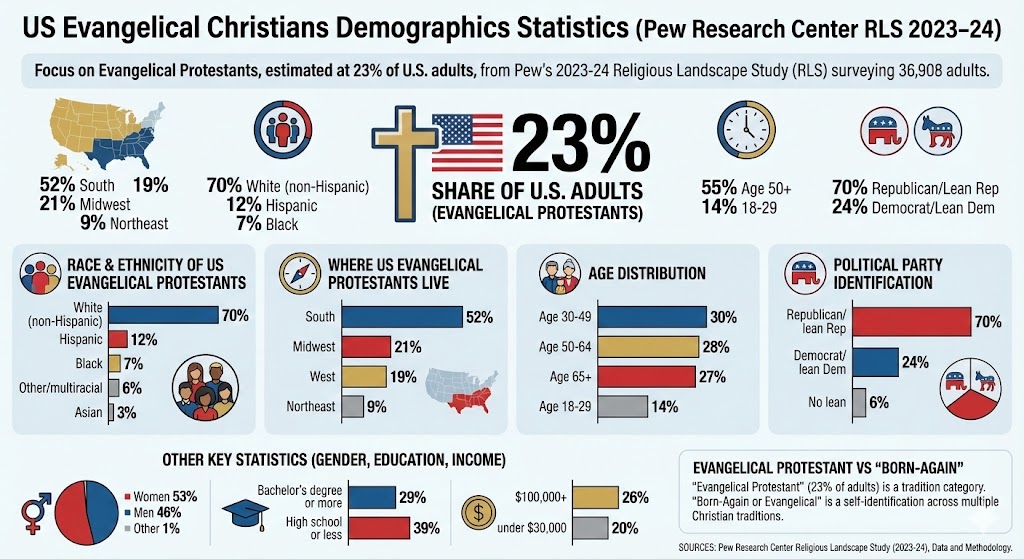
In U.S. survey research, “evangelical Christians” is commonly measured in two ways: (1) people who identify as evangelical Protestants (a Protestant tradition category) and (2) Christians who self-identify as “born-again or evangelical”. The demographics below focus primarily on evangelical Protestants, using Pew Research Center’s 2023-24 Religious Landscape Study (RLS).
US Evangelical Christians demographics statistics
US Evangelical Christians Demographics (Top Highlights)
23% of U.S. adults identify as evangelical Protestants.
52% of evangelical Protestants live in the South (vs. 21% Midwest, 19% West, 9% Northeast).
Evangelical Protestants are 70% White (non-Hispanic), 12% Hispanic, and 7% Black (with smaller shares Asian and multiracial/other).
55% of evangelical Protestants are age 50+ (14% are 18-29).
53% are women and 46% are men (about 1% report another gender identity).
29% have a bachelor’s degree or more.
26% report household income of $100,000+ (20% report under $30,000).
70% identify with or lean toward the Republican Party (24% Democrat/lean Democrat; 6% no lean).
Evangelical Protestant vs “Born-Again or Evangelical”
Evangelical Protestant is a religious tradition category (people affiliated with Protestant denominations in the evangelical tradition). In Pew’s RLS, this group is estimated at 23% of U.S. adults.
Separately, Pew also asks respondents whether they describe themselves as “born-again or evangelical”. This self-description can include people across multiple Christian traditions, not only evangelical Protestants, so it should not be treated as identical to the evangelical Protestant tradition category.
Demographic Profile at a Glance
Metric
Evangelical Protestant estimate
Share of U.S. adults
23%
Women / Men
53% / 46%
Age 50+
55%
White (non-Hispanic)
70%
Bachelor’s degree or more
29%
Household income $100,000+
26%
Live in the South
52%
Republican/lean Republican
70%
Race and Ethnicity of US Evangelical Protestants
Pew’s RLS data shows evangelical Protestants are majority White (non-Hispanic), with Hispanic and Black evangelicals representing notable minorities.
Label
Bar
Value
White (non-Hispanic)
70%
Hispanic
12%
Black
7%
Other/multiracial
6%
Asian
3%
Max = 70. Widths: White (non-Hispanic) 100.00%, Hispanic 17.14%, Black 10.00%, Other/multiracial 8.57%, Asian 4.29%.
Where US Evangelical Protestants Live
Evangelical Protestants are regionally concentrated in the South in Pew’s RLS estimates.
Label
Bar
Value
South
52%
Midwest
21%
West
19%
Northeast
9%
Max = 52. Widths: South 100.00%, Midwest 40.38%, West 36.54%, Northeast 17.31%.
Age Distribution of US Evangelical Protestants
In Pew’s RLS, evangelical Protestants skew older: 55% are age 50+ (28% are 50-64 and 27% are 65+).
Label
Bar
Value
Age 30-49
30%
Age 50-64
28%
Age 65+
27%
Age 18-29
14%
Max = 30. Widths: Age 30-49 100.00%, Age 50-64 93.33%, Age 65+ 90.00%, Age 18-29 46.67%.
Political Party Identification Among US Evangelical Protestants
Pew’s RLS finds evangelical Protestants are one of the most Republican-leaning major religious groups by party identification.
Label
Bar
Value
Republican/lean Rep
70%
Democrat/lean Dem
24%
No lean
6%
Max = 70. Widths: Republican/lean Rep 100.00%, Democrat/lean Dem 34.29%, No lean 8.57%.
Other Demographic Stats Worth Knowing
Gender: 53% women, 46% men (about 1% report another gender identity).
Education: 29% have a bachelor’s degree or higher; 39% have a high school diploma or less.
Income: 26% report $100k+ household income; 20% report under $30k.
Methodology Snapshot
Pew Research Center’s 2023-24 Religious Landscape Study surveyed 36,908 U.S. adults and was conducted from July 17, 2023 to March 4, 2024.
Sources
Pew Research Center — Religious Landscape Study (2023-24): Evangelical Protestant tradition estimates.
Pew Research Center — Religious Landscape Study (2023-24): Demographic profiles by religious tradition (age, race/ethnicity, gender, education, income, region).
Pew Research Center — Religious Landscape Study (2023-24): Religion and political party identification breakdowns.
Pew Research Center — Religious Landscape Study (2023-24): Topline and methodology documentation.
Amplify your worship experience with the 10 best Christian altar furniture sets that promise to transform your space—discover the perfect pieces to elevate your service.