A dependable microphone boom arm keeps your mic positioned consistently while freeing desk space for notes, headphones, and controls. The right model can also reduce handling noise and make it easier to adjust your setup between solo recording, interviews, streaming, and video calls.
These 10 picks cover popular options for Blue Yeti, HyperX, QuadCast, FIFINE, and other microphones, with attention to stability, reach, mounting flexibility, cable management, and everyday adjustment. Use the guide below to narrow the list based on your microphone’s weight and your available desk space.
Best 10 Microphone Boom Arm for Podcasting Picks for 2026
Professional Pick
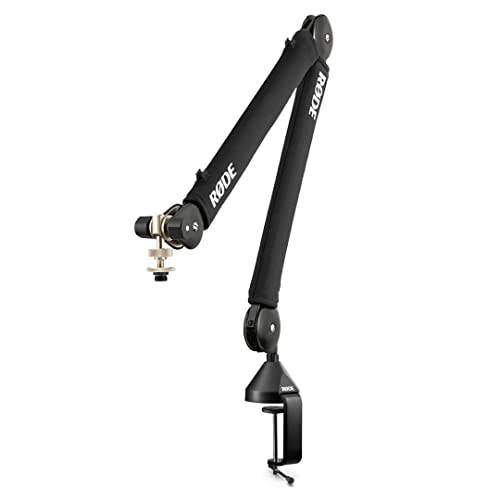
- Quiet internal spring damping
- 360° rotation with hidden cable routing
- Supports microphones up to 1.2kg
Best For: Professional podcast and streaming desks
Low-Profile Choice

- Extends beneath the monitor
- Metal construction with stable C-clamp
- Reaches 29 inches with broad adjustment
Best For: Gaming and podcast desks needing screen clearance
Heavy-Duty Reach

- Handles up to 3.5 pounds
- Reaches 32.3 inches horizontally
- Includes riser and cable channels
Best For: Heavier microphones and large desk setups
Compact Colorful Pick

- 26-inch foldable scissor arm
- 360° swivel and 180° tilt
- Quiet movement with padded clamp
Best For: Small studios and pink-themed podcast setups
Best Space-Saving Pick
Low-Profile Magnetic Cable Mic Arm

- 3.35-inch low-profile arm
- Magnetic cable management
- 3.3-pound capacity and versatile adjustment
Best For: Minimalist desks and compact podcasting setups
Best Classic Boom Arm

- Fold-away standard arm design
- 3.3-pound steel-supported capacity
- Includes clip and thread adapter
Best For: Flexible recording, streaming, and storage
Best Extended Low-Profile Arm

- Extends to 25.6 inches
- 360° horizontal and 250° vertical adjustment
- Headphone-hook clamp and 3.3-pound capacity
Best For: Larger desks and setups needing extra microphone reach
Best Compact Fit

- Supports popular USB and studio microphones
- Dual springs help reduce movement and sagging
- Padded clamp fits desks up to 1.89 inches thick
Best For: Compact podcast and streaming desks
Best Heavy-Duty Stability
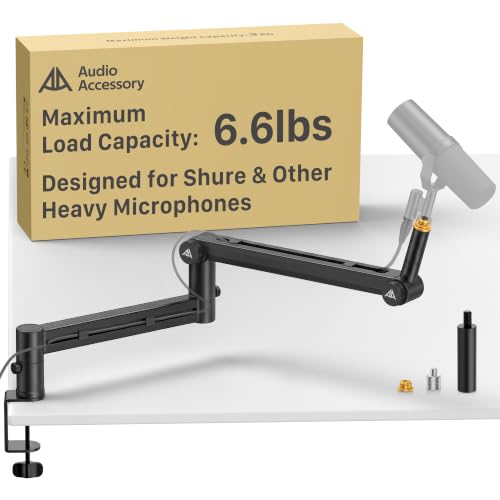
- Handles microphones up to 6.6 pounds
- Gear-lock design helps prevent sagging
- 780 mm reach with cable channels
Best For: Heavy broadcast microphones and permanent podcast desks
Best All-in-One Setup

- Includes pop filter, shock mount, adapter, and cable ties
- Extra-strong spring and padded desk clamp
- Supports up to 1.5 kg and 2-inch-thick desks
Best For: New podcasters building a complete microphone setup
Professional Pick – RØDE PSA1+ Boom Arm
For creators looking for a microphone boom arm for podcasting, the RØDE PSA1+ combines quiet movement, broad positioning, and concealed cable routing. Its clamp supports desks up to 70mm thick, while the arm holds microphones and shock mounts weighing 0.25kg to 1.2kg.
Best For: Professional podcast and streaming setups that prioritize quiet operation and a clean desk.
Pros:
- Internal spring damping helps reduce creaks and handling noise during adjustments.
- 360-degree rotation and full extension provide flexible microphone positioning.
- Integrated cable management keeps XLR runs hidden.
- Includes 3/8-inch and 5/8-inch thread adaptors.
Cons:
- Its 1.2kg maximum load may not suit heavier microphone setups.
- The desk clamp is limited to desks up to 70mm thick.
The PSA1+ is a strong choice when silent repositioning and a tidy broadcast-style appearance matter more than maximum load capacity.
Low-Profile Choice – FIFINE BM88 Boom Arm
The FIFINE BM88 is a practical microphone boom arm for podcasting when you want a sturdy metal stand that stays below your monitor. Its low-profile design preserves screen visibility, while the adjustable arm reaches up to 29 inches.
Best For: Gaming, streaming, and podcast desks where monitor clearance and a stable clamp are priorities.
Pros:
- Low-profile layout can extend beneath a computer screen without obstructing the view.
- All-metal construction and a stable C-clamp help limit wobbling.
- Offers 220-degree vertical and 360-degree horizontal adjustment.
- Includes 1/4-inch, 3/8-inch, and 5/8-inch thread compatibility.
Cons:
- The microphone is not included.
- The clamp fits desktops from 0.8 to 2.4 inches thick.
- The section nearest the C-clamp cannot adjust vertically.
Choose the BM88 if a lower microphone position and clear monitor sightline are more useful to your setup than maximum reach.
Heavy-Duty Reach – InnoGear MU-PSA28 Mic Arm
The InnoGear MU-PSA28 is a flexible microphone boom arm for podcasting with a 3.5-pound load capacity and extended reach. It includes a 6.3-inch riser and built-in cable channels, making it suitable for heavier microphones and larger desk layouts.
Best For: Podcasters using heavier microphones such as a Yeti or SM7B and needing extra height.
Pros:
- Supports microphones weighing up to 3.5 pounds.
- Reaches 32.3 inches horizontally and 37.4 inches vertically with the riser.
- Internal cable channels create a cleaner, less tangled setup.
- Works with a range of microphones through its 5/8-inch connector.
Cons:
- The shock mount is not included.
- The clamp fits desks up to 2 inches thick.
- Its larger reach may be more than compact desks require.
With its higher capacity, extension riser, and long reach, the MU-PSA28 is a good fit for podcast stations built around larger or heavier microphones.
Compact Colorful Pick – FIFINE CS1P Pink Boom Arm
The FIFINE CS1P is a compact microphone boom arm for podcasting that combines a 26-inch reach with a foldable scissor-arm design. Its pink finish adds visual character, while the padded clamp and quiet movement suit small studios, dorms, and home recording spaces.
Best For: Compact podcast, streaming, and voice-over setups that want flexible positioning and a distinctive pink finish.
Pros:
- Provides 360-degree horizontal swivel and 180-degree vertical tilt.
- Folds compactly to help reduce clutter when not in use.
- Includes 3/8-inch and 5/8-inch adapters for broad microphone compatibility.
- Rubber-padded C-clamp helps grip the desk without scratching it.
Cons:
- The 26-inch reach is shorter than some larger boom arms.
- The pink finish may not suit every studio aesthetic.
- Its supplied notes do not specify a maximum microphone weight.
The CS1P makes the most sense for creators who value compact storage, quiet adjustments, and a colorful setup over maximum reach or documented load capacity.
Best Space-Saving Pick – Low-Profile Magnetic Cable Mic Arm
If desk space and cable clutter are your main concerns, this low-profile microphone boom arm for podcasting keeps the lower arm just 3.35 inches above the desk. Its magnetic cable channel, broad adjustability, and 3.3-pound capacity make it a practical fit for compact recording or streaming stations.
Best For: Minimalist desks, small workstations, and creators who want discreet cable management.
Pros:
- Low-profile design helps preserve desk and monitor space.
- Integrated magnetic cable channel keeps wires hidden and tangle-free.
- Offers 360° base rotation, 180° swivel, 170° tilt, and 360° shaft rotation.
- Supports microphones and compatible devices up to 3.3 pounds.
Cons:
- The clamp fits flat desk edges up to 2.36 inches thick.
- A shock mount is not included.
This arm is a strong choice when a clean, unobtrusive setup matters as much as positioning flexibility. Check your desk edge and microphone thread before buying.
Best Classic Boom Arm – Adjustable White Mic Stand
This standard microphone boom arm for podcasting emphasizes flexible positioning and easy storage. Its steel construction, strong springs, 3.3-pound load rating, and fold-away design suit recording setups that need a conventional desk-mounted arm.
Best For: Podcasters and streamers who want a traditional, foldable arm with broad microphone compatibility.
Pros:
- 360° base rotation and adjustable arm sections support flexible positioning.
- Folds away when not in use to save space.
- Steel construction and strong springs support up to 3.3 pounds.
- Includes a standard microphone clip and a 5/8-inch-to-3/8-inch adapter.
Cons:
- The clamp is intended for flat, squared desk edges up to 2 inches thick.
- Some microphones may require an additional shock mount, which is not included.
Choose this model if you prefer a familiar boom-arm layout and need to move the microphone away between sessions. Its white finish also offers an alternative to the usual black stand.
Best Extended Low-Profile Arm – 25.6-Inch Flexible Mic Stand
For podcasting desks that need extra reach, this microphone boom arm for podcasting extends up to 25.6 inches while maintaining a low-profile design. Its 360° horizontal rotation, 250° vertical adjustment, headphone-hook function, and 3.3-pound capacity provide useful flexibility for larger setups.
Best For: Extended-reach recording stations, streaming desks, and users who want a built-in headphone hook.
Pros:
- Extends up to 25.6 inches for broader desk coverage.
- Provides 360° horizontal rotation and 250° vertical adjustment.
- Supports up to 3.3 pounds and includes multiple thread adapters.
- C-style clamp also works as a convenient headphone hook.
Cons:
- The clamp is designed for desktops up to 2.75 inches thick.
- Its longer reach may require more clearance than a compact arm.
This is the most suitable option of the three when reach and positioning range take priority. Confirm that your desk has enough open space for the extended arm and that your device uses a compatible thread.
Best Compact Fit – SUNMON QuadCast Boom Arm
If you need a microphone boom arm for podcasting with a familiar desktop setup, this SUNMON model is a practical match for popular microphones such as the HyperX QuadCast, Blue Yeti, SoloCast, Shure MV7, and FIFINE models. Its dual-spring design and adjustable joints help you position the mic while the padded clamp protects the desk.
Best For: Podcasters using a popular USB or compact studio microphone and wanting a straightforward clamp-mounted arm.
Pros:
- Supports microphones up to 1.4 kg and includes a pre-installed 3/8-inch to 5/8-inch adapter.
- Dual suspension springs and reinforced knobs help reduce shaking, sinking, and handling noise.
- Clamp fits desks up to 1.89 inches thick and includes protective sponge padding.
Cons:
- The package does not include a microphone.
- Its 1.4 kg capacity may be limiting for heavier broadcast microphones and accessories.
This is a sensible choice for a compact podcast or streaming desk, especially if you use one of the listed compatible microphones. Check the microphone and accessory weight before buying.
Best Heavy-Duty Stability – Low Profile Gear-Lock Mic Arm
For podcasting setups built around a heavier microphone, this low-profile arm stands out with a 6.6-pound load capacity and a gear-lock mechanism designed to resist sagging. Its extra-long reach, broad rotation range, and cable channels make it well suited to a more permanent desk-mounted studio arrangement.
Best For: Podcasters using heavier microphones such as the Shure SM7B, Shure MV7, or RODE PodMic.
Pros:
- Supports up to 6.6 pounds, or approximately 3 kg.
- Gear-lock construction is designed for stable positioning without the long-term sag associated with spring-loaded arms.
- Offers a 780 mm reach, 360-degree horizontal rotation, 120-degree vertical adjustment, and built-in cable channels.
Cons:
- At 1.63 kg, it is substantially heavier than more basic boom arms.
- The low-profile design and multiple adjustment parts may be more setup than a casual user needs.
This is the strongest option in the group for a serious podcasting rig where microphone weight and stable positioning matter most. The included adapters and extension rod also broaden compatibility with different microphone mounts.
Best All-in-One Setup – InnoGear Mic Arm Set
This InnoGear kit is a convenient microphone boom arm for podcasting when you want more than the arm alone. Along with the clamp-mounted stand and adapter, it includes a pop filter, shock mount, and cable ties, giving new recording setups several useful accessories in one package.
Best For: First-time podcasters who want an accessory bundle for a standard-size microphone.
Pros:
- Includes a shock mount, double-screen pop filter, 3/8-inch to 5/8-inch adapter, and five cable ties.
- Extra-strong springs and a padded clamp help limit accidental dropping, shaking, and desk damage.
- Supports up to 1.5 kg and fits desks up to 2 inches thick.
Cons:
- The included shock mount is not designed to fit the Blue Yeti.
- Its 1.5 kg capacity is less suitable for heavier broadcast microphone configurations.
- The bundled accessories may be unnecessary if you already own a shock mount and pop filter.
Choose this set when convenience and included accessories are more important than maximum load capacity. Confirm the shock-mount fit for your specific microphone, particularly if you use a Blue Yeti.
How We Picked the Best Microphone Boom Arm for Podcasting
We focused on the features that have the greatest effect on recording workflow: arm stability, smooth positioning, desk-clamp security, reach, construction, and microphone compatibility. We also considered whether each arm suits compact desks, low-profile setups, heavier microphones, or common USB podcasting models.
Spring damping, locking joints, and a strong clamp can help prevent unwanted movement during a recording. Cable-management features are another practical advantage because they keep the microphone lead away from your hands and reduce visual clutter on camera.
Quick Comparison
| Best For | What to Look For |
|---|---|
| Small desks | Low-profile arms with compact clamps and shorter reach |
| Heavy microphones | High load capacity, reinforced joints, and a sturdy desk mount |
| USB podcast microphones | 3/8-inch or 5/8-inch thread compatibility and included adapters |
| Clean camera framing | Low-profile design and integrated cable management |
| Frequent repositioning | Smooth joints, spring damping, and reliable tension control |
Key Buying Factors for a Microphone Boom Arm for Podcasting
Weight Capacity and Balance
Check the combined weight of the microphone, shock mount, and any accessories before buying. An arm rated for a light microphone may sag when paired with a heavier condenser mic or oversized shock mount. Capacity ratings are useful, but joint design and clamp quality also determine real-world stability.
Reach, Movement, and Desk Clearance
Measure the distance from your desk edge to your preferred speaking position. A longer arm offers more placement freedom, while a low-profile model stays out of the way when the microphone is not in use. Confirm that the clamp opens wide enough for your desk and that the arm can clear monitors, shelves, and other equipment.
Thread and Microphone Compatibility
Many microphone arms use 3/8-inch or 5/8-inch threads, and some include an adapter. Verify the connection standard for your microphone or shock mount, especially with Blue Yeti, HyperX, QuadCast, FIFINE, and similar USB microphones. An adapter may solve thread differences, but it cannot compensate for insufficient load capacity.
Cable Management and Noise
Built-in clips or channels make a cleaner setup and help keep cables from catching as the arm moves. For podcasting, choose an arm with quiet, controlled joints and avoid touching the desk or arm during recording whenever possible to limit transmitted vibration.
Who Should Buy Which Microphone Boom Arm for Podcasting?
Choose a low-profile arm if you record at a compact desk, want an unobstructed camera view, or regularly move the mic out of the way. Choose a heavy-duty model if your microphone and mount approach the upper end of the arm’s stated capacity or you need the arm to remain fixed for long sessions. Choose a cable-managed arm if appearance and a tidy streaming or podcasting workspace matter. Choose a versatile adapter-equipped arm if you use multiple microphones or expect to upgrade later.
Before ordering, confirm the desk-clamp dimensions, thread size, load rating, and available clearance. Those four checks usually matter more than appearance and will help ensure your Microphone Boom Arm for Podcasting remains stable through every recording.