Scanning a bound book is different from digitizing loose pages. The right overhead scanner can reduce spine stress, correct curved text, remove fingers from the image, and turn pages into searchable files with far less manual work.
These 10 book scanners for bound documents range from portable models for occasional projects to high-resolution systems designed for libraries, offices, archives, and professional digitization. Use the guide below to match features, format support, and workflow speed to your needs.
Best 10 Book Scanners for Bound Documents Picks for 2026
Best All-Rounder

- About two seconds per page
- Curved-page flattening with laser lines
- OCR and searchable PDF output
Best For: Fast home-office and student book scanning
Best for Hands-Off Scanning

- Scans bound materials without cutting
- Automatic curve correction
- Page-turn detection for batches
Best For: Fragile books, newspapers, and archives
Best High-Resolution Option
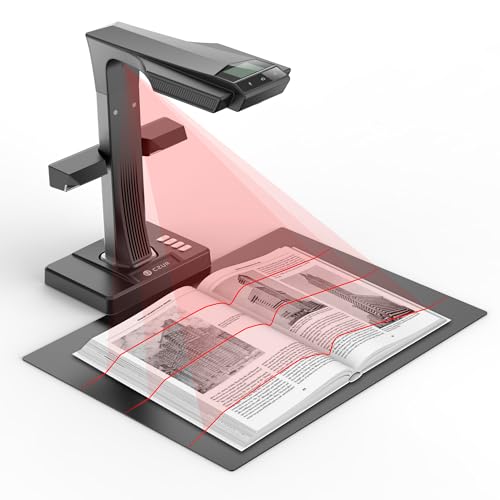
- 24MP camera with 5696 × 4272 resolution
- A3 capture for books and documents
- HDMI and ABBYY OCR support
Best For: Professional and research-grade desktop scanning
Best for Large Formats

- Captures A2 and A3 materials
- 26MP imaging with up to 600 DPI enhancement
- Automatic flattening, splitting, and OCR
Best For: Large books, maps, newspapers, and manuscripts
Portable Speed Pick

- About one-second-per-page scanning
- A3 support with 13MP imaging
- Foldable design and document-camera mode
Best For: Fast scanning of thinner books and documents
High-Resolution Archive Pick

- 48MP overhead capture with detailed imaging
- AI page flattening and automatic splitting
- OCR, text-to-speech, and 4K camera mode
Best For: Book archiving, detailed pages, and teaching
All-in-One Desk Pick

- About two-second scanning for single or double pages
- Laser-assisted curved-page flattening
- Scanner, auto-capture system, and desk lamp
Best For: Home offices and thinner bound books
Best A3 Overhead Option

- A3 overhead scanning for bound and oversized materials
- 16MP camera with up to 300 DPI capture
- Anti-glare LED lighting; Windows and Mac compatible
Best For: Large books, artwork, sheet music, and home or office archiving
Best Heavy-Duty Pick

- 38MP CMOS sensor with up to 410 DPI
- Curve flattening for bound book pages
- OCR, A3 support, and 1.5-second page scanning
Best For: Detailed, high-volume book and document digitization
Best Fast Book Scanning Value

- 16MP camera with 1.5-second-per-page scanning
- Flattening technology corrects curved book pages
- OCR and multi-item scanning flexibility
Best For: Fast book, binder, and mixed-document scanning
Best All-Rounder – CZUR Aura Pro
For shoppers comparing book scanners for bound documents, the CZUR Aura Pro offers a fast, compact setup for books and standard office materials. It scans a page in about two seconds, supports A3 and A4 capture, and uses laser-assisted technology to flatten curved pages.
Best For: Home offices, students, and users who want fast bound-book scanning with OCR and document conversion.
Pros:
- Scans pages in approximately two seconds and exports JPG, Word, PDF, and searchable PDF files.
- OCR supports more than 180 languages, with the listed exceptions of Thai, Hebrew, and Arabic.
- Three laser lines help flatten curved book pages, while supplemental lighting improves capture conditions.
- Works with supported Windows and macOS systems, including Apple Silicon Macs running macOS 13 or later.
Cons:
- Thai, Hebrew, and Arabic OCR are not supported according to the supplied specifications.
- It connects by USB rather than Wi-Fi or Bluetooth.
The Aura Pro is a practical choice when speed, OCR, and ease of use matter more than professional camera resolution. Its built-in lighting and curved-page processing make it well suited to routine book digitization.
Best for Hands-Off Scanning – ScanSnap SV600
The ScanSnap SV600 is designed for book scanners for bound documents when removing pages is not an option. Its overhead design captures books, newspapers, magazines, photos, and documents without cutting or damaging them, while automated correction handles many common scanning tasks.
Best For: Users digitizing fragile, bound, or mixed-format materials without disbinding them.
Pros:
- Scans books, newspapers, magazines, and documents directly without cutting or damaging them.
- Auto Book Correction helps flatten pages and correct curve distortion.
- Page Turning Detection can start scans automatically when a page is turned.
- Multi Document Detection automatically crops and rotates multiple items in one scan.
Cons:
- Its listed resolution is 1200, and the scanner weighs 6.6 pounds, making it less portable than lighter models.
- Point Retouch is needed to remove captured fingers from scans.
- System requirements vary by operating system and include Windows 10/11 or macOS Monterey 12 or later.
The SV600 stands out for convenient overhead scanning and automatic page handling. It is especially appealing for archives and personal collections where preserving the original binding is a priority.
Best High-Resolution Option – CZUR ET24 Pro
For demanding book scanners for bound documents, the CZUR ET24 Pro combines a 24MP camera with book-flattening software and A3 capture. Its upgraded processing system, HDMI support, and preview display make it a strong fit for users who want detailed scans and responsive operation.
Best For: Professionals, researchers, and creators who need high-resolution A3 book and document capture.
Pros:
- 24MP camera provides 5696 × 4272 resolution and a listed 320 DPI capture specification.
- Flattening technology processes curved 3D book surfaces into flatter page images.
- Supports A3 materials, including books, documents, receipts, business cards, paintings, and magazines.
- ABBYY OCR can convert JPG files into editable PDF, Excel, and Word formats.
Cons:
- Very glossy papers are not recommended.
- Arabic OCR is limited to ET-series scanners running Windows; Thai and Hebrew are not supported.
- At 4.5 kg, it is better suited to a dedicated desktop than frequent carrying.
The ET24 Pro is a capable step up for detail-focused scanning. Its resolution, A3 support, preview screen, and multiple lighting options make it useful when image quality and workflow control are important.
Best for Large Formats – VIISAN S21 A2 Scanner
The VIISAN S21 is one of the more flexible book scanners for bound documents, especially when working with oversized materials. Its adjustable A2/A3 overhead design can capture large journals, manuscripts, newspapers, maps, books, and even 3D objects, with software-assisted page correction and OCR.
Best For: Libraries, studios, and offices digitizing large-format books, maps, newspapers, and manuscripts.
Pros:
- A2 capture supports materials up to 594 × 420 mm, with an adjustable A2/A3 design.
- 26MP capture reaches 5888 × 4522 pixels, with software-enhanced output up to 600 DPI.
- Software can flatten curved pages, remove fingers, repair edges, and split facing pages.
- OCR can convert scans into PDF, Word, Excel, EPUB, and text files.
Cons:
- Bundled OfficeCam software is not compatible with ARM-based devices such as the Surface Pro X.
- Very glossy paper is not recommended, and the built-in LEDs are not recommended in bright light.
- The listed hardware interface is USB 2.0.
The S21 is the strongest choice here for oversized documents and varied capture tasks. Its large scanning area and corrective software are particularly valuable for collections that extend beyond standard A3 book sizes.
Portable Speed Pick – CZUR Shine Ultra
The CZUR Shine Ultra is a practical choice among book scanners for bound documents when portability and quick capture matter. It scans pages in about one second, supports materials up to A3, and combines scanning with document-camera functionality for Windows and compatible macOS systems.
Best For: Fast scanning of thinner bound books, loose documents, teaching materials, and remote presentations.
Pros:
- Scans pages in about one second and supports documents smaller than A3.
- Patented technology helps flatten curved pages from thinner books.
- 13MP camera, OCR for more than 180 languages, auto-cropping, and smart paging.
- Foldable, lightweight design with adjustable height and a foot pedal.
Cons:
- The page-flattening technology is intended for thinner books; CZUR recommends the ET series for thicker volumes.
- Not compatible with Android or iOS.
- OCR does not currently support Thai, Hebrew, or Arabic.
Choose the Shine Ultra if you want a compact, fast workflow for everyday books and paperwork. Its limitations around thick bindings and mobile compatibility are worth considering before purchase.
High-Resolution Archive Pick – VIISAN K48 Book Scanner
The VIISAN K48 is a high-resolution option for book scanners for bound documents, particularly when detailed text, diagrams, and archive pages are priorities. Its overhead design uses AI-assisted flattening and automatic page splitting to streamline digitization on Windows and Mac.
Best For: Detailed book archiving, textbooks, reports, searchable files, and classroom document-camera use.
Pros:
- Captures book and document details at up to 600 DPI according to the product description.
- AI-assisted page flattening and automatic page splitting reduce manual cleanup.
- OCR creates searchable PDFs and editable documents, with text-to-speech support.
- Works as a 4K USB document camera at 30 frames per second.
Cons:
- At 2.8 kg, it is less portable than lightweight book-scanning models.
- Its USB setup is intended for Windows and Mac rather than mobile devices.
- The supplied details list a one-year manufacturer warranty but provide limited information about included accessories.
The K48 is a strong fit when image detail and digitization tools matter more than minimal size. It offers a versatile combination of scanning, OCR, text-to-speech, and live presentation features.
All-in-One Desk Pick – CZUR Aura Pro
The CZUR Aura Pro combines book scanning with lighting and automatic capture, making it a flexible option among book scanners for bound documents. It scans single or double pages in about two seconds, handles materials smaller than A3, and uses laser-based page flattening for curved books.
Best For: Home offices, family archives, thinner bound books, and users who want a scanner that also functions as a desk lamp.
Pros:
- Scans single sheets and double-page books in about two seconds.
- Three laser lines help flatten curved pages and improve image clarity.
- Auto-detects page turns and supports foot-pedal scanning.
- Includes supplemental side lights, OCR for more than 180 languages, and four lamp color modes.
Cons:
- The page-flattening approach is best suited to thinner books.
- OCR does not currently support Thai, Hebrew, or Arabic.
- Sound control can be affected by ambient noise and works within about 10 feet.
The Aura Pro is appealing if you want scanning convenience without dedicating the device solely to document capture. Its automatic page detection, supplemental lighting, and desk-lamp functions make it especially suitable for a home workspace.
Best A3 Overhead Option – VIISAN DL16
For shoppers comparing book scanners for bound documents, the VIISAN DL16 is a practical overhead model for books, oversized pages, sheet music, artwork, and other materials that do not fit conveniently on a standard flatbed. Its A3 capture area and 16MP camera support organized digitization at home, in offices, libraries, and study spaces.
Best For: Large bound books, artwork, archives, sheet music, and general A3 document scanning.
Pros:
- A3 overhead design accommodates large documents and bound materials.
- 16MP camera captures images at up to 300 DPI.
- Anti-glare LED lighting helps reduce glare and uneven shadows.
- Compatible with Windows and Mac systems.
Cons:
- USB connection is required.
- Its 300 DPI resolution is lower than the higher-resolution CZUR ET MAX.
The DL16 is a sensible choice when page size and flexible overhead capture matter more than maximum resolution. It offers useful lighting and broad document compatibility for everyday archiving and reference workflows.
Best Heavy-Duty Pick – CZUR ET MAX
The CZUR ET MAX is a strong option for buyers seeking book scanners for bound documents with high-resolution output and fast page handling. Its 38MP CMOS sensor, curve-flattening technology, A3 scanning area, and OCR features make it suited to detailed digitization and larger scanning projects.
Best For: High-detail book digitization, bulk scanning, searchable files, and A3 documents.
Pros:
- 38MP sensor provides up to 410 DPI resolution.
- Curve-flattening technology helps correct distortion on bound pages.
- OCR supports editable and searchable files in more than 180 languages.
- Works with Windows, macOS, and supported Ubuntu versions; HDMI output is included.
Cons:
- Not recommended for glossy or highly reflective materials.
- Arabic OCR support varies by operating system, and Thai and Hebrew are not supported.
- Its feature set may be more than needed for occasional scanning.
With its combination of high resolution, page correction, and fast 1.5-second scanning, the ET MAX is designed for demanding workflows. It is especially compelling when searchable output and detailed A3 captures justify choosing a professional model.
Best Fast Book Scanning Value – CZUR ET16 Plus
For buyers looking at book scanners for bound documents, the CZUR ET16 Plus combines a 16MP camera with automatic curved-page flattening and a claimed 1.5-second-per-page scanning speed. It can handle books, binders, business cards, vouchers, and some physical objects, making it a versatile choice for home or office projects.
Best For: Fast scanning of bound books, binders, business documents, and mixed small items.
Pros:
- Flattening technology helps correct the curved surface of book pages.
- 1.5-second-per-page speed is designed for efficient scanning.
- OCR supports more than 180 languages, with stated language limitations.
- Ten LED lights plus two supplemental lights support shadow-reduced capture.
Cons:
- Very glossy paper is not recommended.
- It uses a 16MP camera and lower listed resolution than the ET MAX.
- Arabic OCR support is limited by operating system, while Thai and Hebrew are not supported.
The ET16 Plus is a practical middle ground for users who value speed and book-page correction without needing the ET MAX’s 38MP sensor. Its ability to scan several types of items also adds flexibility for mixed document projects.
How We Picked These Book Scanners for Bound Documents
We focused on overhead and camera-based scanners designed to capture books without forcing pages flat. The selection considers page-size support, camera resolution, automatic page flattening, finger removal, OCR, lighting, scanning speed, portability, and software features. We also included options for common A3 books as well as larger documents and oversized volumes.
Resolution claims are only part of the decision. A scanner’s software, lighting consistency, page-turning workflow, and ability to correct curved text can matter just as much as megapixels when producing readable digital books.
Quick Comparison
| Best For | What to Look For |
|---|---|
| Home and occasional use | Portable design, simple software, and automatic correction |
| Office document capture | Fast page processing, OCR, and broad file-format support |
| Libraries and archives | High resolution, gentle overhead capture, and reliable flattening |
| Large or oversized books | A2 or A3 capture area and strong edge-to-edge lighting |
| Searchable digital collections | Accurate OCR, text cleanup, and export controls |
Key Buying Factors for Book Scanners for Bound Documents
Capture Size and Book Compatibility
Check the maximum scan area before buying. A3 coverage suits many textbooks, manuals, and large books, while A2-capable models are better for maps, art books, newspapers, and oversized archival material. Also consider whether the camera can capture both pages of an open book in one frame.
Page Flattening and Spine Protection
Automatic curve correction and page-flattening software improve readability near the binding. Finger-removal technology can also keep hands out of the final image while allowing you to hold pages gently. These features are especially valuable for fragile or tightly bound books.
Resolution, Lighting, and Image Quality
Higher megapixel ratings can preserve small print and illustrations, but even lighting and glare control are equally important. Look for anti-glare illumination, consistent exposure, and image cleanup tools. A high-resolution camera is most useful when the software can process the resulting files efficiently.
OCR and Workflow Speed
OCR converts captured pages into searchable and editable text. If you are digitizing hundreds of pages, compare automatic page detection, batch capture, duplex or two-page workflows, keyboard or foot-pedal support, and export options such as PDF, TIFF, and Word.
Portability and Connectivity
Portable scanners work well for classrooms, offices, travel, and occasional home projects. USB connectivity is common, while some models may require a particular operating system or proprietary software. Confirm compatibility with your computer before ordering.
Who Should Buy Which Book Scanners for Bound Documents?
Choose a portable model if you scan occasionally or need to move between workspaces. Choose an A3 overhead scanner for textbooks, ledgers, manuals, and most bound documents. Choose a large-format model for oversized books, newspapers, maps, and artwork. Choose a professional high-resolution scanner when image detail, archival quality, or recurring production work matters most.
For searchable records, prioritize OCR and batch-processing tools over headline camera specifications. For delicate books, prioritize non-contact overhead capture, page flattening, and gentle lighting. Before purchasing, verify software support, included accessories, maximum book thickness, and the file formats required by your archive or workflow.