Digitizing books and paperwork does not always require expensive office equipment. The best book scanners under $300 can combine overhead capture, page-flattening software, OCR, and portable designs for practical home, school, and small-business use.
This roundup compares 10 affordable options, from compact flatbed and mobile scanners to A3 overhead models built for bound books. Consider page size, scan speed, OCR support, lighting, and software compatibility before choosing.
Best 10 Book Scanners Under 300 Picks for 2026
Feature-Rich Choice

- Scans a page in about two seconds
- Flattens curved book pages with laser technology
- Supports OCR and searchable PDF output
Best For: Frequent book and document digitization
Simple Flatbed Pick

- 2400 x 2400 dpi optical resolution
- Auto Scan Mode detects scan types
- Handles photos, receipts, and documents
Best For: Everyday flat documents and images
Portable Speed Pick

- Scans at about one second per page
- Supports A3 and A4 documents
- Folds for portability and doubles as a document camera
Best For: Portable scanning and thinner books
Refurbished Productivity Option

- Certified refurbished and functionality tested
- One-button scanning workflow
- Includes accessories and at least a 90-day warranty
Best For: Budget-conscious document organization
Best for Book Flattening

- 16MP camera with auxiliary lighting
- Auto-flattening, deskew, and finger removal
- Scans A3/A4 pages at up to 40 ppm
Best For: Bound books and desktop archiving
Best Portable Document Scanner

- Weighs just 9.44 ounces
- Scans pages in as little as 5.5 seconds
- OCR creates searchable PDFs and editable files
Best For: Loose documents, receipts, and travel
Best Battery-Powered Option
Hczrc Portable Handheld Scanner

- Battery-powered and weighs 9.6 ounces
- Includes a 16GB Micro SD card
- Scans at 300, 600, or 900 dpi
Best For: Travel and occasional mobile scanning
Best Overall

- Under-one-second A3 scanning
- AI flattening and finger hiding
- OCR in 138+ languages
Best For: All-purpose book and document scanning
Best for A3 Archives

- Overhead A3 scanning
- 16MP camera with 300 DPI capture
- Anti-glare LED lighting
Best For: Large documents, books, and archival materials
Best Portable Pick
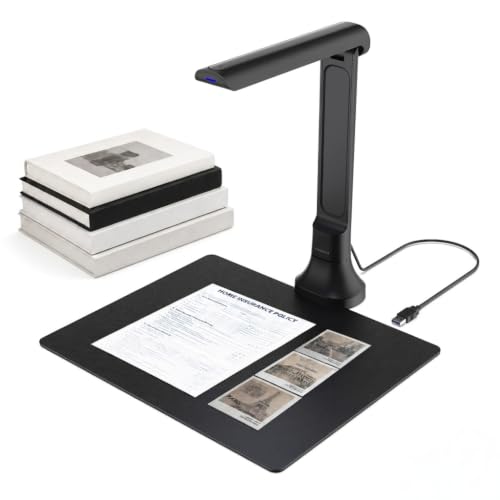
- Foldable 350-gram design
- 16MP autofocus camera
- OCR, read-aloud, and video calls
Best For: Portable scanning, teaching, and remote presentations
Feature-Rich Choice – CZUR Aura Pro
The CZUR Aura Pro is a strong option for shoppers comparing book scanners under 300 who want fast capture, OCR, and book-page flattening in one device. It scans a page in about two seconds and supports JPG, Word, PDF, and searchable PDF output.
Best For: Digitizing books and documents while also using the device as a glare-free smart reading lamp.
Pros:
- Three laser lines help flatten curved book pages for clearer scans.
- OCR supports more than 180 languages, with searchable PDF and Word output.
- Works with supported Windows and macOS systems and includes adjustable lighting.
Cons:
- Thai, Hebrew, and Arabic are not supported by the listed OCR system.
- Requires a USB connection; Wi-Fi and Bluetooth are not used.
With its combination of fast scanning, AI-assisted processing, and curved-page correction, the Aura Pro is suited to frequent book digitization. Check system compatibility before buying, especially if you use an older Mac.
Simple Flatbed Pick – Canon CanoScan LiDE 300
For shoppers seeking book scanners under 300 for everyday flat documents and images, the Canon CanoScan LiDE 300 offers a straightforward USB flatbed design. Its 2400 x 2400 dpi optical resolution and Auto Scan Mode support basic digitizing tasks.
Best For: Scanning flat photos, receipts, business cards, and documents with a compact traditional scanner.
Pros:
- Auto Scan Mode detects what you are scanning automatically.
- Provides 2400 x 2400 dpi optical resolution for detailed image capture.
- Supports common media including photos, receipts, business cards, and paper.
Cons:
- Its flatbed design is less convenient for thick or curved books.
- The supplied minimum system requirement lists Windows 7.
The LiDE 300 is a practical choice when your priority is simple flatbed scanning rather than rapid book capture or specialized page flattening. It is best matched with loose pages and individual images.
Portable Speed Pick – CZUR Shine Ultra
The CZUR Shine Ultra stands out among book scanners under 300 for portable, overhead-style capture. It scans at about one second per page, supports A3 and A4 materials, and can function as both a document scanner and a USB document camera.
Best For: Portable scanning, remote teaching, and digitizing thinner books or large documents.
Pros:
- Captures pages in about one second and supports documents up to A3 size.
- OCR supports more than 180 languages and includes smart cropping and paging tools.
- Foldable, height-adjustable design weighs about four pounds and includes a foot pedal.
Cons:
- Curved-page flattening is intended for thinner books; thicker books may need another model.
- Not compatible with Android or iOS devices.
- Thai, Hebrew, and Arabic are not supported by the listed OCR system.
The Shine Ultra is a flexible choice for users who value speed and portability over a conventional flatbed workflow. Its document-camera function adds usefulness for online teaching and meetings, provided you use a supported Windows or macOS computer.
Refurbished Productivity Option – Fujitsu ScanSnap iX500
The renewed Fujitsu ScanSnap iX500 is worth considering among book scanners under 300 if you want a productivity-focused scanner at a potentially lower cost. Its certified refurbished condition includes functionality testing, cleaning, inspection, repackaging, and a minimum 90-day warranty.
Best For: Buyers seeking a renewed Fujitsu scanner for organized document workflows and one-button operation.
Pros:
- Certified refurbished units are tested and inspected before sale.
- Designed to begin scanning and organization with the touch of a single button.
- Includes relevant accessories and a minimum 90-day limited warranty.
Cons:
- As a renewed product, it may arrive in a generic box.
- The supplied minimum system requirement lists Windows 7.
- Its listed scanner type is photo rather than specifically book scanning.
The iX500 makes the most sense for buyers comfortable with refurbished equipment and focused on general productivity. Because the supplied details do not identify book-page flattening features, it is less specialized for curved books than the CZUR models.
Best for Book Flattening – Joyusing V320pro Book Scanner
If you need one of the more capable book scanners under 300, the Joyusing V320pro is built specifically for bound books and larger pages. Its 16MP camera, A3/A4 support, automatic page flattening, deskewing, and OCR tools make it suited to digitizing books and documents on Windows or macOS.
Best For: Home archivists, students, and offices scanning bound books, thicker documents, and A3 or A4 pages.
Pros:
- Book-curve flattening, smart paging, and finger-removal features simplify book scanning.
- 16MP imaging and auxiliary lighting help produce clear captures, including in low light.
- Supports continuous scanning at up to 40 pages per minute and exports to several formats on Windows.
- Works with Windows XP through Windows 11 and macOS 10 through 14.
Cons:
- Its 1.8 kg weight and fixed desktop design are less convenient for travel.
- Some advanced file-format features are specified for Windows, while Mac support is listed for PDF.
- Book thickness is limited to 3 cm or less.
The V320pro is the strongest choice here when bound-book handling and automated flattening matter more than portability. It is a practical desktop option for repeated scanning projects.
Best Portable Document Scanner – Epson WorkForce ES-50
The Epson WorkForce ES-50 is a compact pick among book scanners under 300 for users who mainly scan loose pages, receipts, and ID cards. It connects by USB, requires no battery or external power supply, and includes software for OCR, searchable PDFs, and editable office files.
Best For: Commuters, remote workers, and small offices that need quick single-sheet document scanning.
Pros:
- Lightweight 9.44-ounce design is easy to carry.
- Scans a single page in as little as 5.5 seconds.
- USB-powered operation avoids batteries and a separate power adapter.
- Handles documents up to 8.5 by 72 inches, plus receipts and ID cards.
Cons:
- Its single-sheet capacity is not designed for bound books or large batches.
- Windows compatibility is specified from Windows 7, so older systems may not be supported.
- It is intended for loose documents rather than direct book flattening.
Choose the ES-50 if portability and straightforward loose-page scanning are your priorities. Its OCR and cloud-oriented software make it especially useful for organizing everyday paperwork.
Best Battery-Powered Option – Hczrc Portable Handheld Scanner
For a highly portable entry among book scanners under 300, this Hczrc handheld scanner saves scans directly to an included 16GB Micro SD card. It works without software installation, runs on two AA batteries, and lets you choose 300, 600, or 900 dpi for JPEG or PDF captures.
Best For: Travelers, students, and users who need occasional scans away from a desk or power outlet.
Pros:
- Compact 9.6-ounce design is easy to carry.
- Includes a 16GB memory card and supports cards up to 32GB.
- Offers 300, 600, and 900 dpi resolution choices.
- Requires no software installation and can transfer files over USB.
Cons:
- Two AA batteries are required and are not included.
- Handheld scanning requires the user to move the scanner across the page.
- Output is limited to JPEG and PDF rather than editable OCR formats.
This model makes sense for mobile capture and simple archival tasks, especially when you want scans stored locally. It is less suitable for high-volume work or hands-off book scanning than a desktop scanner.
Best Overall – IRIScan Desk 6 Pro
The IRIScan Desk 6 Pro is a versatile choice for shoppers comparing book scanners under 300. Its overhead design handles A3 documents and bound books quickly, while AI-assisted flattening, finger removal, and OCR help produce cleaner, more usable digital files.
Best For: Users who want one scanner for books, large documents, OCR, and document-camera tasks.
Pros:
- Scans pages in under one second and supports A3-size materials.
- AI features can flatten curved pages, hide fingers, crop automatically, and adjust scans.
- OCR supports 138+ languages and exports to searchable PDF, Word, Excel, EPUB, and other formats.
- Works with Windows and macOS and doubles as a USB document camera.
Cons:
- Its broad feature set may be more than needed for simple flat-page scanning.
- USB connectivity and a computer are required for operation.
With fast capture, extensive OCR support, and book-specific correction tools, the IRIScan Desk 6 Pro is a strong all-purpose option for digitizing books, plans, and office documents.
Best for A3 Archives – VIISAN DL16
The VIISAN DL16 is a practical pick among book scanners under 300 for oversized or bound materials. Its overhead A3 format, 16MP camera, 300 DPI capture, and anti-glare lighting are suited to books, artwork, sheet music, and archival documents.
Best For: Libraries, offices, educators, and home users digitizing A3-size books, artwork, and large documents.
Pros:
- Overhead A3 design accommodates oversized pages and bound books.
- 16MP camera provides up to 300 DPI scanning.
- Anti-glare LED lighting helps reduce glare and uneven shadows.
- Compatible with both Windows and Mac computers.
Cons:
- The supplied notes do not specify included OCR software or export formats.
- Its 3-pound desktop design is less portable than a compact foldable scanner.
The DL16 emphasizes straightforward overhead capture rather than a long list of extras, making it a sensible fit when A3 coverage and clearer lighting matter most.
Best Portable Pick – VIISAN DB8401
The VIISAN DB8401 stands out among book scanners under 300 when portability and live presentation are priorities. This foldable 16MP document camera scans books and papers, supports autofocus and OCR, and connects with common video-conferencing platforms on Windows and macOS.
Best For: Students, teachers, remote workers, and users who need a portable scanner and document camera.
Pros:
- Foldable 350-gram design is easy to carry and store.
- Autofocus captures documents, photos, receipts, and 3D objects.
- OCR converts scans to editable Word, Excel, PDF, and searchable text.
- Supports text-to-speech, video conferencing, and Gemini-assisted translation or summaries through its web interface.
Cons:
- Gemini features require the VisualCam Lite Web UI and Chrome.
- The supplied notes do not specify a maximum page size or scanning resolution in DPI.
The DB8401 is less focused on dedicated archival workflows than a traditional overhead book scanner, but its compact design and presentation features make it especially flexible for study, teaching, and home-office use.
How We Picked the Best Book Scanners Under 300
We focused on scanners priced for budget-conscious buyers while comparing the features that most affect real-world book and document digitization. The selection includes flatbed, sheet-fed, handheld, overhead, and document-camera designs so shoppers can match the scanner to their workflow.
Our main criteria were capture size, resolution, page-flattening and deskewing tools, OCR capabilities, file-format support, portability, connection options, and ease of use. We also considered whether a model is better suited to occasional home scanning, frequent office work, or preserving bound books without removing pages.
Quick Comparison
- Best for bound books: Overhead A3 scanners with auto-flattening and finger-removal features.
- Best for simple home use: Compact flatbed scanners with one-touch PDF and copy functions.
- Best for portability: Lightweight USB-powered mobile scanners and document cameras.
- Best for batch paperwork: Sheet-fed models designed for receipts, forms, and multipage documents.
- Best for multilingual projects: Scanners with broad OCR language support and editable output formats.
Key Buying Factors for Book Scanners Under 300
Capture Area and Book Size
Check whether the scanner supports A4, letter, or A3 pages. A3 overhead models provide more room for large books, magazines, newspapers, and open documents, while compact flatbeds are easier to store but may require multiple scans for oversized pages.
Page Flattening and Image Correction
Automatic page flattening, deskewing, background cleanup, and finger hiding can make a major difference when scanning bound books. These features are especially valuable because curved pages and uneven lighting can otherwise produce distorted or difficult-to-read files.
OCR and Output Formats
OCR converts printed pages into searchable or editable text. If you plan to revise documents, look for support for Word, TXT, or Excel as well as PDF and JPG. Verify the supported languages if you scan multilingual material.
Resolution, Speed, and Lighting
Higher megapixel counts can help capture fine print, but software and lighting also affect clarity. LED lighting, anti-glare features, and consistent focus are useful for glossy pages. For large projects, compare page-processing speed and batch workflow tools rather than resolution alone.
Connectivity and Software
USB models are generally straightforward for computers, while mobile scanners may be easier to transport. Confirm operating-system compatibility and whether OCR, editing, and PDF software are included or require separate downloads.
Who Should Buy Which Book Scanners Under 300?
Choose a flatbed model if you mainly scan photos, loose pages, and occasional book excerpts and want simple operation. A sheet-fed scanner is a better fit for receipts, forms, and regular stacks of loose documents. For textbooks, archival material, cookbooks, and other bound volumes, an overhead scanner with auto-flattening is usually the more practical choice.
Students and remote workers may prefer a compact portable scanner that fits beside a laptop. Small offices should prioritize OCR, reliable software, and fast document handling. Buyers digitizing rare or fragile books should choose a non-contact overhead design and avoid forcing pages flat. Before purchasing, confirm the current price, included accessories, supported software, and the maximum page size for your intended projects.