Preserving printed photos is easier when you choose a scanner matched to your collection, workflow, and image-quality goals. The best photo scanners under $500 range from compact one-touch models to versatile flatbeds for photos, documents, slides, and negatives.
This roundup compares 10 practical options for digitizing family albums, creating backups, and preparing images for sharing or reprinting.
Best 10 Photo Scanners Under 500 Picks for 2026
Fast Photo Digitizing Pick

- Scans 4x6 photos in about two seconds
- Supports prints up to 8x10 plus documents
- Includes one-click image enhancement tools
Best For: High-volume scanning of standard-size photo prints
Compact Flatbed Choice

- 4800 dpi scanning resolution
- Slim, lightweight flatbed design
- Suitable for photos and documents
Best For: Space-conscious home and document scanning
Computer-Free Film Scanner
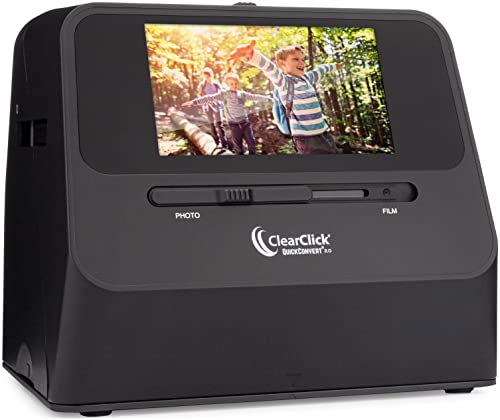
- Scans photos, slides, and negatives without a computer
- Saves JPEGs to an SD memory card
- Includes rechargeable battery and preview LCD
Best For: Portable scanning of small photos and film
Film Restoration Pick
Epson Perfection V500 Photo Scanner

- Scans prints, slides, negatives, and medium-format film
- Offers 6400 dpi and 48-bit color depth
- Includes Easy Photo Fix and Digital Ice
Best For: Detailed film scanning and photo restoration
Fast Photo Digitizer

- 300/600 dpi scanning for multiple photo sizes
- Cleaning kit and protective carrier sheet included
- Organizing and editing tools in Picture Studio
Best For: Quickly digitizing and organizing varied photo collections
PC-Free Scanning
Pandigital Personal Photo Scanner

- 600 dpi scanning up to 8.5 x 11 inches
- Scans directly to an SD card
- Five-in-one memory card reader included
Best For: Standalone photo scanning without a computer
High-Resolution Flatbed
Epson Perfection V19 II Scanner

- 4800 dpi optical resolution for detailed scans
- Handles photos, artwork, books, and documents
- Easy Photo Fix restores faded color
Best For: Mixed home scanning with high-resolution photo work
Best High-Resolution Slim Pick

- 4800 x 4800 dpi optical resolution
- One-cable USB Type-C connection
- Auto Scan Mode and photo enhancements
Best For: Detailed photo scans in a compact flatbed design
Best for Photo Restoration

- 4800 dpi optical resolution
- One-click faded-photo color restoration
- Removable lid for books and thicker originals
Best For: Restoring photos and scanning varied home media
Best for Wireless Document Workflows

- Duplex scanning at up to 15 pages per minute
- Wi-Fi Direct connectivity
- Lightweight 1.3-pound design
Best For: Portable document, receipt, and card scanning
Fast Photo Digitizing Pick – Plustek ePhoto Z300
For shoppers comparing photo scanners under 500, the Plustek ePhoto Z300 is designed for straightforward, high-volume photo scanning. It handles common photo sizes from 3×5 through 8×10, as well as letter and A4 paper, and can scan a 4×6 photo in about two seconds at 300 dpi.
Best For: Quickly digitizing large collections of standard-size prints.
Pros:
- Scans 4×6 photos in about two seconds at 300 dpi.
- Supports 3×5, 4×6, 5×7, 8×10, letter, and A4 media.
- Includes image-enhancement tools for faded photos.
- CCD sensor and selectable 300 or 600 dpi resolution.
Cons:
- Photos must be inserted one at a time.
- USB connection and Windows 7 minimum requirements may limit setup flexibility.
The Z300 favors speed and simple operation over batch automation. Its dedicated photo-feed design can be more efficient than a flatbed for large print collections, while its enhancement functions add useful restoration flexibility.
Compact Flatbed Choice – Canon CanoScan LiDE 400
The Canon CanoScan LiDE 400 is a slim flatbed option for buyers seeking photo scanners under 500 that can also handle everyday documents. Its 4800 dpi resolution and compact 1.65-inch height make it practical for desks with limited space.
Best For: Scanning photos and documents in a compact home-office setup.
Pros:
- Offers 4800 dpi scanning resolution.
- Lightweight design weighs about 500 g.
- Compact body is approximately 1.65 inches high.
- Uses a USB connection and draws 4.5 watts.
Cons:
- Flatbed operation is generally less convenient for large stacks of photos.
- Supplied notes do not specify film or slide scanning support.
The LiDE 400 is a sensible space-saving choice when photo scanning is part of a broader document-scanning routine. Its high stated resolution is useful for detailed scans, though it is better suited to individual flatbed work than rapid collection conversion.
Computer-Free Film Scanner – ClearClick QuickConvert 2.0
Among photo scanners under 500, the ClearClick QuickConvert 2.0 stands out for computer-free scanning of prints, slides, and negatives. It saves JPEG files to an SD memory card, includes a rechargeable battery, and scans 4×6 photos or smaller in roughly two to three seconds.
Best For: Portable conversion of small photos and common film formats without a computer.
Pros:
- Scans photos, slides, and negatives without a computer or drivers.
- Supports 35mm, 110, and 126 film formats plus 4×6 photos or smaller.
- Includes a built-in rechargeable battery and 5-inch preview LCD.
- Offers 14-megapixel scanning, with 22 megapixels interpolated.
Cons:
- Does not support 5×7 photos.
- Media must be scanned one at a time; there is no autofeeder.
- Requires an SD memory card for saving digital JPEG files.
The QuickConvert 2.0 is convenient for archiving mixed photo and film collections, especially where portability matters. Its limitations are clear: it is intended for smaller media and individual scans rather than large-format prints or automated batches.
Film Restoration Pick – Epson Perfection V500 Photo Scanner
The Epson Perfection V500 is a versatile choice among photo scanners under 500 for users who need detailed scans of prints, slides, negatives, and medium-format film. Its 6400 dpi resolution, 48-bit color depth, and restoration features support archival and enlargement-oriented work.
Best For: Detailed photo, slide, negative, and medium-format film scanning.
Pros:
- Supports documents, photos, slides, negatives, and medium-format film.
- Provides 6400 dpi resolution and 48-bit color depth.
- Easy Photo Fix restores faded photos with one touch.
- Digital Ice technology removes dust and scratches from images.
Cons:
- At about 4,000 g, it is considerably heavier than compact scanner options.
- Uses a USB connection and lists Windows 7 as the minimum system requirement.
- Supplied notes do not indicate a cordless or computer-free workflow.
The V500 is the strongest fit here for users prioritizing film compatibility and image detail over portability. Its dedicated restoration tools can reduce manual cleanup, while the LED light source avoids warm-up time.
Fast Photo Digitizer – AMBIR Photo Scanner Bundle
For shoppers comparing photo scanners under 500, the AMBIR bundle is designed for quick photo digitizing with support for several print sizes. It includes cleaning tools and software for organizing and editing scanned memories.
Best For: Families who want a dedicated, USB-connected photo scanner with cleaning supplies and built-in organization features.
Pros:
- Scans at 300 or 600 dpi and handles sizes from 1″ x 1″ prints up to 8″ x 10″ photos, plus panoramas up to 12″.
- Includes a blower, microfiber cloth, anti-static brush, and protective carrier sheet for delicate prints.
- Picture Studio software supports albums, tags, favorites, notes, and photo-editing tools.
- USB connection and a 2-year manufacturer warranty simplify setup and ownership.
Cons:
- It is designed for photos rather than general-purpose document scanning.
- Operation requires a USB connection.
The AMBIR is a practical choice when speed, photo-size flexibility, and memory organization matter more than multifunction document scanning.
PC-Free Scanning – Pandigital Personal Photo Scanner
Among photo scanners under 500, the Pandigital PANSCN06 stands out for its ability to scan photos up to 8.5 x 11 inches directly to an SD card. Its PC-free workflow can be useful for straightforward home digitizing.
Best For: Users who want to scan photos without a computer and transfer files through removable memory or a card reader.
Pros:
- Scans photos up to 8.5 x 11 inches at 600 dpi.
- Can scan directly to an SD card without a PC.
- Includes a five-in-one reader for SD, MS, MSPRO, MMC, and XD cards.
- Files can be transferred to a digital photo frame or computer.
Cons:
- Its listed minimum system requirement is Windows 7, which may limit compatibility with newer setups.
- The product has a 1-year warranty, shorter than some alternatives.
The Pandigital is best suited to simple, standalone scanning rather than software-heavy restoration or photo-management workflows.
High-Resolution Flatbed – Epson Perfection V19 II Scanner
For buyers seeking photo scanners under 500 that can also handle documents and artwork, the Epson Perfection V19 II offers a versatile flatbed design. Its 4800 dpi optical resolution and Easy Photo Fix feature target detailed scans and faded-photo restoration.
Best For: Home users who need one compact scanner for photos, artwork, books, and letter-size documents.
Pros:
- Provides 4800 dpi optical resolution for detailed photo scans and enlargements.
- Scans photos, artwork, illustrations, books, and documents up to 8.5 x 11.7 inches.
- Easy Photo Fix can restore color to faded photos with one click.
- USB-powered design, one-touch buttons, and a removable high-rise lid support convenient use.
Cons:
- As a flatbed scanner, it scans one standard sheet at a time.
- Its listed minimum system requirement is Windows 7.
The V19 II is the strongest fit here for mixed photo and document tasks, especially when high optical resolution and basic restoration are priorities.
Best High-Resolution Slim Pick – Canon CanoScan LiDE 400
Canon CanoScan LiDE 400 Slim Scanner, 7.7" x 14.5" x 0.4", Document & Photo Scanner, Black
Check Price On AmazonIf you want a compact option among photo scanners under 500, the Canon CanoScan LiDE 400 combines 4800 x 4800 dpi resolution with a slim, lightweight design. Its one-cable USB Type-C setup, EZ buttons, and built-in PDF controls make it practical for everyday photo and document scanning.
Best For: Home users who want detailed photo scans from a slim flatbed scanner.
Pros:
- 4800 x 4800 dpi resolution supports detailed photo and image scans.
- USB Type-C cable handles both data and power.
- Auto Scan Mode and EZ buttons simplify routine scanning.
- Color restoration and dust removal help improve scanned photos.
Cons:
- USB-connected rather than wireless.
- Single-sheet capacity is better suited to occasional scanning than large batches.
The LiDE 400 is a strong fit when image detail, compact storage, and straightforward controls matter more than automatic multi-page feeding.
Best for Photo Restoration – Epson Perfection V39 II
The Epson Perfection V39 II is a versatile choice among photo scanners under 500, offering 4800 dpi optical resolution in a compact, USB-powered flatbed. It is designed for photos, artwork, books, and documents, with software features that support restoration and oversized-image stitching.
Best For: Scanning old photos, artwork, and mixed home documents with one-touch controls.
Pros:
- 4800 dpi optical resolution delivers clear, detailed scans.
- Easy Photo Fix restores color to faded photos with one click.
- Removable high-rise lid accommodates books and thicker materials.
- Epson ScanSmart supports cloud storage and image stitching.
Cons:
- USB-powered and not equipped with wireless connectivity.
- Flatbed operation requires placing originals individually.
Choose the V39 II if photo restoration and flexible flatbed scanning are priorities. Its compact build and one-touch buttons also make it approachable for home projects.
Best for Wireless Document Workflows – HP PS150 USB Photo Scanner
For shoppers comparing photo scanners under 500 who also need document productivity, the HP PS150 adds duplex scanning, Wi-Fi Direct, and automatic image handling. Its compact 1.3-pound design supports mobile work, while the feeder handles documents, business cards, receipts, and mixed paper sizes.
Best For: Remote workers and home offices scanning documents, receipts, cards, and occasional photos.
Pros:
- Duplex scanning reaches up to 15 pages per minute.
- Wi-Fi Direct connects directly without a router or internet connection.
- HP WorkScan includes auto-scan, size detection, and image optimization.
- Supports originals from 2 x 2.9 inches to 8.5 x 14 inches.
Cons:
- 300 dpi resolution is lower than the flatbed models in this roundup.
- Document-focused design may be less suitable for highly detailed photo enlargement.
The PS150 stands out for speed, portability, and wireless document handling. It is the more practical choice when digitizing paperwork is as important as scanning photos.
How We Picked the Best Photo Scanners Under 500
We focused on scanners suited to home photo preservation and everyday digitizing, considering scan quality, supported media, operating speed, software or workflow simplicity, physical size, and connection options. The selection includes dedicated photo scanners, flatbed models, film-capable devices, and multipurpose document scanners.
Resolution claims were considered alongside sensor type and intended use. Higher optical resolution can help with cropping, enlargements, and film, while speed and automatic feeding matter more when processing large albums. We also favored products with clear use cases rather than treating one specification as the deciding factor.
Quick Comparison
| Best For | Look For |
|---|---|
| Fast snapshots | Dedicated photo-feed design and simple controls |
| Maximum versatility | Flatbed scanning with document and photo support |
| Slides and negatives | Film holders or dedicated film-scanning modes |
| Large photo collections | Fast throughput, batch handling, and dependable software |
| Occasional home use | Compact size, USB power, and straightforward setup |
Key Buying Factors for Photo Scanners Under $500
Scan Quality and Resolution
For ordinary 4-by-6-inch prints, a true optical resolution around 300 to 600 dpi is generally sufficient for sharing and routine reprints. Choose a higher-resolution flatbed when you plan to crop heavily, enlarge small originals, or scan slides and negatives. Color depth and image-processing software also affect the final result.
Flatbed Versus Dedicated Photo Scanner
Flatbeds are flexible and gentle with fragile, oddly sized, or several photos placed together. Dedicated photo scanners can be faster and more convenient for standard prints, but they may be less suitable for books, thick originals, or unusual media. A feeder-based design is useful for volume, provided your prints are clean and in good condition.
Film, Documents, and Connectivity
If your collection includes 35mm film, slides, or negatives, confirm that the scanner supports those formats before buying. For mixed household tasks, look for document scanning and automatic duplex features. USB models are simple and reliable, while wireless or computer-free operation can make sharing and storage more convenient.
Software and File Management
Check operating-system compatibility, included drivers, and whether the software supports dust removal, color correction, batch naming, or searchable documents. Plan a backup system before scanning: use descriptive filenames, consistent folders, and at least one additional copy of important images.
Who Should Buy Which Photo Scanners Under 500?
Choose a dedicated photo scanner if your priority is quickly digitizing a standard print collection. Pick a flatbed model if you need the broadest compatibility or want to handle documents, delicate prints, books, and mixed sizes. Film-focused buyers should select a model with explicit slide and negative support rather than assuming a high dpi rating is enough.
For occasional users, a compact USB scanner keeps setup and storage simple. Families processing hundreds of photographs should prioritize speed, batch workflow, and reliable software. If you want one device for photos and paperwork, a versatile flatbed or document scanner is usually the better long-term value.